



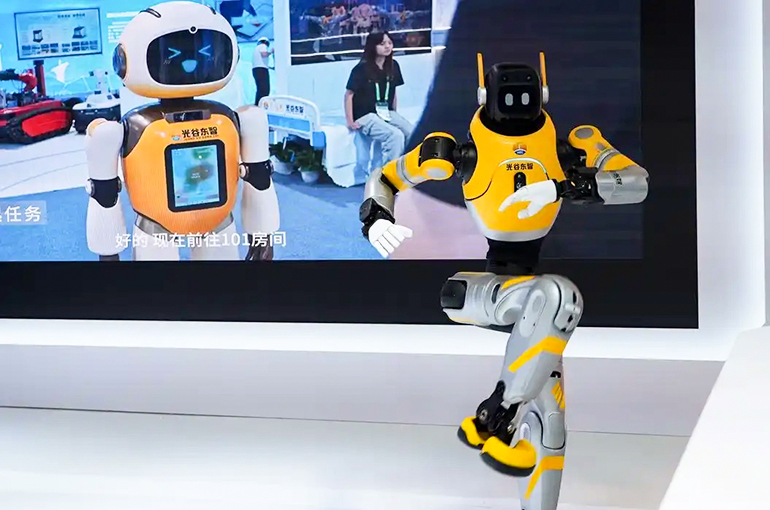
 Humanoid Robots Swap Dance Moves for Household Chores
(Yicai) July 21 -- Humanoid robots at the World Artificial Intelligence Conference in Shanghai traded dance routines and king fu theatrics for a more practical pitch this year, demonstrating tasks such as folding laundry, organizing household items, and assisting the elderly as the robotics industry shifts focus from viral demos to real-world uses.
Fourier Intelligence used the four-day WAIC, which concluded yesterday, to debut its embodied-intelligence solution for home companionship. It enables the Shanghai-based firm’s GR-3 robot to understand user needs through spoken commands in the home, autonomously decide the optimal course of action, and complete tasks such as fetching and delivering objects.
Fourier originally focused on rehabilitation robots to help patients regain day-to-day abilities such as walking and eating. But advances in AI over the past two to three years have convinced the company that robots can play a much broader role in people's daily lives, founder and Chief Executive Gu Jie said at a WAIC forum on July 17.
Hubei Optics Valley Dongzhi Embodied Intelligence Technology, a Wuhan-based company, brought its Lumen S1 robot to the event. Powered by a specific AI model, it can perform various tasks, including safety monitoring, emotional support, health management, and assistance with daily living activities in nursing homes and elderly care communities.
China had about 320 million citizens age over 60 at the end of last year, accounting for 23 percent of the total, creating huge demand for elderly care services. With the population aging, the government has repeatedly encouraged the development of the elderly care sector and the silver economy in policy documents in recent years.
Against this demographic backdrop, robot-assisted elderly care is increasingly seen as a potential solution to future labor shortages and growing care needs, but industry experts caution that widespread deployment in households remains some distance away.
A critical obstacle is safety. Robots intended for elderly users must satisfy exceptionally stringent safety requirements, Gu said. Elderly people do not need robots that can do acrobatic stunts such as flips, he said, rather they need robots that can perform simple tasks reliably, predictably, and safely, such as handing over a glass of water.
Another major issue lies in the insufficient generalization capability of today's AI models, which limits the ability of robots to complete tasks in unstructured real-world environments. According to Gu, overcoming this obstacle will require deeper integration between models and robotic systems, allowing robots to learn through exploration and interaction in the real world.
Editors: Dou Shicong, Futura Costaglione





