



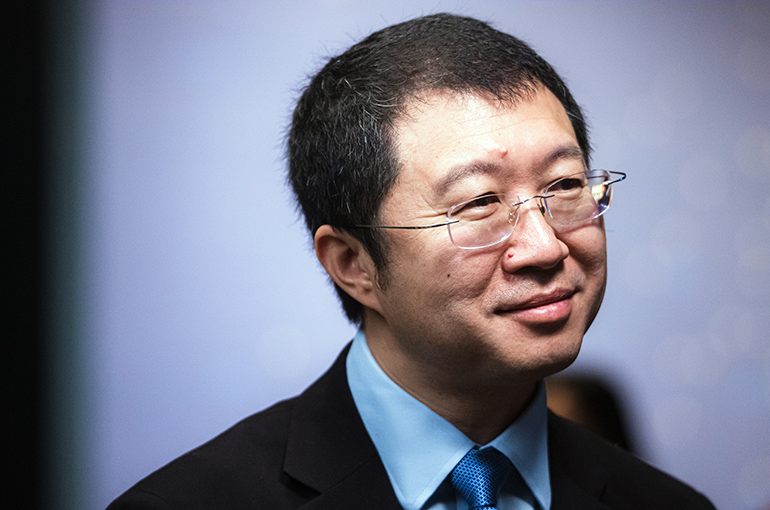
 WeRide’s Founder Isn't Worried About New Robotaxi Players
(Yicai) April 10 -- Even though more driverless taxi providers have entered the market since the second half of last year, the founder of WeRide said he is not concerned about challenges to the Chinese firm's leading position.
"To truly enter the robotaxi industry and compete, a company must have at least 100 fully autonomous driving taxis that have safely operated for at least six months,” Tony Han, who is also WeRide’s chief executive, told Yicai in an interview. “Only then are they qualified to compete with us.”
Several carmakers have forayed into the robotaxi industry since the second half of 2025. Tesla, for instance, rolled out its Cybercab prototype ahead of schedule, and Xpeng set up an independent robotaxi unit.
Han said he is not particularly worried about automakers entering the race, even though they may have some cost advantage because they manufacture cars themselves. Vehicles are not a barrier to entering the industry, as most Chinese carmakers already know how to build them with the safety redundancy robotaxis require, he said.
Han pointed out that it is hard for auto companies to launch their own robotaxi businesses while maintaining a clear cost advantage in vehicle procurement. This is because collaboration between self-driving technology firms and their carmaker partners has become so close that they have achieved front-loaded mass production. In addition, cars bought from these partners are usually priced only slightly above cost.
Huge Gap
The jump from Level-2 to Level-4 autonomous driving technology is enormous and WeRide has spent nine years doing this, surmounting a number of technological barriers on the way, Han said. He contrasted that with the setbacks and retreats of traditional automakers that tried to develop driverless systems on their own.
For example, General Motors' self-driving unit Cruise abandoned its robotaxi operations, and its peer Argo AI, which was backed by Ford Motor and Volkswagen Group, has been dissolved.
As established carmakers have withdrawn from the driverless taxi business, Han said he does not see what technological advantages new entrants would have in pursuing independent operations.
The robotaxi sector is not one where barriers can be overcome simply by increasing investment and manpower in the short term, Han poi need out, adding that strategic alliances between automakers and self-driving tech developers are more likely to gain a stronger competitive edge.
Overseas Expansion
Compared with the Chinese market, robotaxi services overseas command higher prices, which leads to higher profits for operators, so it has become normal for Chinese robotaxi firms, including WeRide, to expand in foreign markets.
Last month, WeRide launched a Slovakian project and commenced commercial operations of fully driverless taxi services in Dubai. This month, it initiated a public robotaxi service in Singapore. The Guangzhou-based company now offers services in over 40 cities across 12 countries.
WeRide plans to further expand its presence in the European market this year. Given that each European city has different regulations and strict compliance requirements for automotive data storage, the firm has adopted a city-by-city approach for its European expansion strategy, Han said.
Despite the Middle East crisis, WeRide's operations in the region continue uninterrupted. From Han's perspective, the region has already become a viable market for profitability. He emphasized the importance of continuing to hire staff and expand operations there.
The overseas robotaxi market is still in the user acquisition phase, with increasing order volume being the primary objective, Han noted. Therefore, maintaining the same gross profit margin last year as in 2024 -- about 30 percent -- was a highly challenging achievement, he added.
Overseas revenue already accounts for one-fourth to one-third of WeRide's overall business income. The firm's robotaxi services in the Middle East achieved operational profitability last year.
Editors: Tang Shihua, Futura Costaglione





