



 Western Australia Seeks Broader Relationship With China, Premier Says
(Yicai) Nov. 4 -- Western Australia is hoping to deepen its investment and trade ties with China, its officials have said, with a view to expanding beyond the traditional trade of energy resources.
The state, Australia’s largest and its primary exporter, is hoping to explore opportunities in areas such as green development, its Premier Roger Cook said at a business briefing on investment and trade between China and Western Australia on Nov. 2.
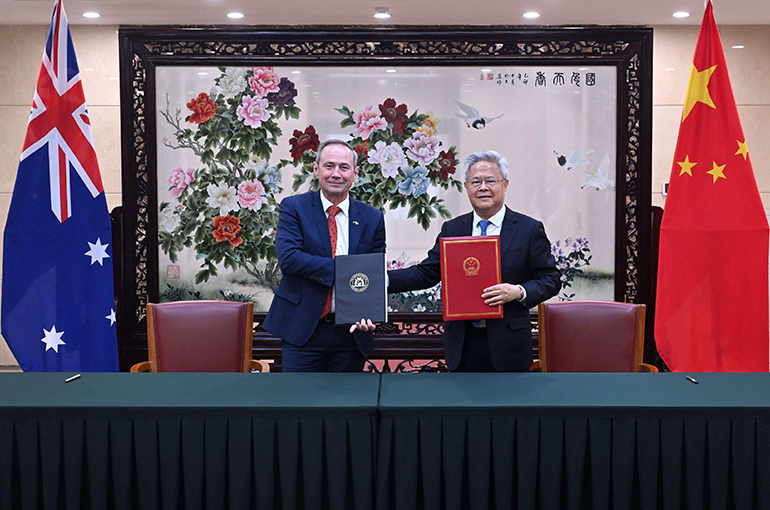
Cook met with Zheng Shanjie, head of China's National Development and Reform Commission, on the same day. The two sides signed a memorandum of understanding on promoting investment cooperation between the NDRC and Western Australia, according to the commission's website.
The memorandum significantly broadens the scope of cooperation beyond traditional resource development to include advanced manufacturing, technological innovation, green development, and cultural and tourism services.
There are strong foundations for cooperation, Zheng said, and the NDRC is willing to pursue mutual benefits, while raising the level of industrial and investment cooperation and creating new opportunities for practical collaboration, he added.
"Through this agreement, we are looking to deepen cooperation and support trade and investment in Western Australia’s priority sectors, including manufacturing, mining, energy, infrastructure and tourism," Cook said. China has been Western Australia's largest trading partner since 2006, based on the state's exports of iron ore, liquefied natural gas, gold, lithium and agricultural products, he noted.
In recent years, imports from China have also supported the state's energy transition, including solar panels, batteries, inverters and electric vehicles used in mining operations and renewable energy systems, Cook said. "Our bilateral relationship is much more than trade figures. It’s built on the connections between our governments, our businesses, our institutions, and, most importantly, our people."
Cathy Kng, Greater China chief representative of the Western Australian Department of Jobs, Tourism, Science and Innovation, said at the briefing that the state is expanding its trade focus to wind power, solar energy, green hydrogen and green ammonia. Western Australia's renewable energy resources are increasingly complementing China's strengths in technology and engineering, she said.
In international education and skills training, China has long been Western Australia's third-largest source of international students, with exchanges of talent between the two sides continuing to deepen, Kng noted.
In agricultural and food trade, Western Australian products are increasingly aligned with the modern demands of Chinese consumers, she added. For example, a substantial proportion of the barley used by China’s Tsingtao Brewery is sourced from Australia, with Western Australia accounting for more than half of the country's total barley exports. Other key exports include rock lobster and premium wines, she said.
The two sides also have complementary strengths in healthcare and life sciences. Although Western Australia's biopharmaceutical industry is relatively small, it has strong research capabilities in specialized fields such as rare diseases, cancer treatment and clinical trials, Kng said, adding that several Chinese pharmaceutical companies and clinical institutions are exploring cross-border research cooperation, including opportunities to leverage Western Australia's standards and expertise.
In tourism, cooperation is shifting beyond traditional sightseeing toward immersive nature-based experiences and tourism investment. Chinese visitors are crucial to Western Australia's tourism market, Kng said, adding that the state is actively exploring tourism investment opportunities with Chinese industry players.
Editor: Tom Litting





