


 What Hong Kong Got Right
(Yicai) Nov. 17 -- Hong Kong’s latest economic figures pose an awkward question for those who have written off the city: What if its business model is adapting rather than disappearing?
Real gross domestic product rose 5.2% in the third quarter from a year earlier and 1.9% from the previous quarter, after seasonal adjustment. Growth over the first nine months reached 5.1%, the fastest expansion for the corresponding period in five years. These are November 3 advance estimates, not a full-year result. Still, a 15th consecutive quarter of growth is difficult to reconcile with an economy in terminal retreat.[1] [2]
The answer is neither that Hong Kong has solved all its problems nor that departures by international firms were imaginary. The city has retained valuable international functions while finding new business in China’s changing relationship with the world. It increasingly serves not only investors entering China, but Chinese companies and wealthy Asian families looking outward.
Start with the acceleration. Third-quarter goods exports rose 30.4% in real terms. Fixed investment increased 7.3%, against 3.7% in the previous quarter, while service exports grew 4.3%. Private consumption rose 2.8%. Trade and investment, rather than a sudden household-spending boom, define this recovery.[1]
The government identifies global artificial-intelligence investment as a support for merchandise exports, alongside tourism, cross-border traffic and financial activity for services. Hong Kong did not create the AI investment cycle. Its achievement is to remain commercially relevant to it, supplying trading, logistics and financial services around products made elsewhere.[1]
That distinction matters: gross exports are not all locally produced output, and imports grew 29.9% in the same quarter. The export surge cannot be counted as an equivalent increase in domestic value added, or the entire GDP improvement credited to policy. There is an external tailwind here, as well as adaptation.[1]
One adaptation is a broader investor base. Southbound Stock Connect recorded average daily turnover of HK$123.1 billion in the first half of 2026, surpassing the full-year 2025 average of HK$121.1 billion. Turnover is not net investment, but it demonstrates mainland investors’ substantial participation in Hong Kong securities.[3]
Yet Hong Kong has not simply become a mainland money pool. In the Securities and Futures Commission’s latest annual survey, investors outside both Hong Kong and mainland China supplied 54% of covered assets under management at end-2025. Industry assets reached HK$42.202 trillion, up 20%, while net fund inflows were HK$2.065 trillion. Asset appreciation contributed to the first figure; subscriptions to the second. These are industry flows, not exclusively foreign inflows, but they show a growing international franchise despite some departures.[4]
Wealth management makes the change visible. An InvestHK-commissioned Deloitte study estimated 3,384 single-family offices at end-2025, against 2,703 in its estimate for late 2023. This is a modeled count, not a register or tally of families relocating from abroad. More tangible evidence is the HK$686 billion in net inflows attracted by private banking and private wealth management in 2025.[4] [5]
According to BCG, Hong Kong also narrowly overtook Switzerland in cross-border wealth booked at the end of that year: Reuters reported $2.95 trillion against $2.94 trillion. BCG co-author Michael Kahlich explained the commercial logic: “What ultimately matters is client proximity.”[6]
Asian wealth is growing, and international banks can follow their clients without abandoning global networks. Hong Kong combines mainland expertise, established financial infrastructure and access to international assets. Deloitte’s respondents also identified tax efficiency and ease of establishing offices as attractions. The city can earn management and professional-service income even when portfolios are invested elsewhere: 65% of the private-banking and private-wealth assets covered by the SFC survey were invested outside Hong Kong and mainland China.[4] [5]
That is different from expecting every family office to buy local shares. A flourishing wealth center can coexist with an uneven stock market. Listed companies must attract investors on their own merits.
This brings us to IPOs. Disappointing debuts since July deserve attention, but treating them as proof of inadequate fundraising capacity gets the diagnosis wrong. In the first ten months of 2026, IPOs raised HK$403.857 billion, up 84.4% from a year earlier. Total equity fundraising reached HK$753.801 billion, up 47.5%, according to provisional exchange figures.[7]
The market has raised substantial capital. The harder question is whether issue prices leave enough reason for the next investor to buy.
RoboTechnik illustrates the distinction. The mainland-listed equipment maker’s H shares closed at HK$414.40 on their September 29 debut, 4.95% below the HK$436 offer price, after a base offering of HK$5.178 billion. Its October disclosure reported stabilization purchases below the offer price, while a partially exercised over-allotment option generated additional net proceeds of HK$273.2 million. Funding success and aftermarket weakness occurred together.[8] [9]
“Theme alone is not enough. Valuation and recent momentum matter more,” Dickie Wong, executive director of research at uSMART Securities, told Reuters. Equity-only average daily turnover fell 13.9% in October from September, making aggressive pricing harder to sustain. These observations establish a risk, not the proportion of all post-July IPOs breaking their offer prices.[7] [8]
The remedy is not a guaranteed first-day gain. Permanent underpricing would transfer value from issuers to initial subscribers and encourage speculation. Banks should give price-sensitive orders more influence, distinguish cornerstone commitments from freely tradable shares, and stop treating subscription multiples as guarantees of continuing demand. Hong Kong’s price-discovery and free-float reforms, implemented in August 2025, provide a foundation. Consistent publication of later trading outcomes would strengthen accountability.[10]
Low valuations pose a related challenge. Ming Yuan Cloud, a software supplier to China’s property industry, traded at HK$0.735 on November 11, implying an issued-share market value of HK$1.38 billion using its latest disclosed share count. Its June 30 accounts reported RMB3.001 billion in cash equivalents and term deposits, excluding separately identified restricted cash—equivalent to HK$3.53 billion at the midpoint of November 11 indicative opening exchange rates.[11] [12] [13] [14]
The gap is striking, but it is not free money. The accounts predate the price; a special dividend was paid in July; first-half operating cash flow was negative; some deposits mature beyond a year. Consolidated bank balances are not automatically cash legally available to shareholders.[11]
The example raises a capital-allocation question, not a verdict that every cheap stock is wrongly priced. Investors may discount cash they expect to be consumed, poorly invested or retained indefinitely. Persistently depressed valuations raise the cost of new equity and weaken Hong Kong’s appeal to future issuers. A financial center cannot thrive indefinitely by celebrating money raised while neglecting returns earned.
Cash-rich boards should publish quantified plans: the liquidity the business needs, what can responsibly be returned, and the return hurdles justifying retention. Measure buybacks by net share reduction after awards and reissuance, not unused mandates. Ming Yuan Cloud has paid a special dividend and bought shares for cancellation; operating performance remains the other half of the equation.[11] [12]
The exchange’s April 2026 governance guide already encourages stronger capital management and clearer dividend explanations. Regulators should make that accountability meaningful while preserving minority protections—not compel higher prices, arbitrary payouts or cheap squeeze-outs.[15]
As Hong Kong approaches the 30th anniversary of its return to China on July 1, 2027, continued growth is possible. Sustaining 5.1% indefinitely is not a credible planning assumption. An AI investment reversal, renewed trade restrictions or persistently high dollar interest rates could test the recovery. The city needs businesses that prosper after the current export cycle cools.[18] [20]
Serving Chinese companies expanding overseas is one opening. The 2026 Policy Address says the GoGlobal Task Force has assisted more than 340 mainland enterprises. Hong Kong can deepen that business through corporate treasury, insurance, legal and compliance services—functions that become more valuable as cross-border operations grow more complicated.[16]
Renminbi finance is another. The HKMA’s RMB500 billion Business Facility channels onshore liquidity toward offshore corporate financing. This is capacity, not proof that the full amount has been lent. The opportunity is to turn settlement relationships into useful lending, hedging and investment services while retaining the dollar-linked currency that anchors international transactions. Its interest-rate constraints are real; so is the value of predictable convertibility.[17] [18]
Digital finance can also solve commercial problems. On November 2, the HKMA advanced its controlled Ensemble TX pilot to support around-the-clock interbank settlement of tokenized deposits in tokenized central-bank money. Faster treasury and investment settlement is a more durable ambition than another speculative asset boom.[19]
Growth must reach beyond finance. Consumption is expanding more slowly than GDP, and July–September unemployment stood at 3.9%. Housing affordability, skills and smaller businesses matter to recovery’s durability. The Northern Metropolis can connect universities and industry, but its financing should be judged by sustainable demand and project returns, not borrowing capacity.[20] [21]
Revised GDP figures and an updated annual forecast are due November 13. Beyond that release, the meaningful tests are broader household gains, operating cash generation and credible investor returns.[1]
Hong Kong got something important right: it adapted to the changing direction of Chinese business and Asian wealth without abandoning its international functions. To keep getting it right, it must protect the legal predictability, regulatory professionalism and openness that make those functions useful. Bringing capital to Hong Kong is an achievement. Giving it good reasons to stay is the next one.
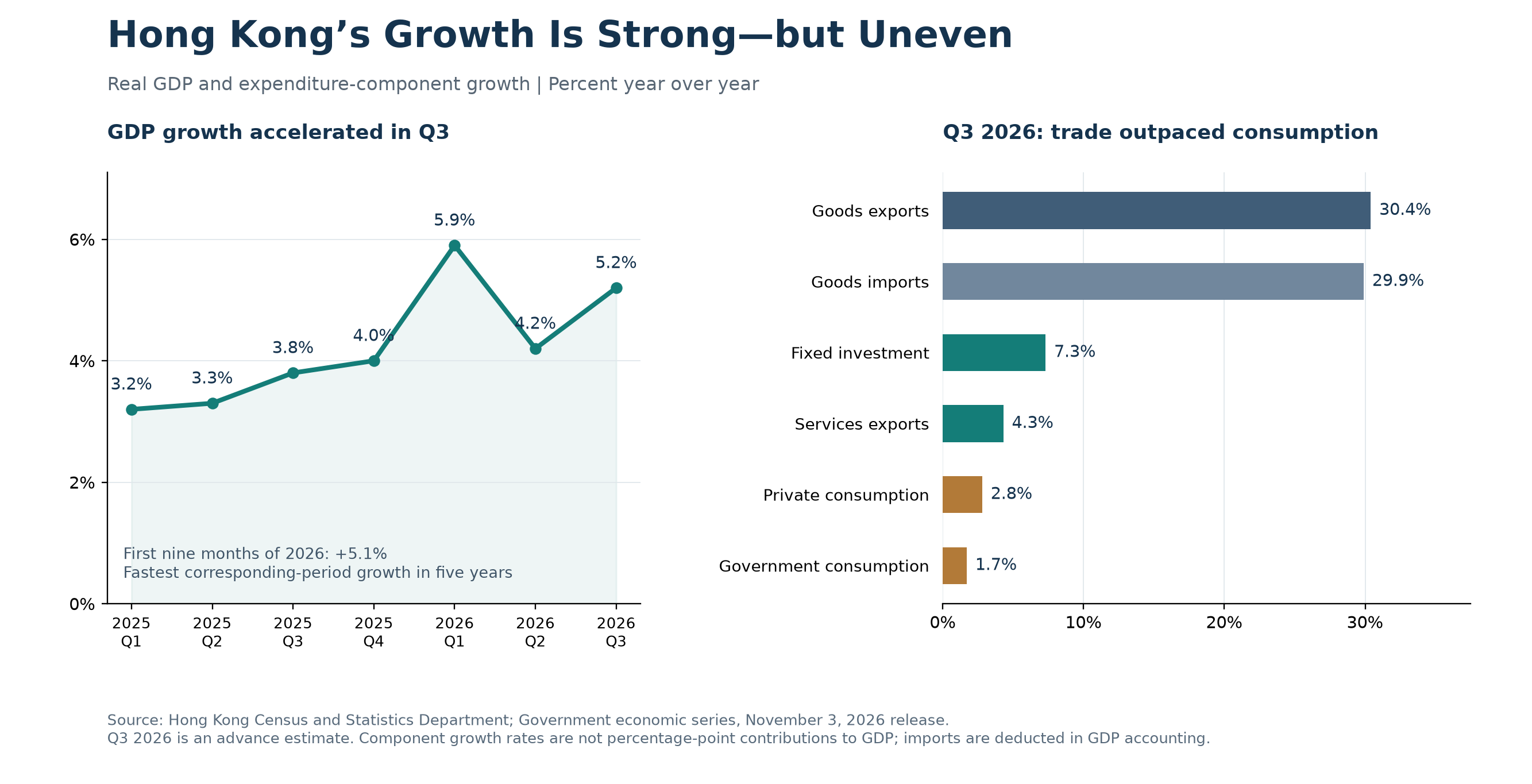
Sources: Census and Statistics Department advance estimates of November 3, 2026, and the government’s accompanying GDP series. Component growth rates are not percentage-point contributions to GDP. The 5.1% nine-month figure is the published same-period growth rate, not an arithmetic average of quarterly rates.[1] [22]
[3] HKEX, September 7, 2026: Stock Connect first-half 2026 review; Southbound trading activity
[8] Reuters, September 29, 2026: RoboTechnik debut close and Dickie Wong’s valuation comments