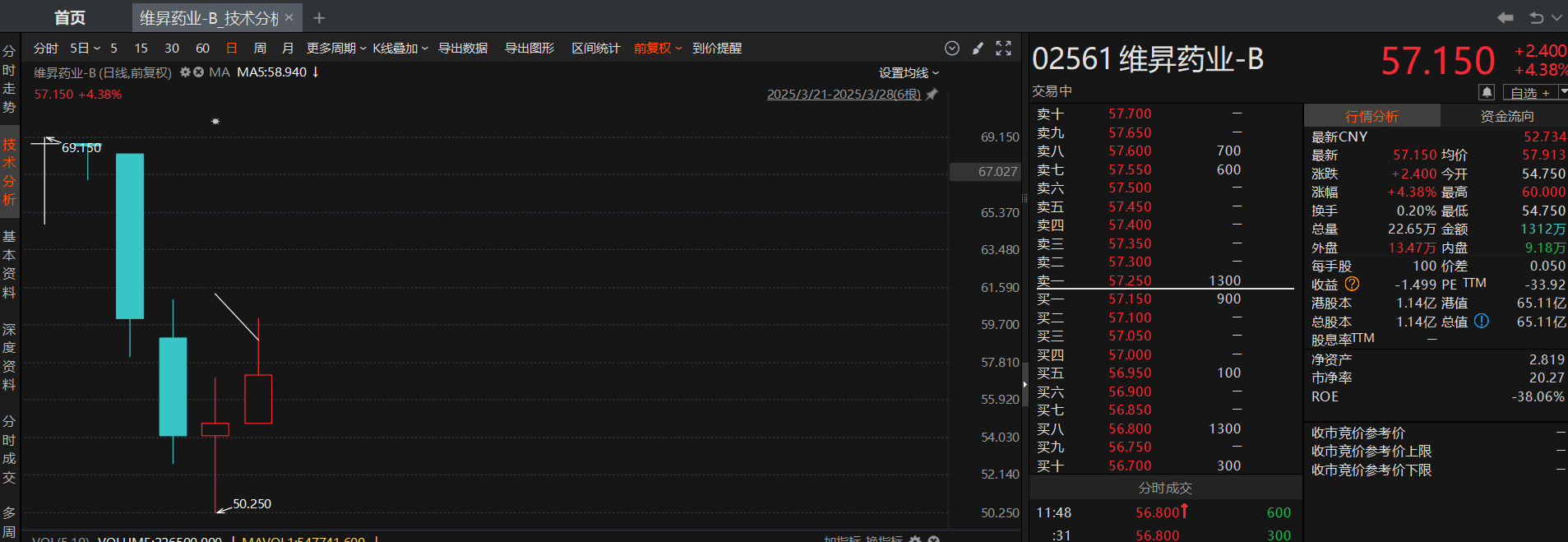
On March 21, Weisheng Pharmaceutical (02561) was officially listed on the main board of the Hong Kong Stock Exchange, becoming the first innovative drug company to be listed on the Hong Kong stock market in 2025, and also the first listed company in the field of growth and endocrine in Hong Kong, known as "the first stock in Hong Kong stock growth and development".
Viscent Pharmaceutical's IPO path was not smooth, and it submitted listing applications to the Hong Kong Stock Exchange four times between November 2022 and September 2024, and finally passed the hearing. The IPO was offered at HK$68.8 per share, raising net proceeds of HK$672 million. Morgan Stanley and Jefferies are the joint sponsors.
However, in the first show after listing, the share price of Weisheng Pharmaceutical was slightly weak, and it broke at one point in the intraday, rebounded slightly at the end of the session, and finally closed flat. In the following days, it continued to fall and break, and the intraday low fell to HK$50.25 on March 27, down 27% from the issue price. The closing price of the day was HK$54.75, with a market capitalization of HK$6.237 billion. In fact, regarding the IPO of Weisheng Pharmaceutical, Caizhong Society has conducted an analysis in September 2024, see "Weisheng Pharmaceutical IPO: Potential Competition for Core Products, Weak Industry Expansion" for details.
Administrative expenses exceed R&D expenses and rely on external financing
Founded in Shanghai in November 2018 by Danish pharmaceutical companies Ascendis Pharma, Vivo Capital and Sofinnova Ventures, Viscent Pharmaceuticals is an early-stage biopharmaceutical company with near-commercialization focused on providing treatment options for specific endocrine diseases in China (Mainland China, Hong Kong, Macao and Taiwan).
As a pharmaceutical company established for 7 years, Weisheng Pharmaceutical has not made a profit so far, with losses of 289 million yuan, 250 million yuan and 129 million yuan in 2022, 2023 and the first three quarters of 2024, respectively.
The reason for the loss is that no commercial products have been approved for marketing so far, and there is no revenue from its main business. At present, the company only has some other income, which will be 5.76 million yuan, 11.36 million yuan and 8.65 million yuan in 2022, 2023 and the first three quarters of 2024, respectively, from government subsidies and bank interest.
And this non-main business income is simply not enough to support various expenses. Taking the first three quarters of 2024 as an example, its administrative expenses and R&D expenses were 64.39 million yuan and 58.91 million yuan respectively, so the result was continuous losses.
The "Financial News Agency" also noted that during the period from 2020 to 2022, the annual R&D expenses of Weisheng Pharmaceutical were higher than the administrative expenses, and in the following 2023 and the first three quarters of 2024, the administrative expenses exceeded the R&D expenses. For example, BeiGene'688235 s R&D expenses over the years have significantly exceeded administrative expenses, with two expenses of 10.166 billion yuan and 3.153 billion yuan in the first three quarters of 2024, respectively, with the former being 3.2 times that of the latter.
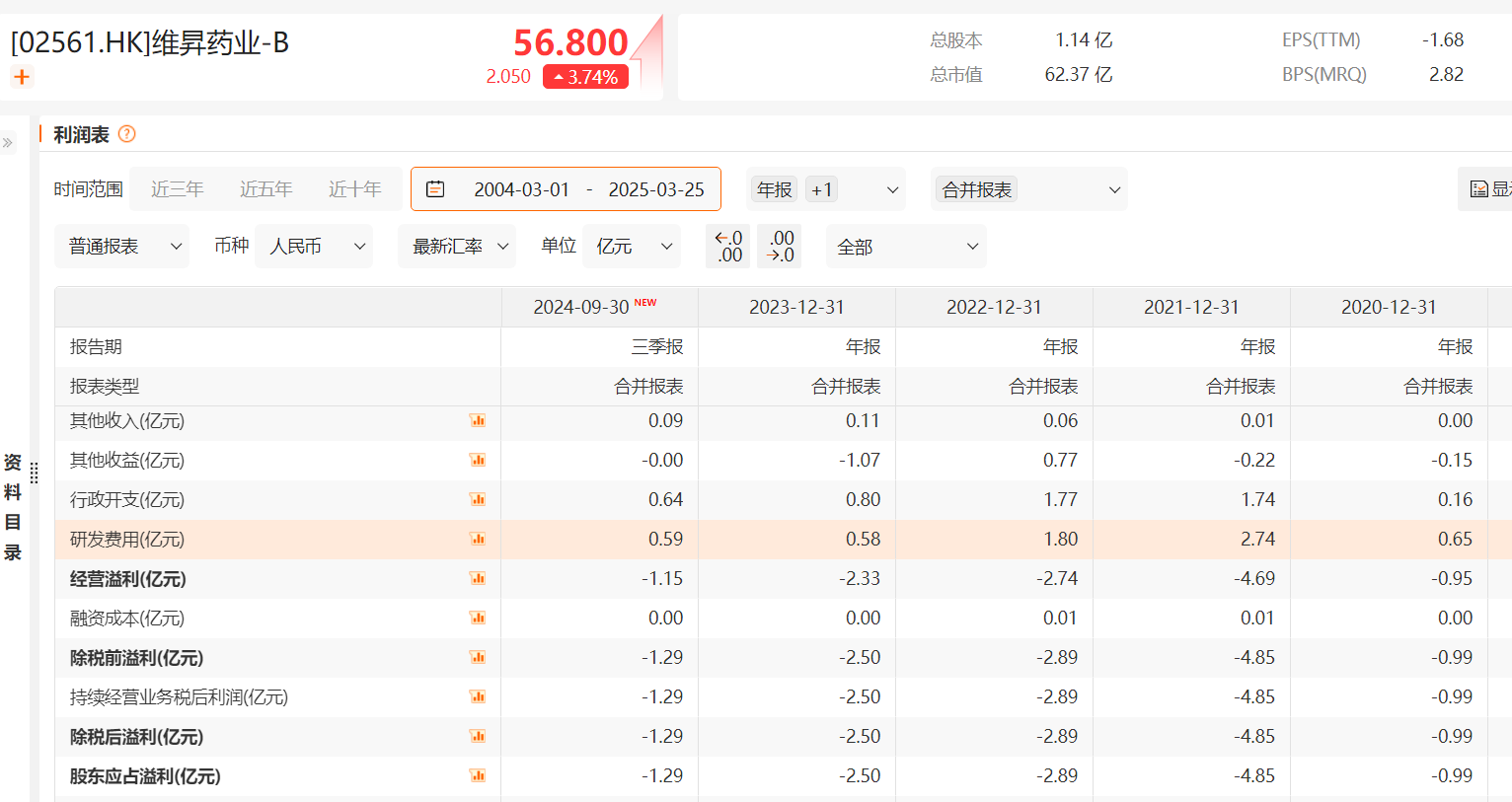
R&D investment is more important for innovative drugs than administrative expenses. However, now the administrative expenses of Weisheng Pharmaceutical have exceeded the R&D expenses, which seems to be a suspicion of sacrificing the basics. According to the statistics of "Caizhong Society", the cumulative administrative expenditure of Weisheng Pharmaceutical since 2020 is 512 million yuan.
Weisheng Pharmaceutical, which has lost money, can only rely on external financing for development. Judging from the disclosed financial report, it raised a lot of money in 2021, and the cash and equivalents reached 883 million yuan at the end of the year, which was the largest cash reserve in the past year. However, it was in this year that the company set a record of the largest loss of 485 million yuan.
In the following years, with the reduction of cash reserves, Viscent Pharmaceutical significantly controlled various expenses, including administrative expenses from 174 million yuan in 2021 to 79.94 million yuan in 2023, and research and development expenses from 274 million yuan to 57.69 million yuan. Under the cost control, its loss in 2023 will be narrowed by 235 million yuan compared with 2021.
Will the abrupt reduction of various expenditures, especially R&D investment, affect the normal progress of R&D? Judging by its funding, it seems that this is a last resort. According to the financial report, Weisheng Pharmaceutical's cash and equivalents decreased from 883 million yuan at the end of 2021 to 348 million yuan at the end of 2023, and continued to decrease to 243 million yuan at the end of the third quarter of 2024.
Judging from the loss of 250 million yuan in 2023, the cash reserves of Weisheng Pharmaceutical are only enough to maintain operations in the next year. Without this IPO financing, the company may face an embarrassing situation of running out of rice after a year.
Commercialization is imminent, can we break the monopoly of the leading enterprises?
According to the prospectus, Viscent Pharmaceuticals has established a product pipeline of three drug candidates. Among them, the core product Rompei somatotropin is a once-weekly long-acting growth hormone replacement therapy for the treatment of growth hormone deficiency in children (PGHD). The product has completed Phase 3 pivotal trials in China, and the BLA application has been accepted by the National Medical Products Administration in March 2024, and the company expects the approval time to be in the second half of 2025, which is also the fastest progress in the commercialization of the product of Weisheng Pharmaceutical.
It is worth noting that Rompei somatotropin is not a self-developed product of Ascendis Pharmaceuticals, but is licensed from Ascendis Pharma, one of its partners and controlling shareholders. The drug has been approved for marketing in the United States and the European Union. According to Ascendis Pharma's financial report, the overseas sales of Rompei auxinotropin in 2024 will be 202 million euros.
According to Frost & Sullivan data, the market size of Chinese growth hormone has rapidly increased from 4 billion yuan in 2018 to 11.6 billion yuan in 2023, with a compound annual growth rate of 23.9%.
For the business plan of this growth hormone, the prospectus of Weisheng Pharmaceutical revealed that the company has targeted about 1,000 public hospitals as target markets, including all major children's hospitals, major tertiary hospitals and some pediatric secondary hospitals with considerable scale.
However, it is important to note that there are strong competitors on the road to commercialization of this product.
In
the domestic growth hormone market, Changchun High-tech (000661) has long presented a dominant pattern, and its subsidiary Jinsai Pharmaceutical's revenue and net profit in 2023 will be 11.084 billion yuan and 4.514 billion yuan, respectively, making it the largest growth hormone leading enterprise in China.
According to the data, Jinsai Pharmaceutical launched the first recombinant human growth hormone powder injection in China in 1998, and the first short-acting water injection in China was approved for marketing in 2005. In 2014, Kinsey's pegylated recombinant human growth hormone water injection (trade name: "Kinsaizeng") was approved for marketing, which is the world's first PEGylated long-acting growth hormone preparation and the first and only long-acting human growth hormone currently on the market in China.
As a leading enterprise in the field of growth hormone for many years, Jinsai Pharmaceutical has first-mover advantages, brand and channel advantages. Whether the long-acting growth hormone of Weisheng Pharmaceutical can break the exclusive monopoly of the former remains to be seen.
At the same time, in addition to Weisheng Pharmaceutical, there are many other powerful domestic long-acting growth hormone research and development manufacturers. In December 2024, I-Mab Biopharma (IMAB) and Jichuan Pharmaceutical Co., Ltd. (600566) jointly announced that the marketing application (BLA) for Etan's long-acting recombinant human growth hormone injection has been accepted by regulatory authorities. At the beginning of 2025, Tebao Biotech (688278) announced that its self-developed long-acting growth hormone, Yipei Growth Hormone Injection, has been accepted for marketing. In addition, many companies, including Anke Biotechnology (300009), Novo Nordisk, Uniokin and other companies, are rapidly advancing the research and development and application process of long-acting growth hormone.
It is not difficult to see that the battle for the long-acting growth hormone market has begun to ignite the smoke of gunpowder.
From the perspective of the entire growth hormone industry, although the prospects of the industry are optimistic by many institutions, the challenges cannot be ignored. Under the centralized procurement policy, short-acting growth hormone will be included in centralized procurement since 2022, and many provinces have successively implemented it, such as the price of a short-acting growth hormone injection in Qinghai Province's centralized procurement has dropped from 5,600 yuan to 3,500 yuan, a decrease of 37.5%. Although long-acting growth hormone has not yet been collected, it may face similar pressure in the future.
As a leader in growth hormone, Changchun High-tech's share price has fallen from an all-time high of 497.53 yuan in May 2021 to only about 100 yuan, a decrease of 80%. It can be seen that the capital market does not seem to be optimistic about the prospects of growth hormone.
In addition to long-acting growth hormone, Viscent Pharmaceutical's other two key drug candidates, navipropide and paropetriparatide, are targeting endocrine diseases in children and adults, respectively, and have entered late-stage clinical trials worldwide.
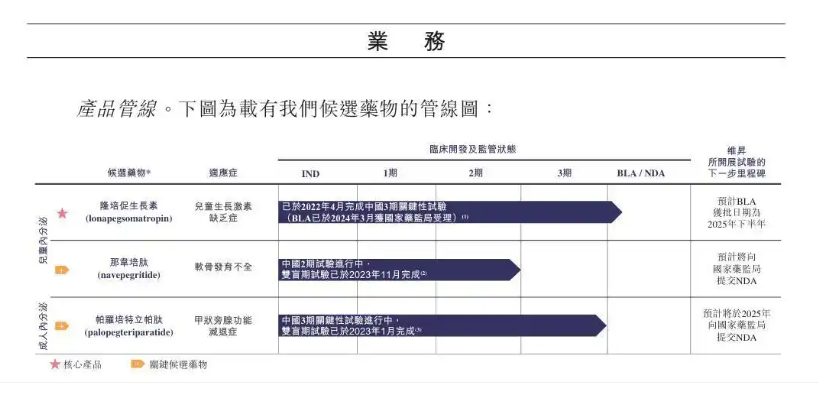
According to the disclosure in the prospectus of Weisheng Pharmaceutical, the company intends to distribute the net proceeds of approximately HK$600 million in the following proportions: 84% will be used for the ongoing BLA registration of imported core products and to fund the commercial launch of Longpei somatotropin; 7.6% was used to fund the commercial launch of parobetliparatide; 1.8% to fund the phase 2 trial of navipetide in China; 6.6% will be used for working capital and other general corporate purposes.
Ticker Name
Percentage Change
Inclusion Date








