



 AI Data Centers Emerge as New Growth Frontier for China’s Energy Storage Sector
(Yicai) April 10 -- Artificial intelligence data centers are becoming a new growth driver for China’s energy storage industry, as companies seek to offset declining profitability by tapping into demand for solutions capable of meeting the AI sector’s rapid and highly intensive power requirements, industry leaders said at a recent summit in Beijing.
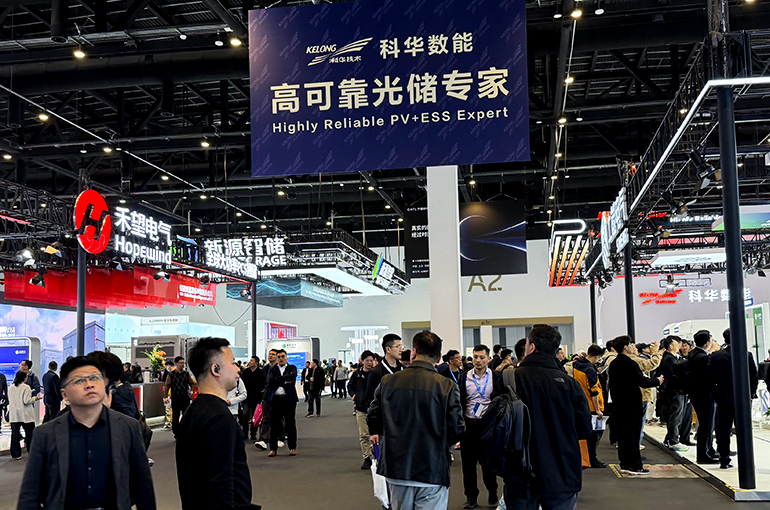
“Coordinated computing and electricity solutions, such as integrating AI data centers with power systems, have become a key growth opportunity across the energy storage sector as margins from traditional standalone energy storage plants, which are primarily reliant on peak-valley arbitrage, are narrowing,” a marketing staff member from an energy storage company told Yicai during the recent 14th Energy Storage International Conference and Expo. “Without new growth avenues, many small and medium-sized firms risk being squeezed out of the market.”
Unlike traditional internet data centers, which have relatively stable electricity demand, AI data centers powered by clusters of graphic processing units exhibit highly volatile load patterns. Workload changes, such as task allocation during model training or the initiation of batch processes, can trigger a power surge of several megawatts within milliseconds, a technical expert with extensive experience in energy storage systems said.
“Conventional energy storage systems typically respond on a timescale of seconds or minutes. In AI computing scenarios, this must evolve to the millisecond-level,” the person said. “Moreover, computing hardware is highly sensitive to fluctuations in voltage and frequency. Even minor disturbances can interrupt training processes, compromise computational accuracy or damage hardware.”
In this context, energy storage is the only solution capable of simultaneously delivering millisecond-level response times, sustaining output for more than half an hour and meeting green energy requirements.
“AI, at its core, is a combination of GPUs and electricity,” said Tian Qingjun, senior vice president of Chinese renewable energy system provider Envision Group. “This has elevated energy storage from a backup power source to a core dispatching hub, effectively making it a standard feature of AI computing infrastructure.”
Main Battleground
The main battleground for AI data center energy storage is between the US and China, an energy storage integrator told Yicai. The US market is largely driven by firms such as Microsoft and Lockheed Martin with strong demand and strong purchasing power. While in China, growth is more closely tied to large-scale, government-led computing infrastructure projects, such as the “East Data, West Computing” initiative.
China's cumulative installed capacity of new-type energy storage, which exceeded 100 gigawatts at the end of last year, already accounts for more than half of the global market, according to a report released by the China Energy Storage Alliance during the expo.
“If a company can only provide standard electricity solutions, margins per kilowatt-hour remain minimal,” an industry insider said. “However, if it can participate in areas such as token-based operations where electricity can be sourced at near-zero cost, value-added services could increase returns by up to 10 times and profits will be much greater.”
Competition these days is defined by those who can deeply engage in electricity market trading, those who understand the power quality requirements of AI workloads, and those who can bring quantifiable benefits to clients, several industry insiders said.
Editor: Kim Taylor





