 Air Cargo Giants Eye Chinese Market Promise
(Yicai) June 30 -- Leading air cargo carriers are positive about the prospects for the Chinese market despite disruptions to the sector caused by geopolitical tensions and shifting trade policies, according to industry insiders. It is a confidence that is reflected in plans to expand their fleets.
The industry is optimistic about business prospects for the second half of this year thanks to clear customer demand for increased capacity and a significant volume of time-sensitive cargo awaiting transport, James Evans, general manager for cargo commercial at Cathay Cargo Terminal, told Yicai at Transport Logistic China.
The biennial trade fair, also known as the International Exhibition for Logistics, Mobility, IT and Supply Chain Management, was held in Shanghai from June 24 to 26.
Strong trade growth between China and Southeast Asia prompted Cathay Cargo to launch services to Bangkok last month as well as increase flight frequencies to Penang and destinations in Vietnam, according to Evans, who said that the company will also hike the frequency of flights to the Americas in the second half.
Besides continuous growth in demand for European medical products, China's imports of fruits, seafood, and other fresh produce are also increasing, so Cathay Cargo opened fresh cargo channels to Macau and Zhuhai and added flights to Guangzhou, he said.
In addition, the artificial intelligence boom is driving rapid growth in demand for hardware shipments, including server racks, high-precision equipment, and batteries, Evans pointed out, adding that this will likely bring important market changes and growth points this year. Because many high-value technology products are manufactured in China and SE Asia, their strict requirements for speed and specialized cargo handling are creating new operational challenges and opportunities for air carriers, he noted.
‘Irreversible Expansion’
Although tariffs imposed on low-value parcels may temporarily weaken demand from the United States and European markets, the broader expansion of global trade is irreversible, Jeffrey van Haeften, senior vice-president of cargo commercial worldwide at Emirates SkyCargo, said to Yicai. During the fiscal years 2025 and 2026, the firm's cargo from the Chinese mainland to the rest of the world jumped by more than 11 percent year over year, mainly due to demand from cross-border e-commerce customers, he noted.
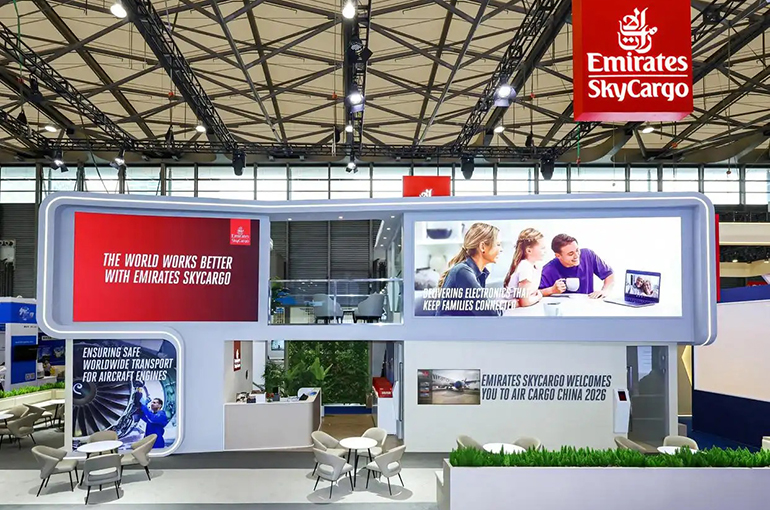
At Transport Logistic China, Emirates announced it will run three cargo flights a week from Zhengzhou, relying on the hub in central China to expand into a larger hinterland market in the country. The company is also adding destinations in Africa and Latin America for more air routes between China and these two continents.
Ethiopian Airlines is pursuing a similar strategy. During the fair, Africa’s largest air cargo provider initiated partnerships with Hubei Ezhou Airport Group, the biggest professional cargo airport operator in Asia, Henan Zhongyu Aviation Group, the main shareholder of Zhengzhou Xinzheng International Airport’s operator, and International Cargo Terminal 3 of Guangzhou Baiyun International Airport. The goal is to improve logistics efficiency and cargo transfer efficiency for shipments from southern and central China to Africa.
Chinese cross-border e-commerce platforms such as Temu and Shein have been stepping up their expansion into the African market in recent years, driving sustained growth in air cargo demand and benefiting Ethiopian Airlines' cargo layout in the Guangdong-Hong Kong-Macao Greater Bay Area, Dereje Derero, managing director of cargo and logistics services at the carrier, told Yicai.
African Tariff Break
China brought in a zero-tariff policy for the 53 African countries that it has diplomatic relations with on May 1, leading to explosive growth in exports of African specialty agricultural products, including coffee, flowers, fruits, beef, and mutton, Derero said. That has boosted cargo loads on Ethiopian Airlines’ flights to China, helping correct the long-standing lopsided one-way imbalance on these routes, he added.
Global air cargo capacity remains structurally tight, and will continue to face shortages in the short to medium term, with demand for cargo planes staying high, Derero pointed out.
Ethiopian Airlines ordered five Boeing 777 cargo planes in 2022 and is considering buying two modified Boeing 777-300ERSF cargo aircraft, Derero said.
Cathay Cargo also placed an order for two Airbus A350 freighters last month and signed a long-term lease agreement for an Airbus A330 jet this month. Emirates received five Boeing 777 aircraft and the first Boeing 777-300ERSF cargo jet converted from a passenger plane this year, planning to get more passenger-to-cargo aircraft by the end of this year and next year.
Editors: Tang Shihua, Martin Kadiev