 Alibaba CEO Says Machines Could Outthink Humans 1,000-Fold, Unveils Powerful New AI Chip
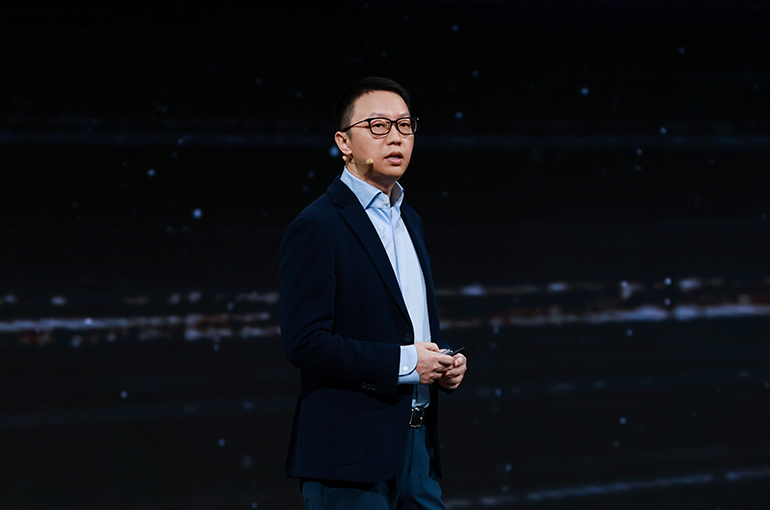
(Yicai) Sept. 22 -- Machine thinking could be 1,000 times greater than human thinking in the future, the chief executive officer of Chinese tech behemoth Alibaba Group Holdings said at the ongoing 2026 Apsara Conference in Hangzhou today, where he introduced what he called “China’s most powerful homegrown artificial intelligence chip.”
“Since machines account for less than 3 percent of total thinking today, there is still potential for that share to grow by at least tens of thousands of times,” Eddie Wu said in his keynote opening speech at the event, which runs until Sept. 24 and has Agentic AI as its central theme.
Just as the Industrial Revolution turned physical power into a capitalized commodity, machine thinking will become a scalable commodity in the AI era, Wu said. Machines already perform 99.9 percent of physical work today. Although humanity’s total thinking capacity will keep growing, machine thinking will expand at a much faster pace. Ultimately, machines are expected to handle 99.9 percent of cognitive work.
Wu forecast that, by then, top-level thinking will evolve from a luxury good to a scalable commodity. Every specialized field could have millions of AI scientists and experts, bringing profound changes to society.
Wu’s second prediction is that the defining products of the machine-intelligence era have yet to emerge. Just as electricity was initially used mainly for lighting before being applied to a wide range of electrical appliances, today’s AI coding applications are still at an early stage, he said.
Once the supply of machine intelligence becomes virtually unlimited, its impact on human society could be even more profound than that of the Industrial Revolution, Wu said.
“The three pillars of the machine-intelligence era are AI models, AI chips and AI cloud,” Wu said. Alibaba will remain firmly committed to building infrastructure around these three areas, which represents a long-term strategic choice for the Hangzhou-based firm.
At the event, Wu unveiled the Zhenwu V900, a new AI chip developed by Alibaba’s subsidiary T-Head Semiconductor, describing it as “China’s most powerful domestically developed AI chip.”
The chip delivers three times the computer power of its predecessor, the Zhenwu M890, and can support the training and inference of trillion-parameter models. Mass production of the V900 is to begin in the first quarter of 2027, and the chip will be deployed at scale in Alibaba Cloud data centers.
Alibaba will step up investment in AI infrastructure, with a goal of expanding the capacity of its globally operated data centers to more than 20 gigawatts by 2032, Wu said.
“The more powerful AI becomes, the more powerful humans become,” Wu said at the close of his speech. “The shift toward the machine-intelligence era means assigning heavy workloads to machines while giving humans more time, creative space and the ability to appreciate the beauty of life.”
The Apsara Conference is an annual cloud computing and AI industry summit hosted in Hangzhou by Alibaba Cloud in partnership with the local government. It is regarded as an industry bellwether for computing power and AI in China.
Editors: Tang Shihua, Kim Taylor