



 Jack Ma and Top Alibaba, Ant Executives Discuss Schooling Changes for the AI Era
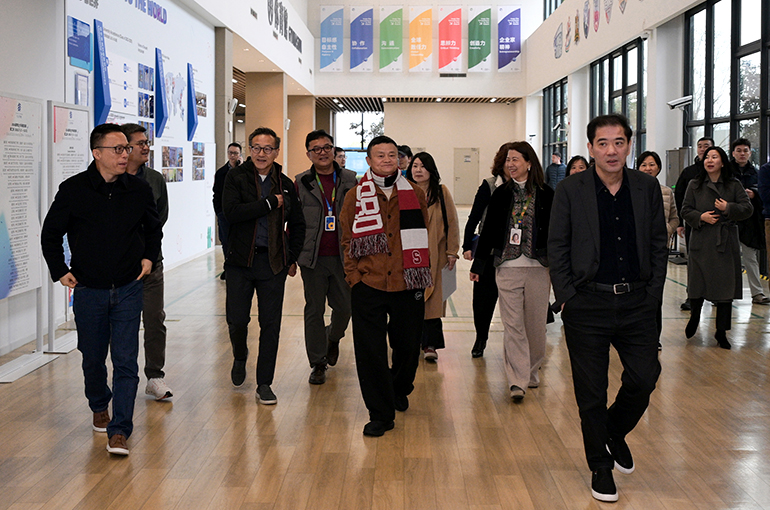
(Yicai) March 4 -- Alibaba Group founder Jack Ma and top executives from the Chinese internet giant and Ant Group, the fintech provider backed by the billionaire entrepreneur, met with teachers at a school in Hangzhou to discuss the educational challenges and opportunities brought by artificial intelligence.
Education should pivot away from rote learning toward giving children the abilities they will need in the AI era, including curiosity, imagination, creativity, empathy, judgment, and aesthetic sense, Ma said yesterday at Hangzhou Yungu School, a private educational institution spanning kindergarten to high school that was set up in 2017 by Alibaba partners, including Ma.
AI has created an opportunity for education to return to its true purpose, Ma said. Time spent on rote memorization and exam drilling should be freed up to nurture creativity and imagination, giving children more room to learn music, art, and sports, he told the meeting.
“The future is not about having children compete with AI in computation and memorization, but about keeping children curious and teaching them empathy and responsibility,” Ma said.
The measure of a school in the AI era is not how many AI servers it has, but whether its teachers can truly become "engineers of the soul" rather than mere transmitters of knowledge, he pointed out.
The AI era has arrived with stunning speed, Ma noted. Its impact on society exceeds all expectations and no one is truly prepared, he said, adding that teenagers have the greatest hope and opportunity to make change.
Alibaba Chairman Joe Tsai, Chief Executive Officer Eddie Wu, and e-commerce business group CEO Jiang Fan were also at the meeting along with Ant Chairman Eric Jing and CEO Cyril Han.
The attendees noted how AI is upgrading every week and how this technological revolution will historically reshape productivity, leading to a major reduction in human working hours and greatly enriched social wealth, but also the demise of many occupations.
“This change will come very quickly,” Ma pointed out. “We need to act fast and help children learn to coexist with AI and adapt to this monumental change starting now.”
Critical thinking is the essential skill in the AI era, said Tsai, noting that it is not merely about asking questions, but about asking the right questions. While machines will handle many tasks in the future, the ability to communicate between humans and machines, as well as among people, may become one of the most vital skills, he stressed.
The key distinction between humans and machines lies in curiosity, empathy, and physical ability, Wu said. Curiosity drives people to act on their own initiative, empathy reflects a distinctly human understanding of others, and when human mental labor is replaced by AI, the value of physical labor will become increasingly prominent, he added.
AI should be left to handle the tedious and repetitive, freeing people to develop their aesthetic sensibilities and creativity, said Ant’s Jing. But he cautioned that one must guard against over-reliance on the technology and preserve the capacity for independent thought.
Editor: Martin Kadiev





