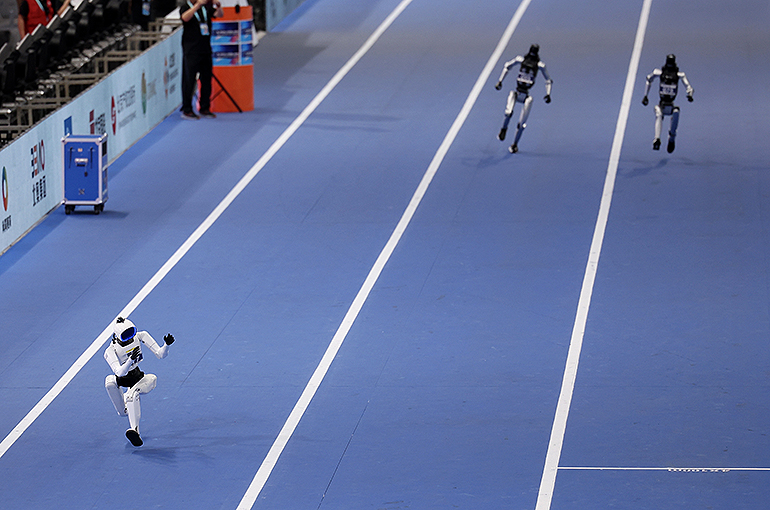
 Robots Shatter Human Records at 'Android Olympics' in Beijing
(Yicai) Aug. 24 -- Humanoid robots have broken human records at several track and field events at the second World Humanoid Robot Games, dubbed the ‘Humanoid Robot Olympics.’
Beijing Humanoid Robot Innovation Center’s Tiangong Ultra beat Usain Bolt’s 9.58-second world record set at the 2009 World Athletics Championships by finishing the 100-meter qualification race in 9.39 seconds at the World Humanoid Robot Games in Beijing at the opening on Aug. 22.
Lightning, the android developed by Chinese smartphone maker Honor that finished second in the same qualification round as Tiangong Ultra, also beat Bolt’s record with a time of 9.47 seconds. The 100m final will take place on Aug. 26.
Compared with its predecessor, Tiangong Ultra features improvements across joint motors, mechanical configuration, and heat dissipation systems, sources from Beijing Humanoid Robot Innovation Center told Yicai, adding that higher-power core motors boost athletic performance and explosive power, while lightweight construction and aerodynamic styling cut drag during high-speed runs.
Beijing Humanoid Robot Innovation Center’s Tiangong Ultra also won the large-sized humanoid robot 400-meter race in 38.15 seconds and the 1,500-meter final in 2:21.64 minutes, smashing the world records of 43.03 seconds and 3:26 minutes, respectively.
Tiangong Ultra’s “brother” Tiangong Omni clinched the gold in the small-size 400m final with a time of 45.66 seconds.
Last year, Unitree Robotics’ H1 robot won the 1,500m race in 6:34 minutes. However, the company did not secure any medals at this year’s track events.
At the inaugural World Humanoid Robot Games last year, many human operators ran alongside their robots, and there were incidents where the robots knocked over the humans. This year, all events except the 100m obstacle and 400m obstacle races require fully autonomous robots, with operators only giving the start command.
Robots relied largely on line-following algorithms last year, while this year’s systems have advanced to autonomous navigation through simultaneous localization and mapping, according to Beijing Humanoid Robot Innovation Center engineers. Robots can now sprint at high speeds within course boundaries without continuously tracking track lines.
Speed competitions keep pushing the boundaries of robot locomotion while stress-testing hardware reliability to extremes, an investor attending the games told Yicai. Such capabilities are not meant solely for racetrack use, as they can be transferred to high-mobility scenarios, including long-range inspection, logistics operations, and emergency disaster response in complex terrain, the investor noted.
While the games demonstrate impressive robot capabilities, they do not represent robots’ full real-world potential, the investor said, adding that machines built specifically and heavily optimized for the competition tend to achieve better results during the events.
Editor: Futura Costaglione