



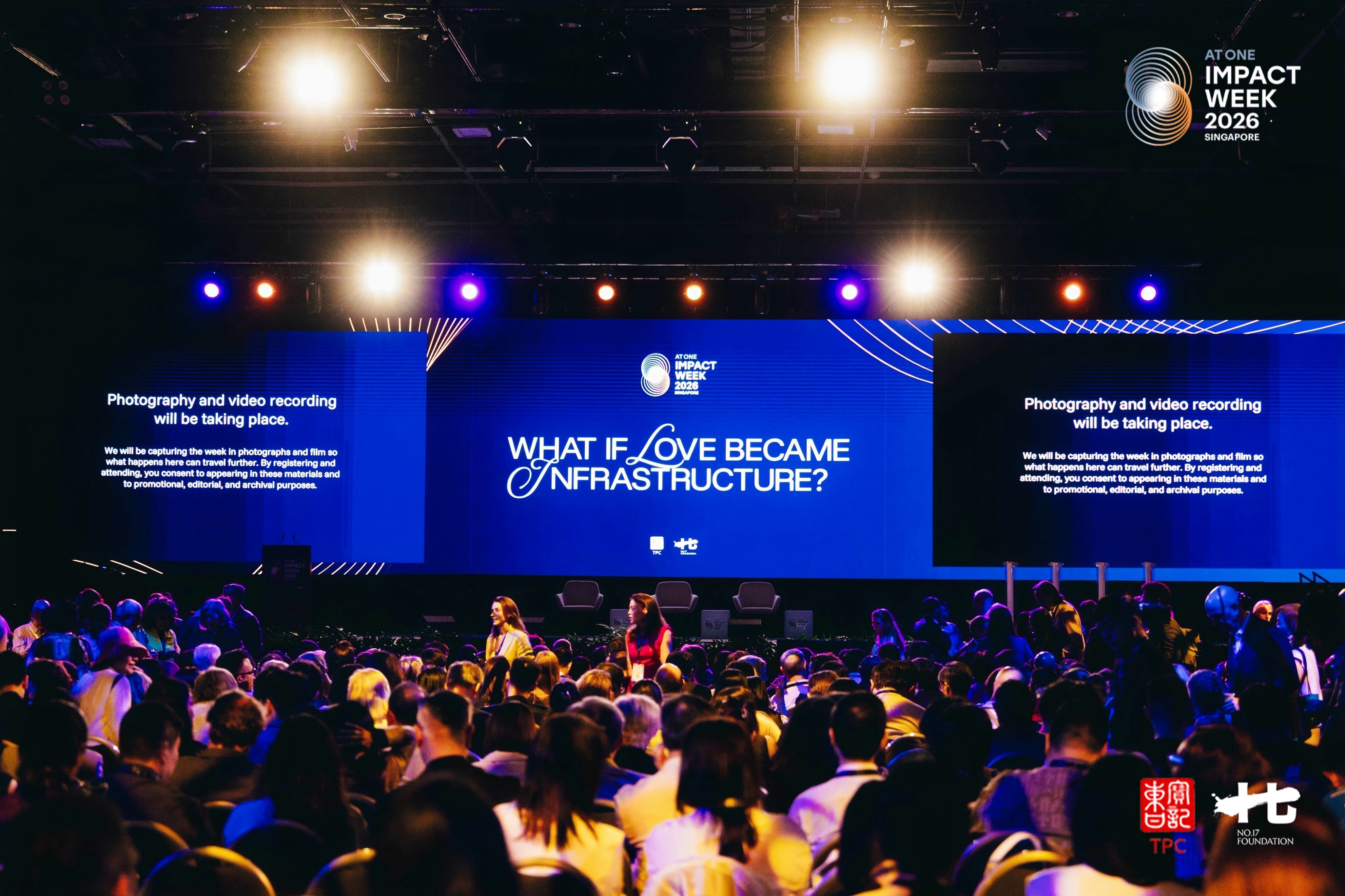
 At One Impact Week 2026 Explores Incorporating Love Into Infrastructure
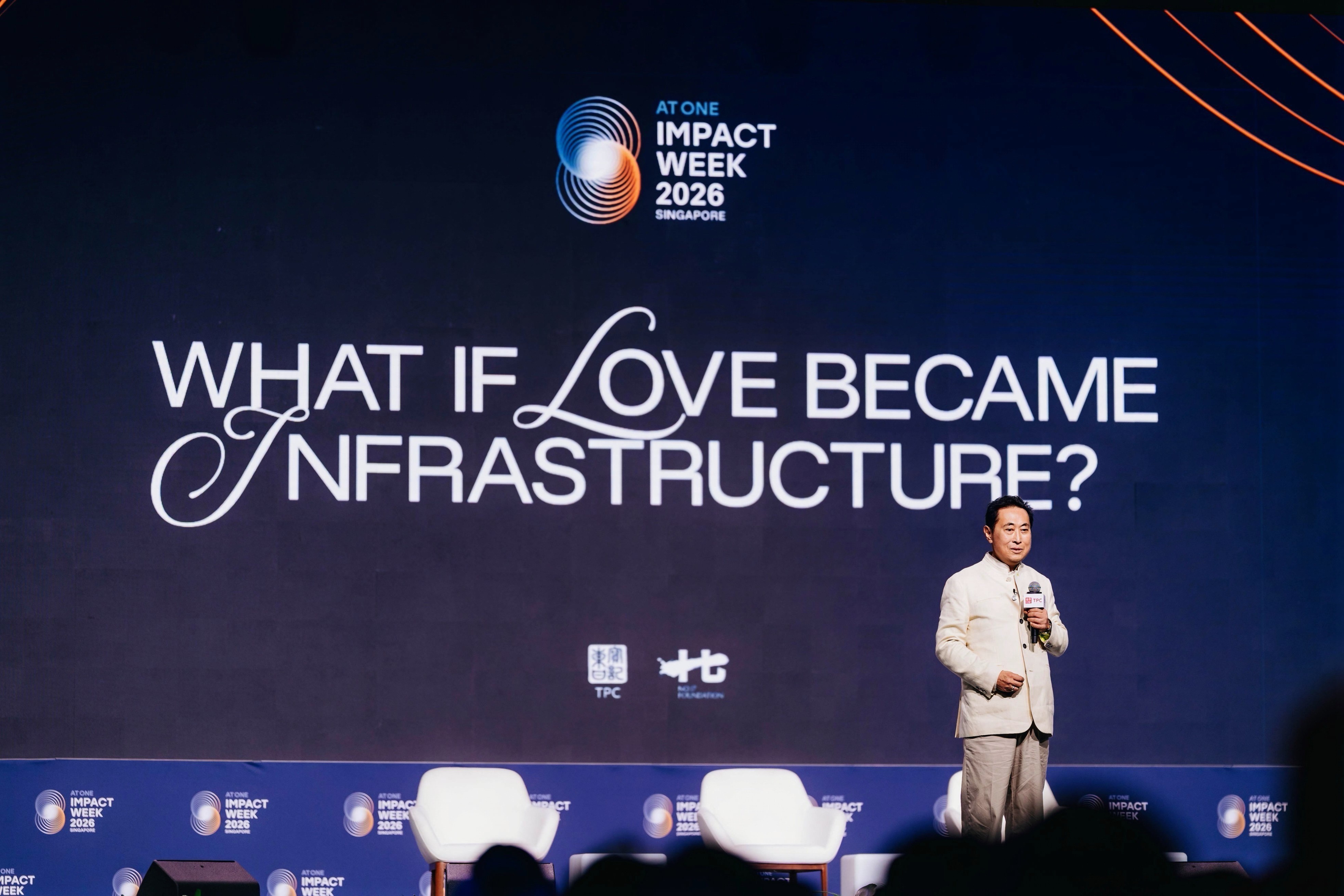
(Yicai) Sept. 10 -- Themed ‘What if Love Became Infrastructure?,’ At One Impact Week 2026 in Singapore asks what institutions, investments, and communities could look like if care, responsibility, and coherence were built into the way we function and how that intention can be embedded into the systems that shape economies and people’s livelihoods.
“Love is not a sentiment,” said Chavalit Frederick Tsao, chairman of Tsao Pao Chee, a Singaporean firm committed to empowering the well-being and happiness economy. “It begins as intention and comes to care in action -- and it must be built into infrastructure, so it can hold us all, codified into how capital flows, how decisions are made, and what endures.”
“Infrastructure is what keeps working when goodwill runs out,” said Sook Yee Tai, chairman of the No. 17 Foundation. “So love, in our vocabulary, moves through three stages: it begins as intention, is expressed through action in how we lead, decide and take responsibility, and must ultimately be built into systems so it can scale, endure and outlast any individual.
“This is not love as a soft value,” he pointed out. “It is an organizing principle for designing businesses and economies where the well-being of people, society and nature is inseparable from long-term prosperity."
At One Impact Week opened on Sept. 8 and will run through Sept. 12. More than 450 speakers from over 100 partner organizations will attend, offering over 180 programs and exploration sessions. Moreover, a three-day public-facing Well-Being Economic Forum on how to build the well-being economy and the ‘At One - All Is Well’ Festival will be held.
Convened by TPC and the No. 17 Foundation, At One Impact Week is organized as an architecture. Transformation becomes visible across four ecosystems and is enabled to scale through four infrastructures, advancing TPC’s six investment-focused pillars for the Well-Being Economy.
The four ecosystems of transformation are urban, rural, ocean, and human consciousness. The four infrastructures of enablement are capital, energy and nature, human development, and community and culture. The six investment-focused pillars are well-being, climate and nature, energy transition, food systems, circular economy, and human construct.
Rethinking Economic Value
The broader challenge is finding out how these ideas translate into the economic definition of value.
At the ‘Redefining Value for Nature Beyond Growth’ session on Sept. 9, speakers discussed whether economic systems adequately account for the depletion of natural capital, as well as health, social resilience, and long-term well-being.
Well-being economics needs to move beyond alternative measures of gross domestic product and become relevant to broader economic and policy objectives, said Sandrine Dixson-Declève, honorary president of the Club of Rome. “We have to translate well-being economics beyond GDP indicators into de-risking our economy, reducing conflict, ensuring competitiveness, and enabling security.”
Mark Gough, founder of the Capitals Coalition, put forward ways to develop accounting approaches that could bring natural, social, and human capital into mainstream corporate reporting.
Naoko Ishii, director of the Center for Global Commons at the University of Tokyo, approached the issue from the perspective of governance of shared resources, arguing that when communities lose direct responsibility for common resources, they can also lose part of the trust and sense of responsibility associated with managing them.
For now, much of the discussion remains at the level of principles, frameworks, and possible standards. Whether they can materially change corporate capital allocation and become operational accounting practices remains to be tested.
Turning an Idea Into Infrastructure
Singapore’s Minister for Sustainability and the Environment Grace Fu offered a more concrete interpretation. “Our way of putting love into infrastructure is to make sure that everyone in the population is taken care of,” she said. “Public health, electricity, water, sanitation.”
Fu also discussed Singapore’s work on a long-term national climate adaptation plan to assess climate risks and prepare infrastructure and public systems for future conditions. The financing gap for climate adaptation remains significant, and public funding alone cannot cover the needs, requiring participation from businesses, investors, philanthropic organizations, and communities, she noted.
The Financing Asia’s Transition Partnership, unveiled by the Monetary Authority of Singapore in 2023, uses up to USD500 million in concessional capital as a catalytic anchor, aiming to mobilize up to SD5 billion in public, private, and philanthropic capital for low-carbon transition projects in Asia.
Al Gore, former vice president of the United States and chairman of The Climate Reality Project, called for climate advocates to work with investors and institutions able to provide longer-term capital: “By pairing climate advocates with the stewards of the patient capital this transition requires, we can mobilize action at the scale this crisis demands.”
For investors, “patient capital” points to a practical challenge: How can the return periods of climate adaptation and ecological restoration projects be reconciled with investment horizons often measured in quarters or years?
From AI to East-West Cooperation
A central thread running through At One Impact Week is the opportunity to bring East-West perspectives into greater dialogue, not as opposites, but rather as complementary sources of knowledge and practice.
At the “Reclaiming Human Agency in the Age of Artificial Intelligence” session, participants examined how leadership may change as AI increasingly expands human capabilities in analysis, creation, and execution.
According to the session description, the discussion focused on whether the constraints on leadership are shifting from information processing toward judgment and the ability to make sound decisions under pressure.
James Chen, philanthropist and chairman of The Chen Yet-Sen Family Foundation, shared his experience of promoting access to vision correction, including efforts in Rwanda and work associated with a 2021 United Nations General Assembly resolution on universal eye health. Chen has spent 23 years working on global vision care.
Chen’s experience offered another perspective on value. Projects can generate clear social benefits without necessarily producing conventional financial returns on the same timetable, raising questions about how investors assess long-term and less easily captured forms of value.
The debate also extended beyond individual companies and investors. At the opening plenary session, “A New Generation of East-West Relations,” speakers examined how climate change, AI, and economic transformation are reshaping the basis for international cooperation.
The question is now whether these shared challenges can create practical areas for collaboration despite wider geopolitical tensions. It mirrors the challenge running through the event: can a broader definition of prosperity move from an idea to how capital is measured, allocated, and deployed?
Editor: Futura Costaglione





