



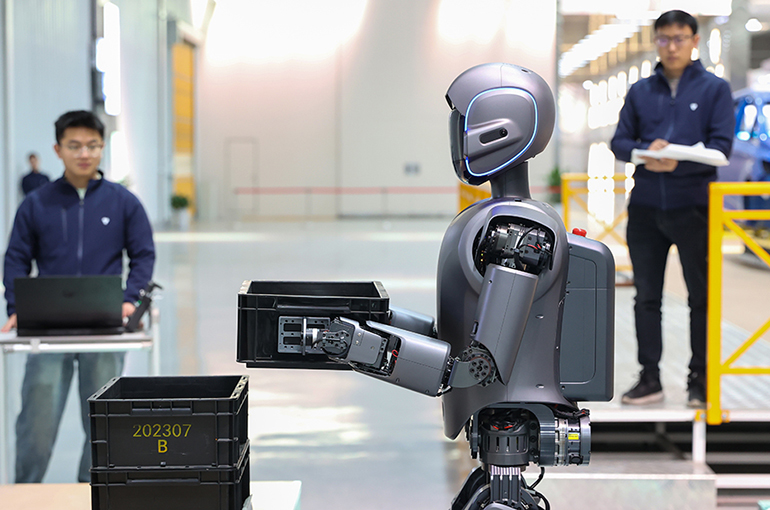
 Auto Parts Suppliers Expand into Humanoid Robot and Embodied Intelligence Businesses
(Yicai) April 28 -- As more and more carmakers venture into the humanoid robot industry, their suppliers are following suit in exploring the related component business.
Several auto part suppliers, including Aptiv, Versigent, Valeo, and Horizon Robotics, are showcasing their latest embodied intelligence technologies and products at the ongoing Beijing International Automotive Exhibition, better known as Auto China.
Perception technologies for embodied intelligence are similar to those used in intelligent driving for vehicles, so the solutions offered to automakers can also be applied to humanoid robots, Yang Xiaoming, president for China and Asia-Pacific at Aptiv, a leading provider of automotive intelligent systems and connectivity technologies, told Yicai.
Aptiv is leveraging its extensive presence in the automotive ecosystem to help the humanoid robots developed by its embodied intelligence partners access industrial scenarios while providing them with supporting technical solutions, Yang explained.
Aptiv unveiled a lineup of embodied intelligence technologies, including the Pulse integrated radar and vision perception system, at Auto China. Capable of real-time environmental perception and dynamic path planning in complex scenarios, Pulse allows robots to operate autonomously in a safer and more efficient manner.
China has emerged as the world’s fastest-growing market for embodied intelligent robots. Aptiv is bullish on the substantial growth potential of this emerging trend, according to Yang.
Although Aptiv’s revenue generated from non-automotive businesses remains limited, it has maintained a robust compound annual growth rate. “Emerging product markets beyond autos will be our business’s next growth driver,” Yang said.
Aptiv has entered a strategic cooperation with Vecna Robotics, an artificial intelligence-powered autonomous material handling technology firm, to jointly develop next-generation autonomous mobile robot solutions. The firm has also teamed up with industrial AI automation company Robust.AI to co-create AI collaborative robots.
Versigent, a Swiss supplier of signal, data, and power transmission systems, focuses heavily on automotive wiring harnesses. The company’s core products are compatible with both vehicles and embodied intelligent devices, such as humanoid robots, Qi Song, global vice president and president for China at Versigent, told Yicai.
“Humanoid robots and autos share many core underlying technologies, such as an efficient neural system,” Qi noted. “The expertise we have accumulated in the automotive industry can be rapidly transferred to these emerging markets, fostering new long-term growth drivers for the company.”
French automotive parts supplier Valeo displayed its new humanoid robot-oriented technologies and products for the first time at Auto China. Its portfolio includes vehicle-grade hardware and software tailored for humanoid robots and automated guided vehicles, which have already been deployed in the company’s own manufacturing facilities.
Most supply chain players hold a positive forward-looking view on the prospects of the humanoid robot industry and plan to gradually scale up production capacity upon receiving tangible orders, Du Qian, head of industrial technology research at Goldman Sachs China, told Yicai in a recent interview.
Nevertheless, orders for humanoid robots have yet to reach a large scale. “Taking industrial-grade humanoid robots as an example, we believe that order volumes need to exceed 10,000 units to support the formation of a large-scale supply chain system,” Du noted. “Small-batch orders of several hundred or a few thousand units are insufficient to underpin the overall development of the supply chain.”
Editors: Tang Shihua, Futura Costaglione





