



 Beijing Clamps Down on Covid-19 in Catering; Japanese Food Operators' Revenue Drop 80%
(Yicai Global) June 18 -- Beijing has tightened its Covid-19 screws anew in the throes of a fresh Covid-19 outbreak, so catering companies will suffer huge losses again, and some Japanese food firms hit hardest by signs salmon may be a vector have already folded, while those still in business have seen their revenue shrink 80 percent, National Business Daily reported yesterday.
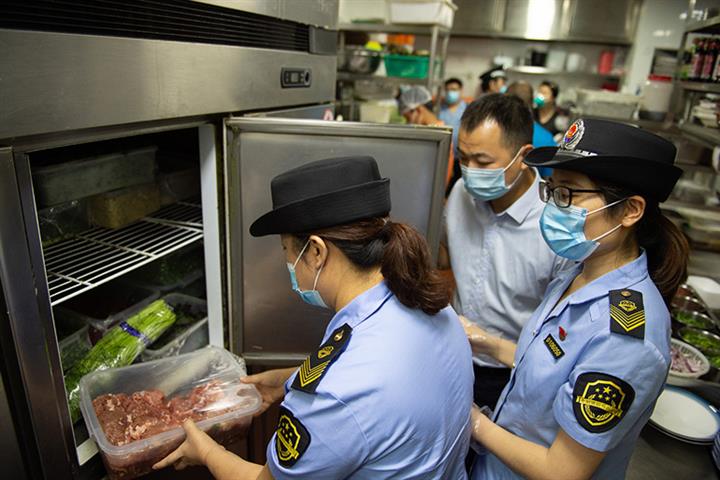
Many catering firms still in business have bolstered measures for coronavirus control in their stores, such as demanding their Beijing employees undergo nucleic acid testing, disinfecting their premises every morning and evening at a minimum, and checking temperatures at the door, according to the newspaper, citing several sources in the sector. Catering companies will still suffer great losses, however, because of the controls and ebbing consumer confidence.
Clusters of Covid-19 cases have sucker-punched Beijing since June 11 after over 50 consecutive days of zero local transmissions, with over 130 new cases popping up just in the last week. Most have a close nexus with the Xinfadi wholesale market in the capital's southwest, which is Asia's largest such emporium. The city rolled out a series of measures to stamp out the outbreak on late June 16, imposing strict curbs on farmer's markets, restaurants and dining halls.
Japanese food firms are the ones most floored by the outbreak. Of 40 samples tested from the Xinfadi market, salmon chopping boards appeared to stand out as especial vectors, which unleashed a public panic. Many Japanese food restaurants in Beijing removed salmon from their menus soon after.
Japanese chain restaurant Murakami Ichiya's business volume has plummeted 80 percent in recent days, said He Shiyuan, its founder and chief executive officer, adding its business had recovered by that same percentage last month as business and production resumed, and it had also further improved early this month but has now "fallen back to the level before the resumption" because of the second outbreak.
No evidence shows salmon itself is a direct or intermediate host for the virus, Shi Guoqing, deputy director of the emergency center under the Chinese Center for Disease Control and Prevention, noted, adding the consumer appetite for salmon is nevertheless unlikely to revive in the short term in light of the market feedback.
Editor: Ben Armour





