



 China’s Consumer Inflation Hits Two-Year High After Below Forecast 2.7% Gain
(Yicai Global) Aug. 10 -- Despite a less-than-expected acceleration, China’s consumer inflation rose by the most in two years last month. The National Bureau of Statistics said the gain was driven higher by costlier food and energy.
The consumer price index rose 2.7 percent in July from a year earlier, the fastest pace since July 2020 and up from 2.5 percent in June, according to data the NBS released today. That was slower than the average 2.8 percent clip predicted by 17 chief economists polled by Yicai Global.
Surging pork prices pushed up the CPI, said Li Chao, chief economist at Zheshang Securities, and prices of the meat are expected to continue rising in the short term because there is still an imbalance in supply and demand.
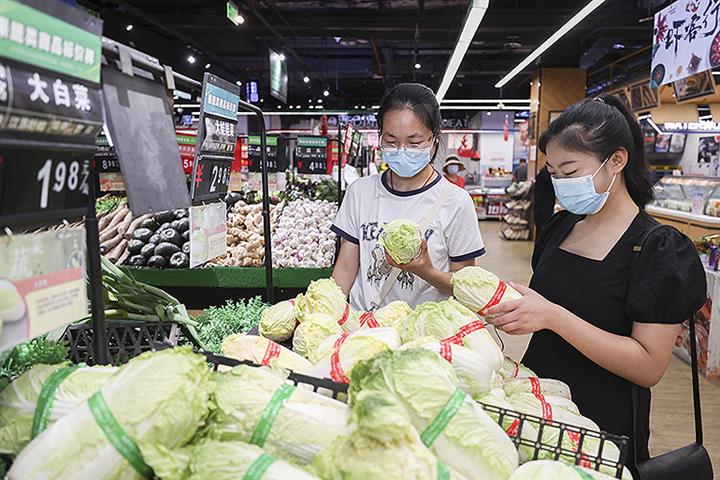
Pork cost 20.2 percent more in July, after dropping 6 percent the month before. The price of fresh fruit also surged, gaining 16.9 percent, while fresh vegetables rose 12.9 percent.
But future increases in pork prices should be moderate, Li added, as livestock inventories have already recovered to healthy levels and the government is set to release more frozen reserves into the market.
Costlier Food, Energy
Food prices climbed 6.3 percent, the most in 22 months, with food items accounting for about 1.1 percentage point of July’s consumer inflation, while non-food items made up the other 1.6 percentage point.
Diesel prices jumped 26.7 percent, gasoline 24.6 percent, and liquefied petroleum gas 22.4 percent, though the gains slowed from June.
The CPI for the whole of this year should come in below the government’s 3 percent target, despite consumer inflation climbing since February and the possibility that the CPI may exceed 3 percent this quarter, Wu Chaoming, deputy dean at the Chasing Institute, told Yicai Global.
So stabilizing employment and keeping economic growth within a reasonable range remain the government’s top priority, Wu said, adding that he expected market liquidity to stay at a reasonably ample level.
Lower Factory Inflation
The gain in factory gate prices continued to slow from last October’s 13.5 percent, NBS data also showed today, falling to a 17-month low, as global commodity prices declined.
The producer price index advanced 4.2 percent in July from a year earlier, the slowest pace since February 2021. June’s PPI had jumped 6.1 percent. Last month’s increase was also less than expected as the economists surveyed by Yicai Global had forecast a gain of 5 percent.
The PPI may continue to rise more slowly over coming months as the global economy is slowing and demand is ebbing, while last year’s baseline was quite high, Wu said. That will result in moderate inflationary pressure abroad and limited impact in China, he added.
Editors: Tang Shihua, Emmi Laine





