



 China’s Consumer Inflation Rises to 15-Month High in November
(Yicai Global) Dec. 9 -- China’s consumer inflation rose last month by the most since September last year, driven by the rising cost of fresh vegetable and non-foodstuffs.
The consumer price index gained 2.3 percent in November from a year earlier, according to data released by the National Bureau of Statistics today. It rose 0.8 percentage point from October.
The core CPI, which strips out food and energy prices, rose 1.2 percent from a year ago and fell 0.1 point from the prior month. Non-food prices climbed 2.5 percent, 0.1 point higher than in October.
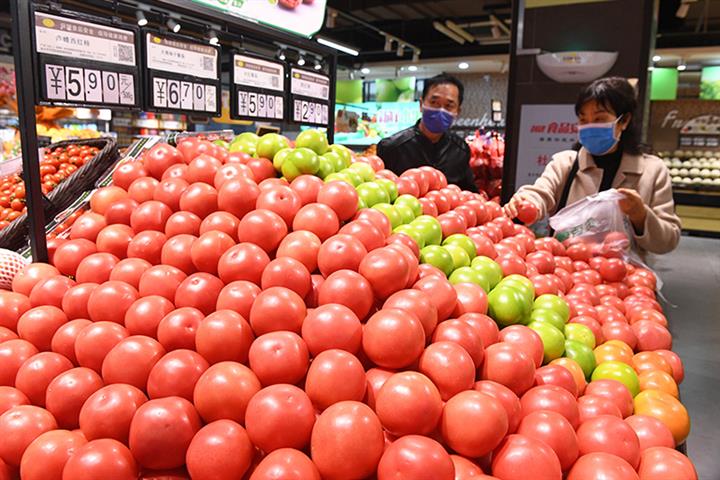
The increase in food prices slowed from October’s 2.4 percent to 1.6 percent. Of that, the cost of fresh vegetables surged 30.6 percent, a widening of 14.7 points on October.
The CPI expanded more due to new price increases as well as the low base in the same period last year, said Dong Lijuan, senior statistician at the NBS’s urban surveys department.
In November, China’s CPI rose 0.4 percent from October, lower than the previous month’s 0.7 percent gain. In the 11 months ended Nov. 30, the CPI gained 0.9 percent from the same period a year earlier.
Looking ahead, Guotai Junan Securities believes that consumer inflation will rebound moderately next year at around 2 percent, with a chance of more than 3 percent in certain months.
The factors previously pushing up prices have hiked the cost of energy and raw materials in the upstream, with midstream and downstream firms and consumers facing passed on costs for some time to come, according to the 2022 blue book on the economy published by the Chinese Academy of Social Sciences on Dec. 6.
It is expected that growth in the CPI next year will be greater than this year. But overall, the CPI will be in a moderate range in 2022, with little chance of full-blown inflation.
Producer Prices
Meanwhile, with the further implementation of policies to ensure supply and stabilize prices, China’s producer price index rose 12.9 percent last month, up 0.6 percentage point from October, according to the NBS.
The implementation of policies has curbed the rapid rise in coal and metal prices to start with, Dong said.
The coal mining and dressing industry surged 88.8 percent in November from the same period last year, a drop of 14.9 percentage points over October. The ferrous metal smelting and rolling processing industry rose 31 percent, down 8.9 points. The non-ferrous metal smelting and rolling processing industry rose 26.5 percent, down 3 points.
According to estimates, of the 12.9 percent PPI growth in November from last year, the carry-over effect of price changes last year was about 1.2 points, down 0.6 point from October. The impact of new price increases was about 11.7 points, the same as in October.
Prices of ferrous metals, coke and coking coal have fallen sharply after the state’s intervention, Zheng Houcheng, director of Yingda Securities Research Institute, told Yicai Global. International oil prices have slumped amid the global pandemic coupled with the United States and Japan considering the release of strategic oil reserves and the base effect.
China’s PPI in November was the same as in October, which gained 2.5 percent from September. The PPI rose 7.9 percent in the first 11 months from a year earlier.
Editor: Peter Thomas





