



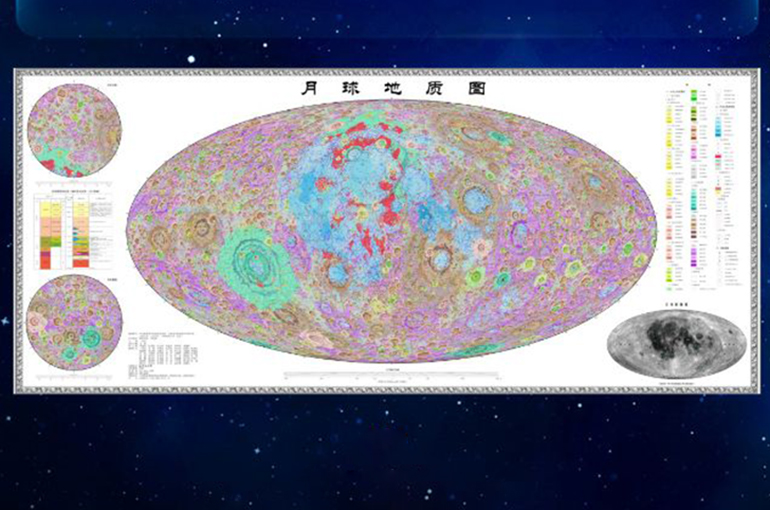
 China Creates Highly Detailed Geological Map of the Moon
(Yicai) Aug. 6 -- Chinese researchers have finished making a new and highly detailed geological map of the moon, using data from recent lunar missions and updated scientific understanding of lunar history, minerals, and geological structures. It is expected to support future moon exploration.
The 1:5,000,000-scale map, which is about 280 centimeters long and 120 cm high, also has detailed supplementary maps of the lunar north and south poles, Xinhua News Agency reported today. It accurately marks more than 13,000 impact craters and 81 impact basins, while classifying 14 types of geological structures and 17 types of rocks.
The map, compiled by a team at the Institute of Geology under the Chinese Academy of Geological Sciences, has revised the lunar geological timescale based on the latest research, changing the starting age of the Aitkenian Period to 4.33 billion years ago, that of the Nectarian Period to 4.17 billion years ago, and that of the Imbrian Period to 3.92 billion years ago.
It marks the first time lunar strata from the late period have been classified in such detail, and optimizes rock classification standards by using a high-resolution map of critical mineral distribution on the lunar surface.
The map provides vital scientific support for China’s future lunar landing-site selection, research station construction, and deep space exploration, said Yang Zhiming, the institute’s director. It also marks China’s latest contribution to human understanding of the solar system, he pointed out.
Drawing on discoveries made during China’s Chang’e lunar exploration program, the map updates the “Moon material inventory” as well. It identifies a new type of rock called gabbro norite in the South Pole-Aitken Basin, allowing humans to directly “see” deep interior materials of the moon.
The researchers created a “customized magnifying glass,” with differentiated minimum representation standards based on feature type. This ensures the vast map remains readable, while preserving key geological features of significant scientific value.
Editor: Tom Litting





