



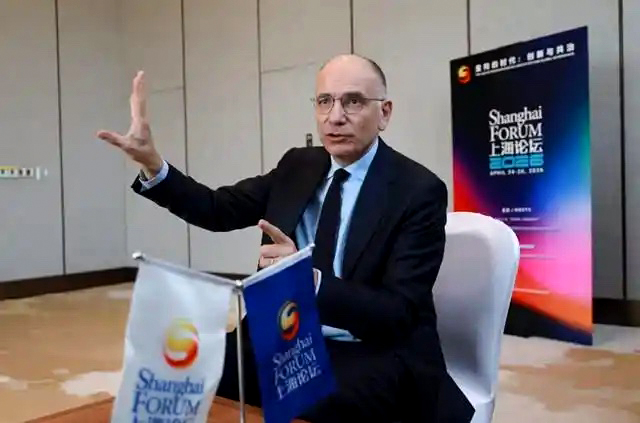
 China, EU Have Historic Chance to Work Together, Italy's Ex-PM Says
(Yicai) April 29 -- China and the European Union must strengthen their cooperation, having a "fundamental opportunity" to work together in building a more cooperative world, according to former Italian Prime Minister Enrico Letta.
Italy and China share a millennial history, which carries lessons that have nothing to do with nostalgia, Letta, who is dean of the IE School of Politics, Economics & Global Affairs at Spain's IE University, told Yicai at the Shanghai Forum 2026. "Trump is nostalgic. MAGA -- Make America Great Again -- this word is a very nostalgic approach.
"We are not nostalgic, China and Europe," Letta noted. "We learn lessons from history, and lessons from history are telling us that the law of the jungle is not the way to solve problems. I don't like the world of today.
"I don't like the law of the jungle, in which the biggest is not the most responsible," Letta stressed. "The biggest in the Trump era is the one who has the most advantages. This is not my world. My world is the world in which the biggest is the most responsible."
Letta used the legacy of Ban Ki-moon, who served as secretary-general of the United Nations between 2007 and 2016 and was vital for the Paris Agreement on climate change, as proof that China and Europe can deliver together, noting that it shows the two, when Barack Obama led the United States, were "able to work together and to be successful."
Excerpts from the interview with Letta are below:
Yicai: How do you assess the overall state of China-Europe cooperation? What new areas could they expand into?
Enrico Letta: We have to consider that we have a common joint responsibility in the future. So we have to work together more than we did in the past. In the last five years, the cooperation between Europe and China was not a very close cooperation, and it was a pity. And today, what is happening at the world level is bringing us to consider that cooperation has to be strengthened.
China and Europe together have a great responsibility in the world of tomorrow. First of all on geopolitics, we have to bring the US on the side of wisdom, because the US of today, they are not on the side of wisdom. And Europe and China, we share wisdom and a long-term vision as the approach. That is not the way in which Trump works. Trump works with the next six hours, the next tweet, the next two days.
But history is not made by tweets. History is made by long-term decisions and wisdom. So Europe and China share wisdom and long-term vision. Today is absolutely fundamental to turn the page of the last years with Europeans. We were not happy with some Chinese decisions on Russia, on Ukraine. There was a clear division on that, and a different approach now is absolutely fundamental for the future of the world to restore cooperation, multilateral cooperation, to strengthen the UN.
An opportunity for China and the European Union to be together is the choice of the next UN secretary general. We had the opportunity here to listen to the previous Secretary-General Ban Ki-moon.
Ban Ki-moon was a secretary general very much supported by Europe and China, and he was the one who successfully drove the Paris agreement against climate change, and it was he the one who launched the SDGs. Ban Ki-moon has a fantastic legacy, and his legacy is the demonstration that China and Europe together, at that time with Obama leading the US, were able to work together and to be successful.
There's another big topic, a new era of China-Europe cooperation. That is technology, because the revolution of AI is changing everything in terms of tools, opportunities, and consequences. We need to share views, we need to learn from each other, and we need to know that there's the possibility to take the best from AI and to leave the potential negative on the side, because together we can overcome the negative.
AI is a fantastic opportunity in many fields, for industry, for people, and for education. But on education, for instance, we have to share lessons. AI is a technological tool, but at the same time obliges a new relationship between teacher and student. They need to meet physically.
This is the paradox of AI, because if they don't meet physically, for the teacher, it is very difficult to understand if the student has his own compass, or if his own compass is only the use of AI.
Yicai: The Middle East crisis has yet to ease significantly, and Europe has faced two energy crises within four years. Could geopolitical factors become a major catalyst for China-Europe energy cooperation?
Letta: Very broad question. There are two levels: the first level is the short-term answers, and the second level is the long-term answer.
The Strait of Hormuz challenge is obliging us to move on two levels. The main problem is that public opinion and politicians tend to give only answers in the short term, because these short-term answers are the ones that people are asking for. And the answers in the short term are answers related to reducing energy prices through subsidies and relaxation of the European Stability Pact, the way in which we can put more subsidies to reduce the cost of energy.
Now the point is that these interventions that are fundamental and very useful to avoid inflation and recession are not what we need in the long term, because in the long term, we need not use public money to reduce in an artificial way the cost of energy.
In the long term, we need two things: we need energy independence, which means renewables, and we need a more integrated European energy market internally. Because our treaties, our fundamental rules, give national countries the power to define their energy mix, we are not living in one energy union at the European level, but we live in a sum of 27 energy systems, not well interconnected among them.
The first challenge is renewables, and the second one is interconnections among the different member states. We need to build up a system of interconnections, able to interconnect each member state and able to give all the European consumers the possibility to use all the energy sources that we can have in each country.
Europe and China, because of what is happening, have to put aside some of their differences, and we have to consider and build up the future of more cooperation. First of all on energy, there are a lot of opportunities. China is betting on renewable technologies, and Europe needs to bet on renewables. So yes, we have to cooperate. And we have to organize a cooperation for the future on this, on technology, on geopolitical aspects. So I see a big potential.
Yicai: The EU has rolled out multiple foreign investment and trade regulatory tools. Could these trade barriers and restrictions impede the long-term development of China-Europe economic ties?
Letta: Europe is working to strengthen its resilience, its industrial resilience. We are doing this with the project based on 'Made With Europe,' a project of openness and cooperation.
What we tell our Chinese friends is that we want to strengthen our cooperation, and we are open to doing so in reciprocity conditions. So the key point is that it's time to work together to relaunch our cooperation based on reciprocity.
And so the key point is that we would like China to open to European goods, European services, and common reciprocity can be a fantastic boost for Chinese companies to Europe, because we welcome Chinese companies. And this, in a reciprocity mode, can be of mutual benefit.
Editor: Martin Kadiev





