



 China Sets Up Body to Get SOE Science and Tech Research to Market
(Yicai) June 1 -- China has launched a new group to help centrally administered state-owned enterprises bring their scientific and technological research results to market by providing its members and partners with one-stop, end-to-end services that ease the “last mile.”
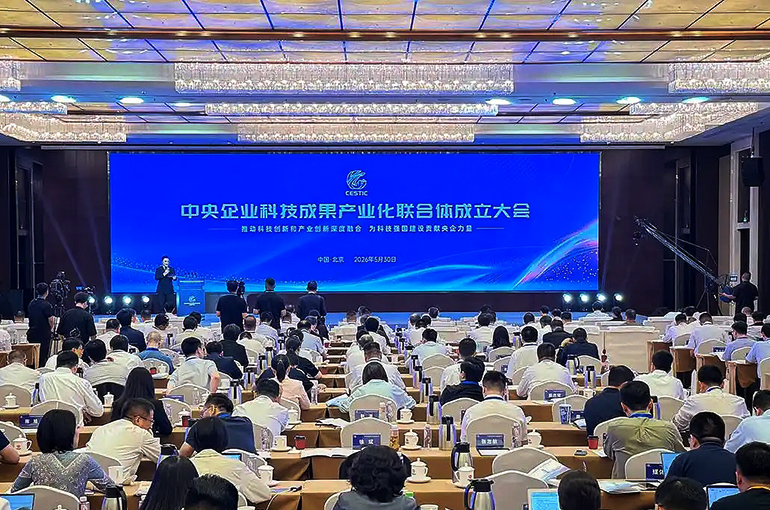
The Consortium for the Industrialization of Scientific and Technological Achievements was set up by CHN Energy Investment Group and others under the guidance of the State-Owned Assets Supervision and Administration Commission in Beijing on May 30. It includes all 97 central SOEs, the key firms in their industrial chains, major research institutes, universities, innovative private businesses, and other stakeholders, Yicai learned at the founding meeting.
China’s centrally administered state-owned enterprises are non-financial SOEs supervised by the SASAC. They form the backbone of the country’s state-owned sector, and most operate in industries tied closely to national security, the national economy, and public welfare.
The consortium aims to capitalize on the advantages of central SOEs in concentrating innovation resources, offering extensive use cases, and and having a vast market scale, while also strengthening their role in driving the integration of tech innovation and industrial development, Yan Guochun, deputy general manager of CHN Energy, a large state-owned energy and mining company, said at the event.
The new group will build and operate a smart services platform for the industrialization of sci-tech achievements. Serving as its digital foundation, the platform will first be opened to member companies and institutions, then gradually shared with various innovators, with the goal of accelerating the conversion of sci-tech achievements into practical productive forces.
The platform will become a key piece of infrastructure supporting sci-tech innovation at central SOEs and a hub that links China nationwide while extending globally, SASAC Deputy Director Li Zhen said at the event. Using digital technologies such as artificial intelligence, it will efficiently connect research achievements with demand, research and development, pilot testing, and application, Li added.
The consortium will focus on building a service ecosystem for the transformation of sci-tech achievements, acting as a bridge for their industrialization, and addressing the persistent bottlenecks at the “last mile,” including reluctance, unwillingness, inability, or slowness, noted Liu Ziqian, GM of state-owned China Telecom's sci-tech innovation department.
Editors: Tang Shihua, Martin Kadiev





