



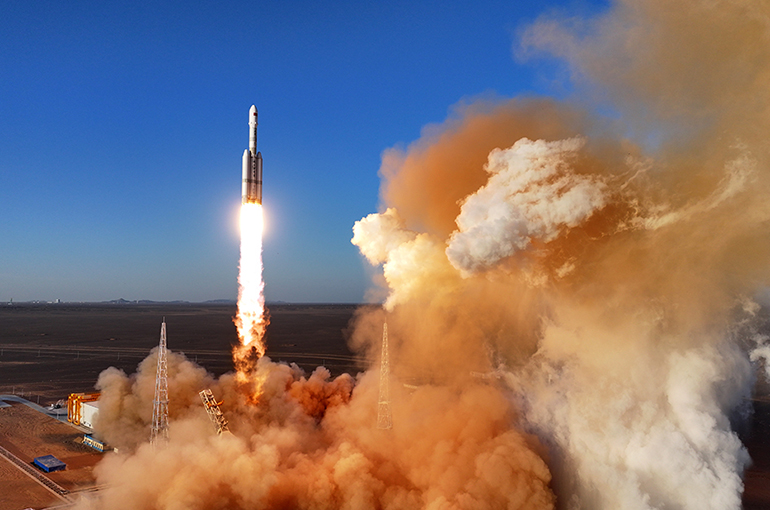
 China Launches High-Scalability Carrier Rocket to Support Satellite Networking
(Yicai) March 31 -- China sent a carrier rocket that can assemble a different number of boosters to meet the launch requirements of various payloads into Earth's orbit, enabling the support of large communication satellite networking and other space missions at a lower cost.
The next-generation commercial Kinetica-2, developed by CAS Space, took off carrying three satellites from the Dongfeng Commercial Aerospace Innovation Testing Area at the Jiuquan Satellite Launch Center in northwest Gansu province yesterday, the Guangzhou-based aerospace technology company announced on the same day.
The rocket is 53 meters high and equipped with a 4.2-meter payload fairing. It is capable of delivering eight metric tons to a 500-kilometer Sun-synchronous orbit or 12 metric tons to a 200 km low Earth orbit, according to the Chinese Academy of Sciences-backed CAS Space.
"Kinetica-2 is engineered around an innovative common booster core architecture," CAS Space noted. "Its first stage can be dynamically configured with zero, two, or four strap-on common boosters, allowing us to easily scale LEO payload capacity from two up to 20 metric tons to meet our clients' needs.”
"Kinetica-2 will serve as a premier, heavy-duty commercial launch solution," CAS Space said. "It is built to support the industry's most critical missions, from low-cost space cargo transportation and the rapid deployment of LEO megaconstellations to the launch of vital carbon-emission monitoring satellites."
CAS Space has completed 12 rocket launch missions since it was set up in 2018. Its first-gen Kinetica-1 has an SSO payload capacity of 1.5 metric tons, focusing on batched launch of small satellites. The company is also testing recovery technology on its Li Hong spacecrafts, aiming to make Kinetica-2 rockets reusable to further cut launch costs.
In addition, CAS Space is building a superfactory in eastern Zhejiang province that can produce 12 Kinetica-2 rockets per year, the company pointed out, noting that the plant will soon become operational.
Editors: Dou Shicong, Martin Kadiev





