



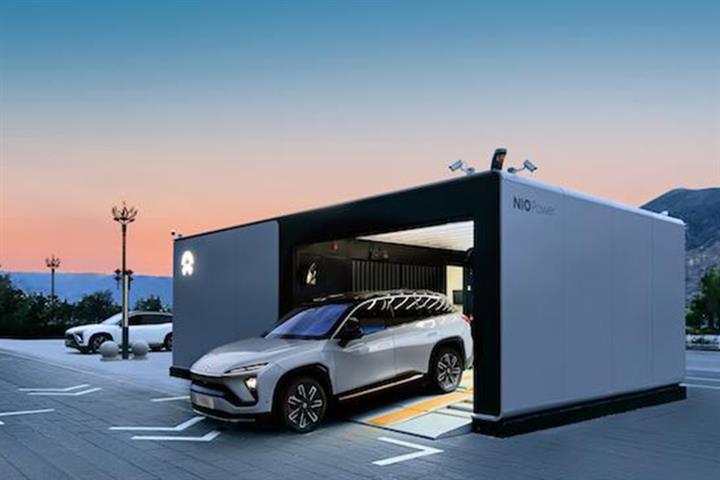
 China's Nio to Build Over 4,000 Battery Swap Stations Worldwide by 2025
(Yicai Global) July 7 -- Nio, a Chinese new energy vehicle startup, intends to establish more than 4,000 battery swap stations around the world by 2025.
However, some three quarters of the total will be located in China, the Shanghai-based company said in a statement yesterday. The network should involve 19 urban hubs including Beijing, Shanghai, and Chengdu.
The manufacturer is improving its charging technology. Nio intends to launch its third-generation battery swap station with a larger capacity, equipped to serve more vehicle models, within half a year, it said, without disclosing which manufacturers and models that would involve.
Since debuting the battery swap business in 2018, Nio has constructed more than 1,010 such stations in China, covering all provincial-level administrative regions. And the facilities are welcomed by drivers. Switching batteries made up more than half of Nio users' electricity demand last month, according to the latest data.
Electric vehicle companies in China tend to steer toward either fast charging or battery swaps to keep their clients on the roads when far from home. Global battery giant Contemporary Amperex Technology has launched its battery swap brand Evogo while carmakers Geely Holding Group and SAIC Group have begun building their corresponding systems. Meanwhile, Tesla, Xpeng Motors, and Changan Automobile are still firmly supporting fast charging.
The industry could benefit from sharing. NEV companies should come up with unified battery standards to increase their business volumes and to make operating battery swap networks profitable, according to industry insiders. Currently, it is costly to build a station to exchange batteries while most firms are not collaborating, they added.
Auto firms may themselves have propped up the hurdles. Manufacturers like to design vehicles that look different from their rivals and that makes it hard to unify battery sizes, the insiders said. That consequently limits the opportunity to share resources which could boost profitability, they added.
Editors: Shi Yi, Emmi Laine, Xiao Yi





