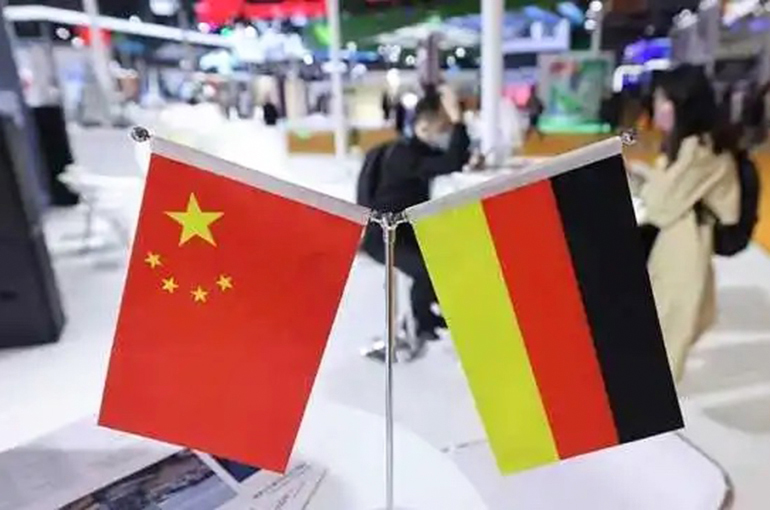
 China Overtakes US as Germany's Main Foreign Investor for First Time in Eight Years
(Yicai) May 22 -- The number of greenfield and expansion investment projects, excluding mergers and acquisitions, in Germany by Chinese enterprises has surpassed that by US companies last year for the first time since 2017.
Chinese firms initiated 228 investment projects in Germany last year, up 15 percent from 2024, according to the Foreign Investment in Germany 2025 report released by Germany Trade and Invest yesterday. US and Swiss companies ranked second and third with 206 and 174 such investment projects, down 10 percent and 14 percent, respectively, in the period.
Overall, the number of greenfield and expansion investment projects in Germany declined 9.3 percent to 1,564 in the period, while that in the European Union fell 18 percent. The global total dropped 9.5 percent.
Chinese enterprises' greenfield and expanded investment projects in Germany cover a wide range of sectors. Electronics and automation projects top the list, accounting for 30 percent of the total, followed by transportation and logistics at 22 percent and energy and raw materials at 15 percent.
The continuous expansion of Chinese companies' investment activities in Germany further demonstrates their highly diversified layout, covering industrial applications, cutting-edge and future technologies, and knowledge-intensive services, said Thomas Bozoyan, author of the report.
Germany Remains Attractive
Despite Germany's mediocre economic performance, the country has not dampened the interest of foreign investors, including Chinese enterprises operating locally, Shou Shuning, tax partner at PricewaterhouseCoopers Germany, told Yicai. The upstream and downstream segments of the new energy vehicle and digital technology industries are the most popular investment sectors, she added.
China has prominent advantages in autonomous driving, industrial robots, intelligent manufacturing, and other fields, said Wu Huiping, deputy director of the Germany Research Center of China's Tongji University. Germany's digital infrastructure construction still needs to be improved, so the government is pleased with this investment direction, she noted.
Against the backdrop of growing emphasis on economic security, Germany and Europe are focusing more and more on attracting industrial chain companies through local manufacturing. "For Chinese enterprises investing in Germany, it is necessary to shift from the previous M&A model to greenfield investment and even localized operation," Wu said.
Chinese investment projects in Germany are dominated by greenfield investment, Shou pointed out. M&A activities peaked between 2015 and 2018 but have declined since then, while greenfield investment has experienced sustained growth.
Even though foreign investment supervision in Germany and Europe is tightening, the German government still attaches great importance to inbound investment in the green and digital economy, Wu believes. In particular, it expects Chinese enterprises' experience in intelligent manufacturing to empower Germany's industrial transformation and boost economic development.
Editors: Tang Shihua, Futura Costaglione