


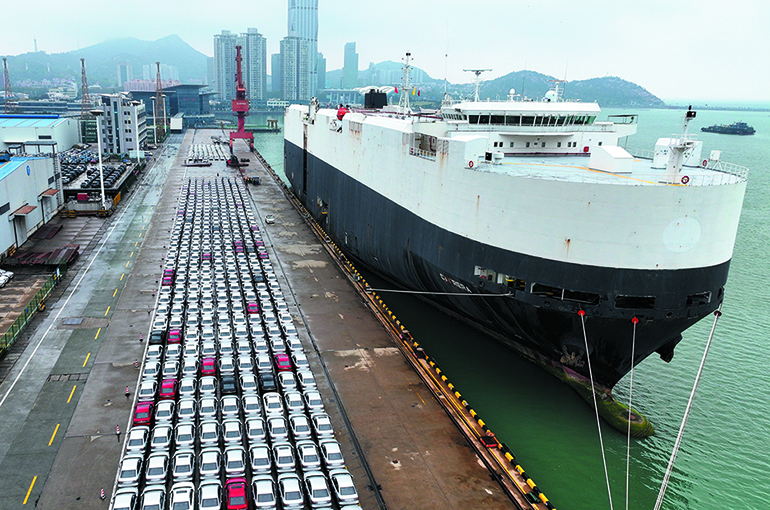
 China Secures EU's Biggest Hybrid Car Import Quota
(Yicai) Nov. 26 -- China has received the largest quota among all import sources subject to the provisional quantitative restrictions on imports of hybrid vehicles that the European Union will impose for 200 days starting Dec. 1.
China was allocated a quota of about 192,000 vehicles for the 200 days, equivalent to an annual quota of 350,000 units, followed by Japan with about 171,000 units, Türkiye with 126,000 units, and the United Kingdom with 105,000 units. South Korea, Mexico, Morocco, Serbia, and the United States are also subject to country-specific quotas, while Norway, Iceland, Liechtenstein, Ukraine, Kenya, and certain eligible developing countries were exempt.
The provisional safeguard measures will remain in place until June 18 and cover conventional hybrid, mild hybrid, and plug-in hybrid electric vehicles, according to an implementing regulation issued by the European Commission. The quotas will be administered quarterly, with unused allocations carried over to the following three months. Further imports will not be permitted once the applicable quotas are exhausted.
The reference period for calculating the quotas was a key issue in more than 30 rounds of consultations between China and the EU.
Under the standard approach set out in the World Trade Organization's Agreement on Safeguards, China might have received an annual quota of only about 70,000 vehicles if average imports between 2022 and 2024 had been used as the reference, Shi Xiaoli, director of the WTO Research Center at China University of Political Science and Law, told Yicai. Even if last year had been included, the three-year average would have been only about 150,000 units, Shi noted.
The EU imported 302,000 hybrid vehicles from China last year, up from 107,000 units in 2024 and 46,000 units in 2023, according to Eurostat. The country became its largest source of hybrid car imports after overtaking Japan.
China and the EU eventually agreed to use last year's actual imports as the baseline, resulting in an annual quota about 16 percent higher than actual imports.
China and the EU agreed on three fundamental principles: respect for facts, non-discrimination, and compliance with rules, with the country's quota no lower than that of any other source of EU imports, the Ministry of Commerce said on Oct. 12.
Hybrid vehicles accounted for 46 percent of new car registrations in the EU in the latest reporting period, up from 33 percent in 2023. However, the average profit margin for EU manufacturers of hybrid autos fell 57 percent from 2023 levels, according to European Commission data.
Under the new regulation, hybrid cars originating in China must be accompanied by an export quota certificate issued by the China Chamber of Commerce for Import and Export of Machinery and Electronic Products to qualify for the quota.
Chinese carmakers are primarily concerned with quota allocation and export procedures at this stage, Chen Huiqing, director of the chamber's legal services department, said to Yicai. Over the longer term, they will optimize their export model portfolios by accounting for profitability, market demand, and brand development, Chen added.
Editor: Martin Kadiev