 China Targets Launch of World's First Equatorial Deep-Sea Neutrino Telescope in 2027
(Yicai) Oct. 8 -- China aims to bring the world’s first deep-sea neutrino telescope near the equator into operation next year, following successful prototype testing in the South China Sea, as part of a broader international effort to use neutrinos to investigate some of the least understood phenomena in the universe.
TRIDENT, short for Tropical Deep-sea Neutrino Telescope, will be deployed near the equator in 2027, Xu Donglian, the project’s initiator and chief scientist, told Yicai in a recent interview. “We’ve completed comprehensive validation of the entire engineering and technological chain, the project's most critical technical milestone,” he said.
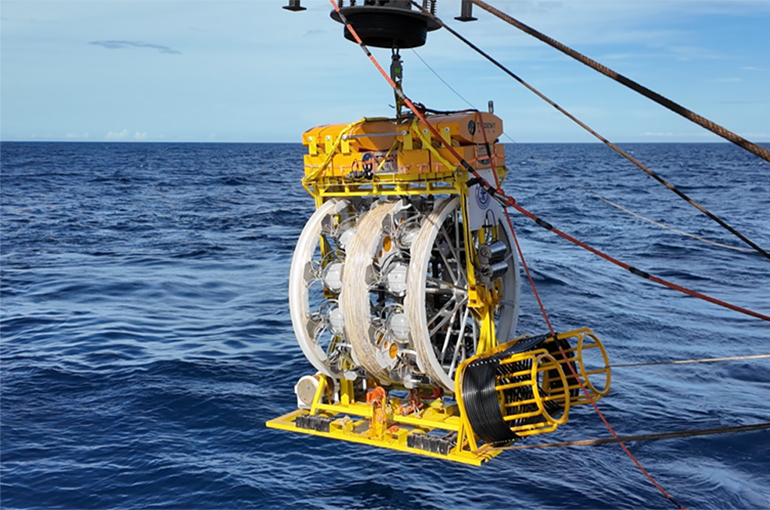
During China's recent National Day holiday, the TRIDENT team completed a full battery of tests on the prototype detector string and successfully installed the unit in the deep sea, formally connecting it to the South China Sea observation network. The system is operating normally, the team reported.
Xu spent about a decade working on the IceCube Neutrino Observatory, an international project led by theoretical physicist Francis Halzen, who was awarded the Nobel Prize in Physics earlier this week. Located in Antarctica, IceCube was built to detect high-energy neutrinos arriving from cosmic sources beyond our solar system.
Neutrinos are elementary particles and fundamental constituents of the universe. Because they interact so weakly with matter, they cannot ordinarily be detected directly. Scientists infer their properties by studying secondary particles generated when neutrinos interact with matter. Less than two years after IceCube's completion, the observatory detected extremely high-energy neutrinos originating beyond the Milky Way, helping establish neutrino astronomy as a new field of scientific research.
Xu began spearheading the development of TRIDENT, a next-generation high-energy neutrino telescope, in 2018. In 2021, the project team selected a site 3,500 meters beneath the sea in the Xisha waters of the South China Sea. The telescope, now under construction, is designed to achieve detection sensitivity more than 1,000 times greater than IceCube's.
“Seawater causes far less scattering than Antarctic glacial ice, which allows for a qualitative leap in the telescope's angular resolution,” Xu pointed out.
TRIDENT's first phase is intended as a pilot to demonstrate feasibility. It will deploy 10 detector strings, representing about one-tenth of IceCube's scale, and its main objective will be to validate the entire engineering and technological chain required to build and operate a deep-sea neutrino telescope in Chinese waters.
TRIDENT incorporates numerous technological innovations and design improvements over IceCube. The project is expected eventually to work in coordination with IceCube in Antarctica as part of a global neutrino-observation network, according to Xu.
“IceCube also will be upgraded in Antarctica to a second-generation facility,” Xu said. “We hope to establish a global neutrino-observation network that combines competition with complementarity.”
Editor: Tom Litting