



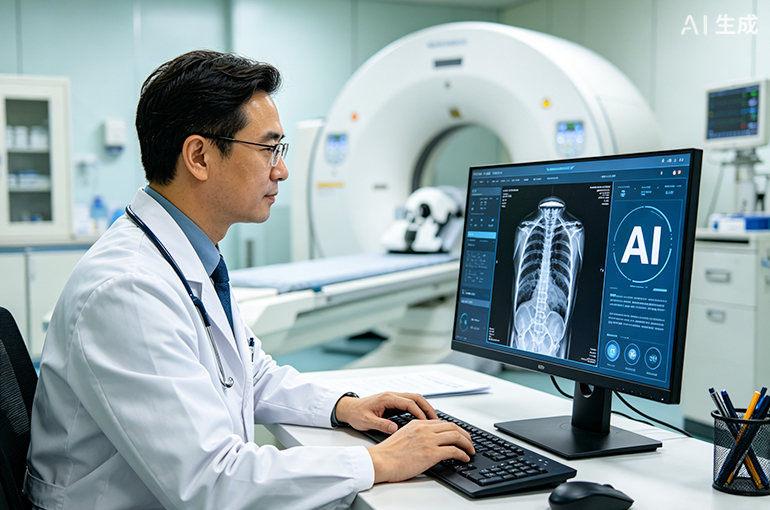
 China to Host Global AI Medical Imaging Contest
(Yicai) April 10 -- The National Healthcare Security Administration and the government of Guangxi Zhuang Autonomous Region have co-organized China's first global competition calling for innovative artificial intelligence solutions in medical imaging.
"The National Medical Imaging AI Recognition Competition" will be held in Guangxi from August to October, Chinese regulators announced on April 8. Promotion events will be held in Shanghai, Shenzhen, Chengdu, and select members of the Association of Southeast Asian Nations, inviting teams from both China and abroad to participate.
The contest will feature eight tracks, focusing on lung cancer, breast cancer, intracranial aneurysms, and other high-incidence diseases, as well as cutting-edge areas like multi-disease detection in chest X-rays and ultrasound lesion recognition.
Guangxi will support the competition by developing a standardized medical imaging dataset with 30 million cases and setting up an industry guidance fund worth CNY10 billion (USD1.5 billion). Outstanding achievements will receive financial support and enjoy expedited approval through green channels.
The medical insurance imaging cloud, which connects the data of 1.4 billion people, has been integrated with physician workstations across various medical institutions, said Lu Xiaoliang, vice president of Chinese AI tech developer iFlytek. AI companies can connect to the platform to serve many hospitals, significantly reducing delivery and deployment costs, Lu pointed out.
The core value of China's medical insurance imaging cloud lies in enabling secure sharing and unified quality control of imaging data, laying the foundation for AI model training and clinical application, said Teng Gaojun, president of Zhongda Hospital affiliated to Southeast University. AI serves as an auxiliary tool for preliminary screening by physicians, helping to quickly identify lesions from the heavy workload of reading images, with the final diagnosis remaining in the hands of doctors, he noted.
Commercialization-focused companies are most concerned about whether AI can be included as a reimbursable item under medical insurance, said Zheng Chao, chief technology officer of leading AI medical imaging solutions provider Shukun Technology. The industry is looking forward to a genuine shift from "fee-for-service" to "value-based payment," Zheng stressed.
China's medical insurance data covers 1.33 billion insured individuals, while the NHSA has gathered 366 million medical imaging index records, noted Cao Wenbo, deputy director of the administration's big data center. A pilot program for the "Personal Healthcare Cloud" was also launched earlier this year, integrating the health data of insured individuals scattered across medical institutions, pharmacies, health examination centers, wearable devices, and other channels, Cao added.
Editor: Martin Kadiev





