



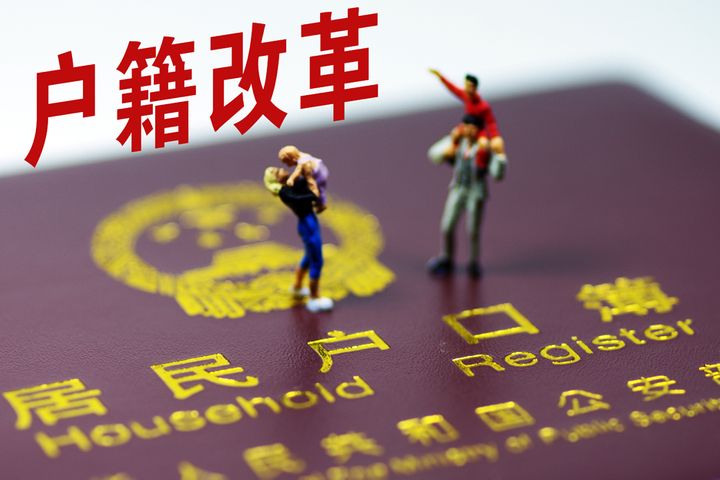
 China Lifts 3,000-Year-Old Curbs on Freedom of Movement
(Yicai Global) Dec. 26 -- China will ease restrictions on household registration by lifting these limits in cities with a permanent resident population of up to 3 million and relaxing them in those with more to promote sustainable and healthy development via rational and orderly movement of people, China's cabinet the State Council said in a circular it issued yesterday.
The new policy thus chips away at a system in place in one form or another since the Zhou dynasty (1046-256 BCE), public information shows.
The country will greatly slacken the hitherto taut rules on domicile in cities with a permanent resident population of between 3 million and 5 million, hone points-based registration policies in cities with over 5 million permanent residents, and simplify the list of items needed to gain each point to ensure years of social insurance payments and local residence become the deciding factors, per the document, which laid down no timetable for its implementation, but is of a type that typically affords regional authorities wide latitude to adapt its dictates to local conditions.
China's exacting household registration system mandates that residents' place of domicile is mainly that of their parents, and this has hampered free movement, as migrant families are not entitled to free education for their children or other civic benefits outside of their hometowns. The country has been loosening these restraints in recent years and applicants will now be able to receive approval to transfer their official residence to their destination cities when they rack up the required number of brownie points.
The country has 27 cities with a permanent resident population of over 3 million, of which nine have between 5 million and 10 million and four over 10 million people, per government statistics. The country will thus lift all limits in cities other than these 27, including provincial capitals.
Easing or axing restrictions in second-tier cities will elevate the overall carrying capacity of regional conurbations and city clusters and enhance their ability to optimize resource allocation and further bring hub cities' pivotal function in regional economic development into full swing, an industry insider told Yicai Global.
Second-tier cities will embark on a gilded age of economic development, even as behemoths like Beijing and Shanghai are beset by blight and other urban ills and have high living costs, while small and medium cities appear drab by comparison, Zhang Baotong, president of the Shaanxi Province Economic and Cultural Research Institute, told Yicai Global.
Developing hub cities will also help concentrate resources and drive development of surrounding regions, Hu Shuigen, director of Zhejiang University's Center for Public Service and Performance Evaluation Studies, told Yicai Global.
Editors: Tang Shihua, Ben Armour





