



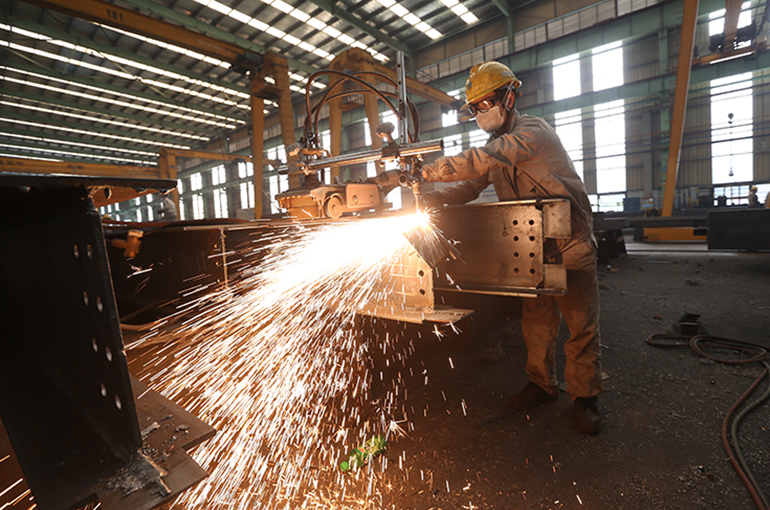
 China to End Curbs on Foreign Investment in Manufacturing, President Xi Says
(Yicai) Oct. 19 -- China will lift all market access restrictions on overseas investment in the country’s manufacturing sector, Chinese President Xi Jinping said during his keynote speech at the opening ceremony of the third Belt and Road Forum for International Cooperation.
“We will comprehensively remove restrictions on foreign investment access in the manufacturing sector,” Xi said yesterday.
The move heralds the further opening-up of China’s manufacturing industry to the rest of the world after the country cancelled all restrictions in its pilot free trade zones at the start of 2022.
“China’s manufacturing sector has moved up to the medium-to-high-end of the global production, supply, and value chains from the medium-to-low-end,” Wei Jianguo, vice chairman of the China Center for International Economic Exchanges, told Yicai.
“Lifting all restrictions on foreign investment in manufacturing is good news for the entire planet, especially for the sector itself,” said Wei, who is also a former commerce vice minister. The move also signals the start of China’s next round of high-level opening-up, he noted.
“China will not take the same path as Western countries by shifting the focus of their economies to the service sector and neglecting manufacturing,” but will continue to make efforts to upgrade production while developing the service sector, Wei added.
China must play an active role in economic globalization in order to use all available resources to leapfrog from being a manufacturing giant to a manufacturing power, Bai Ming, a researcher at the commerce ministry, told Yicai.
Ending all market access restrictions on foreign investment in manufacturing is a symbolic action that shows China’s resolution to further open-up, noted Huang Feng, chairman of the Shanghai Foreign Investment Association.
Faced with the challenge of attracting investment from overseas because of the sluggish global economic recovery, China needs to come up with more targeted and valuable policies to stabilize market confidence, Huang added.
China’s massive market is still attractive to foreign investors, Wei said. It has a huge thirst for advanced technologies such as medical devices, high-precision technologies, and fifth-generation mobile network applications, and should stick to its own unified national market against the backdrop of the US reshoring of production because market resources are China’s greatest advantage, Wei pointed out.
“The heads of European and American multinationals are smart and consider carefully whether to build plants in the United States and then export products to China or directly build plants in China,” Wei said. “That’s why Elon Musk, Tim Cook, and many other Western tycoons visited China recently, because only large markets can attract big projects.”
The era of attracting foreign investment by just relying on preferential policies and low-cost labor is over, Wei noted. China must seek dividends from rules, regulations, management, and standards and implement institutional opening-up to attract more foreign investment, he said.
Editors: Tang Shihua, Futura Costaglione





