



 China's Aerospace Industry Faces Rocket-Related Bottlenecks
(Yicai) Jan. 26 -- China's aerospace industry ecosystem is developing unevenly, with rocket launches becoming a bottleneck, slowing down the satellite application and ground terminal segments.
The three main issues are the low supply of available rockets, insufficient single-rocket capacity, and high operating costs against the backdrop of high-density satellite launch demand.
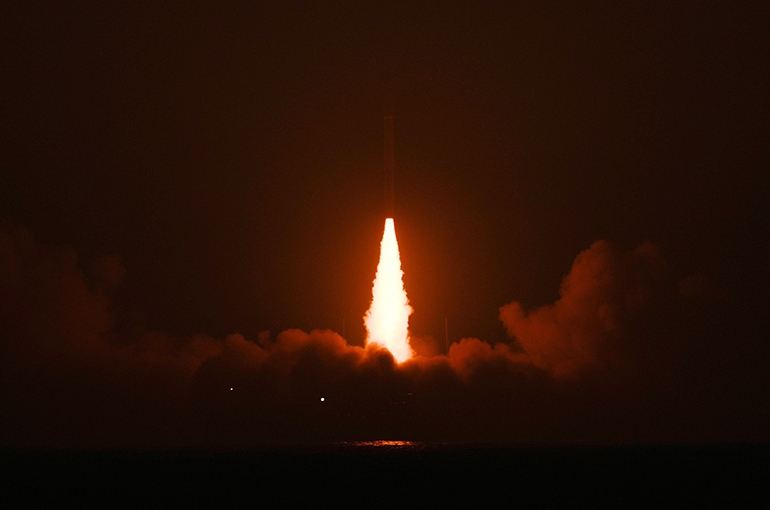
On Jan. 17, two Chinese rocket launches resulted in failure. A Long March 3B carrier rocket experienced flight anomalies while launching the Shijian-32 satellite at the Xichang Satellite Launch Center, and a Ceres-2 rocket of Galactic Energy Space Technology failed its maiden test flight at the Jiuquan Satellite Launch Center.
China recently submitted an application to the International Telecommunication Union to launch an additional 203,000 satellites for 14 satellite constellations. According to ITU rules, the first satellite of a constellation must be launched within seven years of the project approval, and the last one within 14 years.
This poses a severe test for rocket launch capacity, with private Chinese rocket companies expected to become an effective supplement to the national team.
China's commercial aerospace sector completed 50 launches last year, accounting for 54 percent of the country's total, with commercial carrier rockets making 25 launches, according to recent data from the China National Space Administration.
Moreover, reusable technology that could reduce rocket launch costs has encountered consecutive setbacks. For example, while LandSpace Technology's Zhuque-3 reusable carrier rocket successfully completed its maiden flight on Dec. 3, its first-stage rocket recovery failed.
Commercial aerospace development is influenced by the technical maturity and launch success rate, particularly the verification and scaled application of recoverable rocket technology, which is core to reducing costs and achieving high-frequency launches, the pace of satellite network implementation driven by national-level satellite constellation bidding, especially for the GW and G60 constellations, and policy support and safety regulations, Qiu Shiliang, co-director of Zheshang Research Institute, told Yicai.
SpaceX's rocket recovery development began in 2015, while its first launch was in 2006, said Pan Helin, member of the expert committee on information and communication economy at China’s Ministry of Industry and Information Technology. Even though the company benefited from the US aerospace foundation, it still took 10 years, he added.
China's aerospace technology foundation is quite solid, and if efforts are concentrated on overcoming rocket recovery technology, it should be achievable within three to five years, Pan predicted.
Editor: Futura Costaglione





