



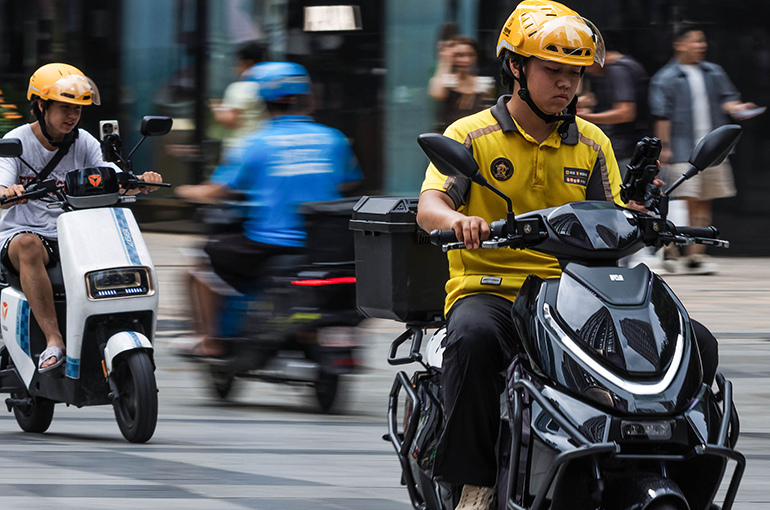
 China’s Blue-Collar Wage Growth Beats White-Collar Pay for Sixth Year as Flexible Workforce Tops 300 Mln
(Yicai) June 5 -- China's labor market is undergoing some significant structural changes as the income of blue-collar workers such as food delivery riders and maternity caregivers has increased faster than that of white-collar workers for six consecutive years, steadily narrowing the wage gap between the two groups, according to a new industry report.
The flexible workforce has emerged as a key pillar of the labor market, with the number of people in flexible employment surpassing 300 million, according to the 2025 China Blue-Collar Employment Research Report, which was compiled by the China New Employment Forms Research Center, a think tank established by Capital University of Economics and Business and the China Association for Employment Promotion.
China’s blue-collar workforce reached approximately 427 million people last year, representing modest growth of about 0.5 percent from 2024, according to the report, which is based on 28,450 valid responses and gives a comprehensive analysis of developments in China’s blue-collar labor market between 2024 and 2025.
The average monthly income gap between blue-collar and white-collar workers narrowed 32.7 percent in 2025 to CNY2,250 (USD332) from a peak of CNY3,344 (USD493) in 2013, said the report. If this trend continues, the gap is expected to shrink further to around CNY2,020 by 2027.
Data from 2023 to 2025 show a significant divergence in wage growth among blue-collar occupations. The highest-paying jobs include maternity caregivers who earn CNY10,128 a month (USD1,495 a month), food delivery riders at CNY8,325 per month and truck drivers at CNY8,279 per month, all of whom earn more than CNY8,000 per month on average. Food delivery riders recorded a compound annual income growth rate of more than 10 percent over the three-year period, with hourly earnings reaching CNY37.30 (USD5.50).
Stability Challenges
Flexible workers account for a substantial share of the blue-collar workforce. However, this large group still faces challenges in employment stability and social security coverage. China had 280 million flexible workers last year and the figure is expected to reach 320 million this year, representing more than 40 percent of urban employment, according to the report.
The flexible workforce currently displays a structural pattern of "basic security, but limited development opportunities," the report said. Participation in basic medical insurance has reached 91.5 percent, while occupational injury protection covers 86.2 percent of workers, indicating that essential social protection mechanisms are largely in place. However, confidence in long-term value such as retirement planning remains low at 42.3 percent and only 54.8 percent believe they have meaningful opportunities for career advancement.
These findings highlight a deeper challenge within the current social security system. While flexible workers have gained a certain level of security, many still lack a sense of control over their long-term future.
Editor: Kim Taylor





