 From Single Cards to Full Systems: WAIC 2026 Witnesses the Systemic Evolution of China's Computing Power
(Yicai) July 19 – "We have always believed that the true breakout of the AI era will come not from one or two chips, but from a more open, better coordinated, and more efficient full-stack computing power system," Gao Hui, Vice President of T-Head Semiconductor, said at the 2026 World Artificial Intelligence Conference (WAIC) yesterday.
On the same day, T-Head open-sourced its self-developed AI software stack, T-Head SAIL. As the base-layer software for the company's Zhenwu AI chips, it is specifically designed to unleash the chips' full computing potential.
At this year's WAIC, Yicai observed that amid the rapid advancement of homegrown semiconductors, computing power vendors have moved beyond merely showcasing individual chips. With an increasing number of supernodes and clusters on display, alongside base-layer AI chip software going open source, China's domestic computing sector is undergoing a system-level upgrade.
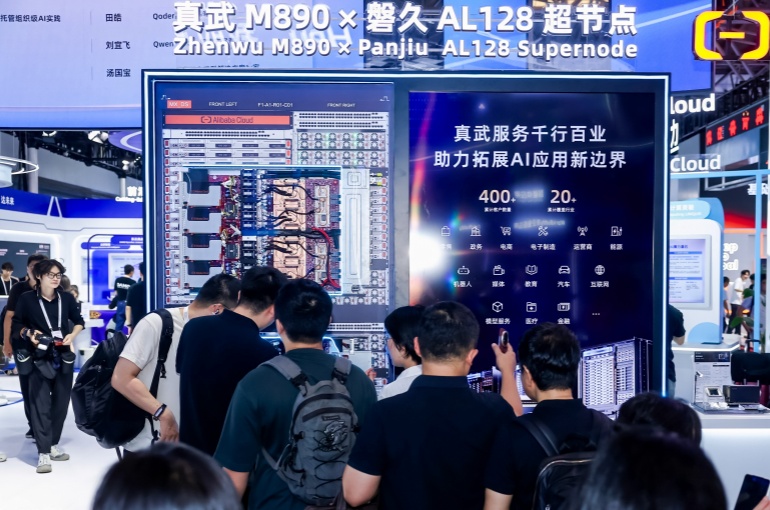
Notably, this year's conference served as the central stage for the collective debut of several heavyweight supernode products. T-Head showcased its Zhenwu M890 × Panjiu AL128 supernode, which integrates 128 chips into a single cabinet. Meanwhile, Alibaba Cloud unveiled its Lingjun Zhenwu M890 supernode instance — marking the first time the cloud giant has offered AI computing services in a supernode format via the public cloud. Huawei, for its part, exhibited the Atlas 950 SuperPoD supernode, displaying 1,024 Ascend cards on site.
In addition, MetaX launched its next-generation AI supernode, the Xijing S600, at the conference, while ZTE Corporation released its new ZTE OEX supernode. Behind these high-profile launches, the core hardware foundation of China's computing power vendors is evolving at a markedly faster pace as the industry aggressively gears up for the era of large-scale AI models.
Competition in China's computing power sector is shifting wholesale from single-point peak performance to system-level, full-stack efficiency, with cluster engineering capabilities and software ecosystems emerging as the core competitive moats, Guosheng Securities noted in a recent research report.