



 China’s Consumer Prices Hit 20-Month High in November on Rising Food Costs
(Yicai) Dec. 10 -- Consumer prices in China rose by the most in 20 months in November, driven higher largely by an increase in food costs.
The consumer price index edged up 0.7 percent last month from a year earlier to the highest level since March 2024, according to figures released today by the National Bureau of Statistics. That compared with a 0.2 percent increase in October.
The uptick in the key inflation measure was largely due to rising food prices, said Dong Lijuan, a senior statistician at the NBS.
Food prices posted their first increase in 10 months in November, gaining 0.2 percent after dropping 2.9 percent in October and thereby flipping their contribution to the CPI from a 0.54 percentage point drag to a modest 0.04 point uplift.
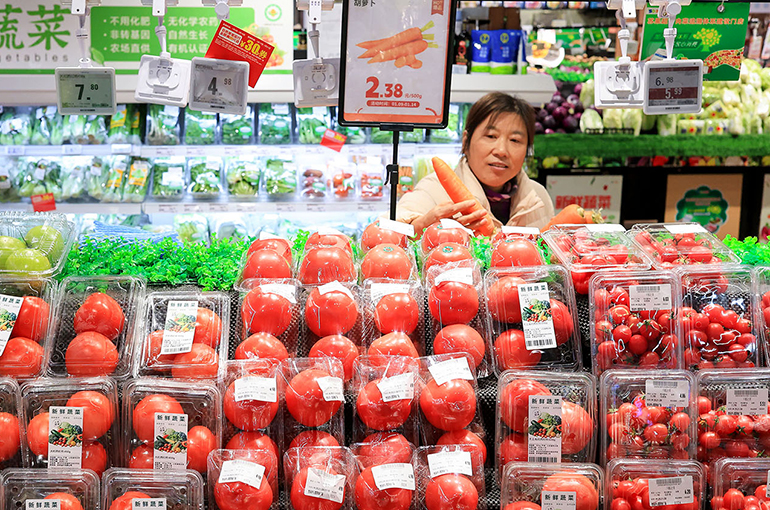
The cost of fresh vegetables jumped 14.5 percent after slumping 7.3 percent in the prior month, snapping a nine-month decline and contributing 0.49 point to the year-on-year increase in consumer inflation versus October.
Fresh fruit prices flipped to a 0.7 percent increase from a 2 percent decrease. Pork and poultry prices were still down, but the pullbacks narrowed to 15 percent and 0.6 percent respectively.
The core CPI, which excludes food and energy prices, climbed 1.2 percent, staying above 1 percent for the third consecutive month.
Good weather in the same period of last year underpinned vegetable growth, keeping the comparative base low, said Zhang Yu, chief macro analyst at Huachuang Securities. But since mid-October this year, cooler temperatures and heavy seasonal rains have caused frost and flood damage, tightening the supply of some vegetables, Zhang noted.
Thanks to that low base effect, consumption‑boosting government policies, and efforts to curb involution (profit-sapping hyper competition), the CPI is likely to rise each month, averaging 0.7 percent over this quarter, according to Wu Chaoming, chief economist at Hunan Chasing Financial Holdings.
The producer price index, a measure of industrial profits, slid for the 38th month in a row in November, the NBS data also showed. The PPI declined 2.2 percent from a year earlier, up from a 2.1 percent drop in October, mainly due to last year’s higher base of comparison.
While the base effect, anti‑involution measures, and new fiscal support are stoking inflation expectations for the fourth quarter, weak external demand, tariff strains, and ongoing domestic challenges in steadying the property sector and employment mean any CPI and PPI gains are likely to remain modest, Wu said.
Stronger demand‑side policies would be needed to drive prices higher, Wu pointed out.
Editor: Kim Taylor





