



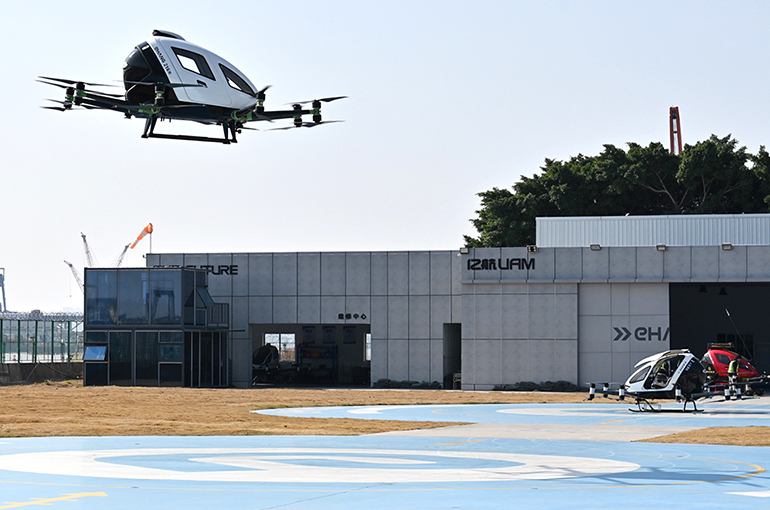
 China’s Guangzhou Sets Out 10-Year Plan to Develop Low-Altitude Economy, Aerospace Sector
(Yicai) Jan. 12 -- Guangzhou, the capital of China’s southern Guangdong province, has released a 10-year plan to develop its low-altitude economy and commercial aerospace sector.
The city will build a globally influential “Sky City” and a new center for China's commercial aerospace sector by 2035, local authorities announced on Jan. 8. A number of companies in fields such as intelligent aircraft are expected to emerge, further expanding the scale of the local industry, they said.
Guangzhou plans to become a global manufacturing and design center for the low-altitude economy, Ma Yanxin, director of the Rule of Law Research Center for Digital Government and Digital Economy at South China Normal University School of Law, told Yicai.
The plan calls for deploying low-altitude intelligent aircraft in key areas such as land management, hydrology, environmental protection, emergency response, power, and maritime operations. The local government also aims to launch a “drone + smart logistics” initiative, piloting urban drone delivery and intercity drone transport within Guangzhou.
The city has built a full industrial chain for the low-altitude economy, according to Jia Pengcheng, founder and chairman of Guangzhou Starway Communication Technology, which develops key radio frequency technologies for low-orbit satellite communication.
The chain spans research, development, design, equipment manufacturing, communication and navigation, and operational services, Jia said, adding that Guangzhou has gathered hundreds of related companies, enabling shared public testing platforms to reduce redundant investment and rapidly respond to upstream and downstream needs.
In the field of commercial aerospace, the plan emphasizes bolstering Guangzhou's edge in ground-based communication and navigation equipment, as well as seizing opportunities in the development of satellite internet services, and expanding production of communication devices.
The city also plans to support the R&D of chips and devices for China’s Beidou satellite navigation system, aiming to enhance its integration with fifth-generation networks, satellite internet, the Internet of Things, Big Data, and artificial intelligence technologies.
“Compared to the low-altitude economy, Guangzhou faces more intense competition in the commercial aerospace sector,” Ma told reporters. He pointed out challenges such as coordinating development in complex airspace around multiple world-class airports, and the absence of dedicated launch infrastructure.
Guangzhou needs to push several initiatives to achieve its industrial development goals, Pan Helin, a member of the Expert Committee for Information and Communication Economy under the Ministry of Industry and Information Technology, told Yicai. Since commercial space involves global collaboration, Pan said the city must strengthen regional and international partnerships.
Additionally, the city should provide policy support to attract commercial aerospace firms, and offer targeted assistance for scientific research in key areas, Pan said. This includes building a solid technological foundation, with a particular focus on rocket recovery technology.
Editor: Tom Litting





