


 China’s Hesai Joins Lidar Rival RoboSense in Spatial Intelligence Market
(Yicai) Oct. 15 -- The spatial intelligence market has emerged as a new draw for leading Chinese light detection and ranging sensor manufacturers, with Hesai Group launching a new three-dimensional world data engine to follow in the footsteps of rival RoboSense Technology in a push into the embodied intelligence market worth trillions of Chinese yuan (hundreds of millions of US dollars).
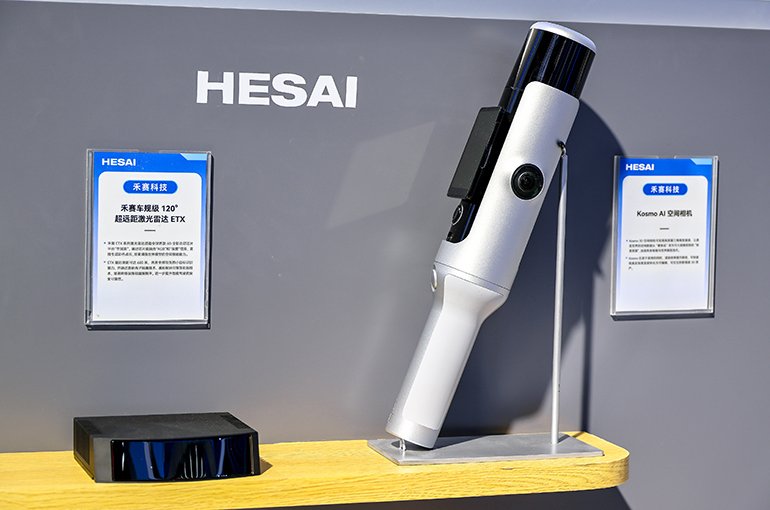
Hesai released the Kosmo, which aims to give access to high-quality real-world data at scale, at a launch event yesterday. The data engine combines the Kosmo One, an 8K ultra-high-definition artificial intelligence spatial camera integrated with lidar, with the AI-powered cloud platform Kosmo World.
Dylan Sisson, creative lead for Pixar Animation Studios' rendering software RenderMan, had already tried out Kosmo before the event. In less than 20 minutes, he scanned the plaza at the California-based firm's headquarters, imported the data directly into Houdini in universal scene description format, and rendered it with RenderMan, recreating the entire plaza in a digital world without rebuilding a traditional polygon-based scene.
The spatial intelligence sector, including spatial cameras, may eventually exceed the lidar market itself, Li Yifan, co-founder and chief executive officer of Hesai, said in an interview with media, including Yicai.
The underlying logic is that robotics depends heavily on infrastructure and supply chain support. From data collection to actuation, the entire chain relies on high-precision spatial perception, so lidar makers' capabilities in opto-mechanical system design, custom chip development, and mass-production manufacturing can be directly leveraged in spatial perception.
Achieving high quality, large scale, and low cost simultaneously for embodied intelligence data is difficult, noted Xiang Shaoqing, chief technology officer of Hesai. 2D images lack depth information and real spatial relationships; purely simulated data cannot faithfully reproduce material properties, friction, or deformation physics; and data collected through teleoperation on real machines is realistic enough but costly, inefficient, and hard to scale, he pointed out.
Kosmo's approach is to use spatial cameras to digitize the real world and then generate 3D data through an AI cloud platform, addressing the pain points of robot training: "fake visuals," "fake interactions," and "inaccurate spatial perception."
At the launch event, Hesai also announced strategic partnerships with embodied intelligence companies Galbot and Dexmal on the Kosmo project.
Shenzhen-based RoboSense launched its first Active Camera product, the AC1, in March last year, followed by the AC2 seven months later. Its product portfolio has expanded from lidar to three core robot component categories: "eyes," "skin," and "muscles," according to its financial report for the first half of this year. The "eyes" segment includes lidar and the newly added spatial camera.
During RoboSense's first-half earnings conference call, CEO Qiu Chunchao said that the company had already secured large-scale orders for space cameras and planned to begin deliveries by Sept. 30, with full-scale mass production targeted for next year. "We are confident that it will become one of the core growth engines for our performance in 2027."
Editor: Martin Kadiev