



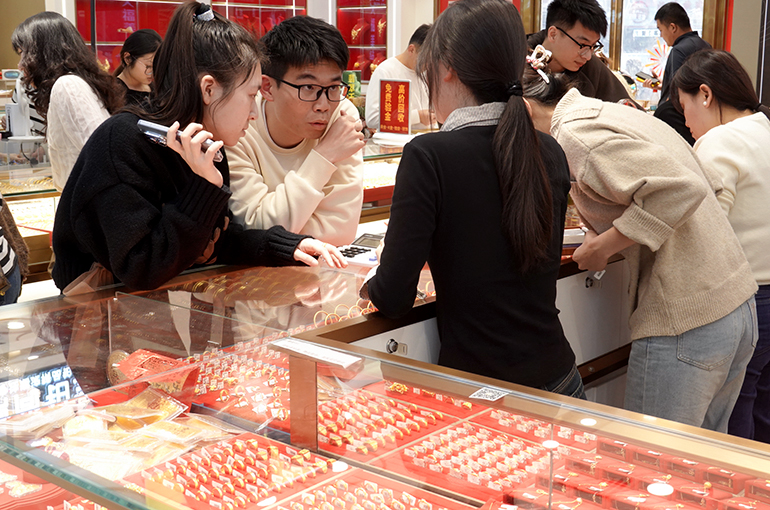
 China's Jewelry Market Rebounds as Young Consumers Start Investing in Luxury Assets, Bain Says
(Yicai) Feb. 2 -- The jewelry market in China showed signs of a rebound last year, primarily due to the next generation of consumers increasing investments in luxury assets against the backdrop of surging international gold prices, according to a new report by US consultancy firm Bain & Company.
Luxury items in China are shifting from being a target of "emotional consumption" to one of "rational asset allocation, Bain said in its latest annual report on the market. Young Chinese consumers focus on the investment value and cost-effectiveness of such goods when buying, the report showed.
The latest trends drove the recovery of China's jewelry market and the rapid growth of the second-hand luxury goods market last year.
Although the very important client segment remains the core driver of the luxury goods market, younger potential consumers are cautiously entering the market, Bruno Lannes, a senior global partner at Bain, told Yicai.
Last year was one of readjustment for the Chinese luxury goods market, Lannes said. Consumers sought balance amid caution, being more inclined to choose high cost-performance products that achieve a good balance among quality, uniqueness, and practicality, he pointed out.
"Consumers are becoming more rational when buying luxury goods, shifting towards viewing them as investment assets," the report said.
Whether being wealthy or middle-income individuals, an increasing number of people are starting to view luxury goods as part of their overall personal asset allocation, Yang Yue, a global partner at Bain, said to Yicai, noting that more people regularly review their investment portfolios.
Chinese consumers "regularly buy and sell some luxury assets as part of optimizing their investment portfolios," Yang noted. "From the demand side, many of them, especially young and price-sensitive ones, are increasingly open to accepting pre-owned luxury goods, reflecting a cognitive upgrade among domestic consumers."
The Chinese second-hand luxury goods market grew 15 percent to 20 percent last year from the previous year, driven by the increase in product supply, higher consumer acceptance, especially among younger and price-sensitive ones, and the widespread adoption of livestreaming platforms, according to Bain's data.
As international gold prices continue to reach new highs, several young consumers told Yicai that jewelry, particularly diamonds, is more representative of "emotional value," but it is better to buy gold as part of an asset allocation. "Many top luxury jewelry brands have excessive premiums, so it's more practical to buy gold," one person said.
According to Bain's report, around 35 percent of luxury goods transactions by Chinese consumers were completed outside the Chinese mainland last year, a significant drop in the proportion of such overseas buys compared to previous years.
In addition, China's visa-free policies for multiple countries and flexible tax refund systems have attracted some foreign consumers to buy luxury goods in the mainland.
However, from the total luxury consumption in the Chinese market, the proportion of luxury goods bought by foreigners in the mainland remains relatively small, Lannes stressed.
China will continue to be the cornerstone of global luxury growth, noted Priscilla Dell'Orto, a global partner at Bain. A strong market recovery trend has been observed since the second half of last year, she pointed out, adding that despite the volatility and uncertainty the industry may face in the future, more positive signals are likely to come this year.
Editors: Tang Shihua, Martin Kadiev





