



 China’s Jiangsu Province to Cover 30% of Universities' Home-to-Dorm Conversion Costs
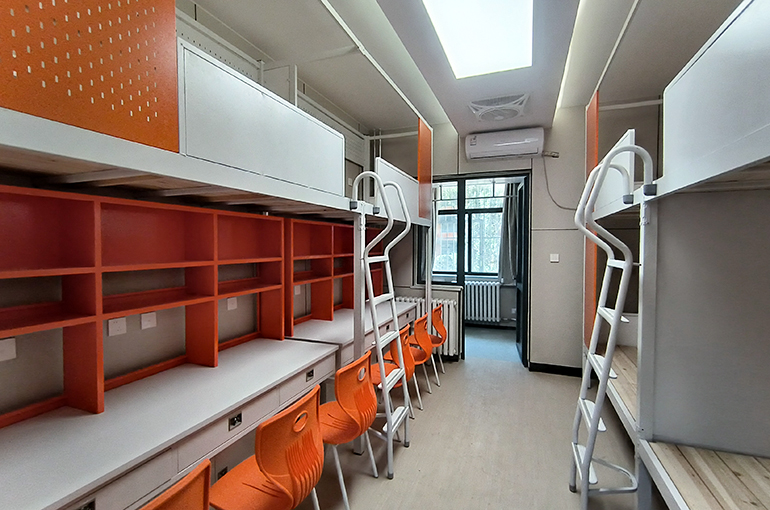
(Yicai) Sept. 8 -- Eastern Jiangsu province has rolled out China’s first policy supporting universities in buying off-campus homes to convert into student accommodation, offering to pay 30 percent of the final price, a measure also aimed at reducing inventory in the local real estate market.
The three-year action plan supports universities acquiring houses for use as student dormitories in lower-priced cities including Xuzhou, Huai’an, and Lianyungang, according to a policy jointly released by Jiangsu’s finance and education departments and the local development and reform commission on Sept. 5.
Jiangsu will also offer CNY2,000 (USD274) per bed a year to universities leasing off-campus premises for student accommodation, not only cutting rental costs but also enabling full use of existing housing resources. In addition, the policy set subsidy standards for on‑campus renovation, expansion and new construction of student dorms, as well as repurposing other on‑campus properties into student accommodation.
“Jiangsu is the first Chinese province to introduce subsidy standards for various approaches addressing the shortage of university student accommodations,” Zhang Bo, president of 58 Anjuke Research Institute, told Yicai. Clear standards provide concrete guidance for colleges developing student housing solutions, Zhang noted.
The new policy explicitly supports buying and leasing houses for use as student dorms, opening a new channel to revitalize idle commercial stock, said Cheng Wei, research supervisor at China Index Academy. The move will likely strengthen the link between expanding student accommodation capacity and improved local real estate market activity, Cheng added.
The initiative also creates a new rental scenario, Cheng pointed out, adding that the rental market has paid limited attention to student dorms in the past. Jiangsu’s new policy may encourage long‑term apartment operators and property holders to explore new offerings or business models, including “student‑oriented leasing” or university‑enterprise cooperative dorms, Cheng stressed.
Jiangsu’s new policy reflects local authorities’ intent to improve the educational infrastructure while stabilizing the real estate market, said Cao Jingjing, general manager of China Index Academy’s index research department. It benefits developers in cities saddled with substantial commercial inventory pressure, especially those holding projects with low occupancy rates near university campuses, Cao pointed out.
Editors: Tang Shihua, Martin Kadiev





