 Medical Tourism to China Grows as Hospitals Offer Robotic Surgery, Specialist Expertise
(Yicai) Jan. 27 -- Social media has been buzzing with stories of foreign patients traveling to China for healthcare. The country’s appeal now extends beyond lower costs to services that are now as good as those in developed nations, according to medical experts.
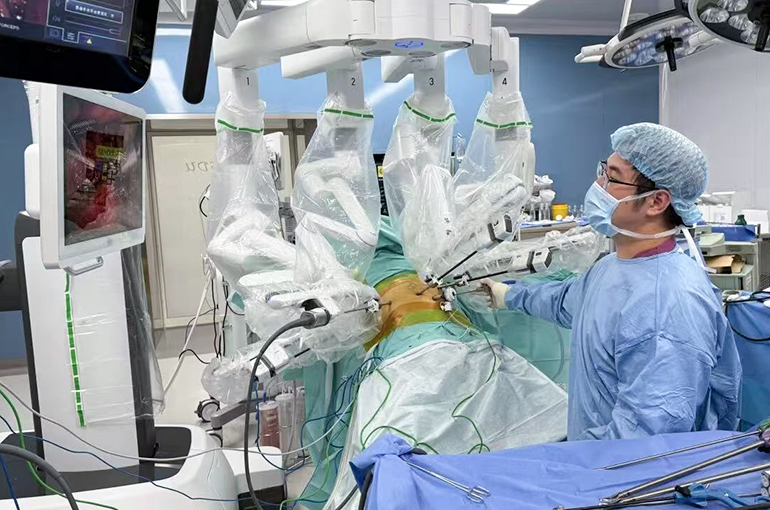
Kevin, a Chinese doctor who has worked in Vancouver, Canada for 20 years, and his wife recently brought their daughter, who had a pancreatic tumor, to Ruijin Hospital affiliated with Shanghai Jiao Tong University School of Medicine. The 10-year-old girl had robotic surgery costing CNY160,000 (USD22,995) and has now recovered and been discharged from hospital, her father told Yicai.
In Canada, Kevin had taken his daughter to top experts at several hospitals. Their consensus was that the tumor surgery would also involve removing the child’s spleen. But he later decided to come to China after learning that Ruijin Hospital in Shanghai can conduct robotic laparoscopy surgery, which is much less invasive and also offered the possibility of leaving the spleen in place.
The surgical team at Ruijin Hospital led by Dr. Jin Jiabin used robotic technology to precisely separate the patient’s pancreatic tumor from the blood vessels of the spleen, and then perform precise suturing on the damaged vessels. This successfully removed the tumor and also kept the patient’s spleen intact.
Kevin’s experience is not an isolated case. Nowadays, more and more overseas patients are learning about China’s medical advancements through the internet, and can seek remote consultations and appointments.
“In the long run, it will likely develop into a trend that overseas patients come to China for medical treatment,” Du Lei, an attending surgeon in the metabolic surgery department of the Tenth People’s Hospital of Tongji University, told Yicai.
“Our medical devices are developing rapidly and the prices are more favorable compared to those in foreign countries,” Du said. “Also, Chinese doctors perform surgery with greater precision than their foreign counterparts.”
Li Shengli, chief of the plastic and reconstructive surgery department at Shanghai Ninth People’s Hospital, Shanghai Jiao Tong University School of Medicine, told Yicai that many foreigners come to the hospital for medical treatment. “In the treatment of congenital hand deformities, hemangiomas, and lymphedema, China's technology in these specialized diseases is among the world's best,” he said by way of example.
Many top Chinese hospitals have established international medical departments specifically to serve overseas patients, Yicai learned. These patients do not use China’s public medical insurance and typically have strong willingness and ability to pay, experts noted.
This does not mean hospitals will reduce their focus on domestic patients, Zhao Chongke, a doctor in the ultrasound department at Zhongshan Hospital Affiliated to Fudan University, told Yicai. Also, there’s a limited number of people who can provide the services for foreigners, he added, as there are high requirements not only in terms of the treatment but also foreign language skills.
In the long run, there is huge market potential for foreigners seeking medical treatment in China, Pan Wenzhi, chief cardiology physician at Zhongshan Hospital, told Yicai. The country should establish corresponding systems and service guarantees to further enhance the attractiveness of Chinese healthcare, Pan noted.
Editors: Dou Shicong, Tom Litting