 China's NovaFusionX, Other Nuclear Fusion Firms to Speed Commercialization Amid AI Power Boom
(Yicai) July 30 -- China's NovaFusion Energy Technology and some of its peers are racing to compress the nuclear fusion commercialization window to target the massive electricity demand expected to be brought by the rapid advancement of artificial intelligence.
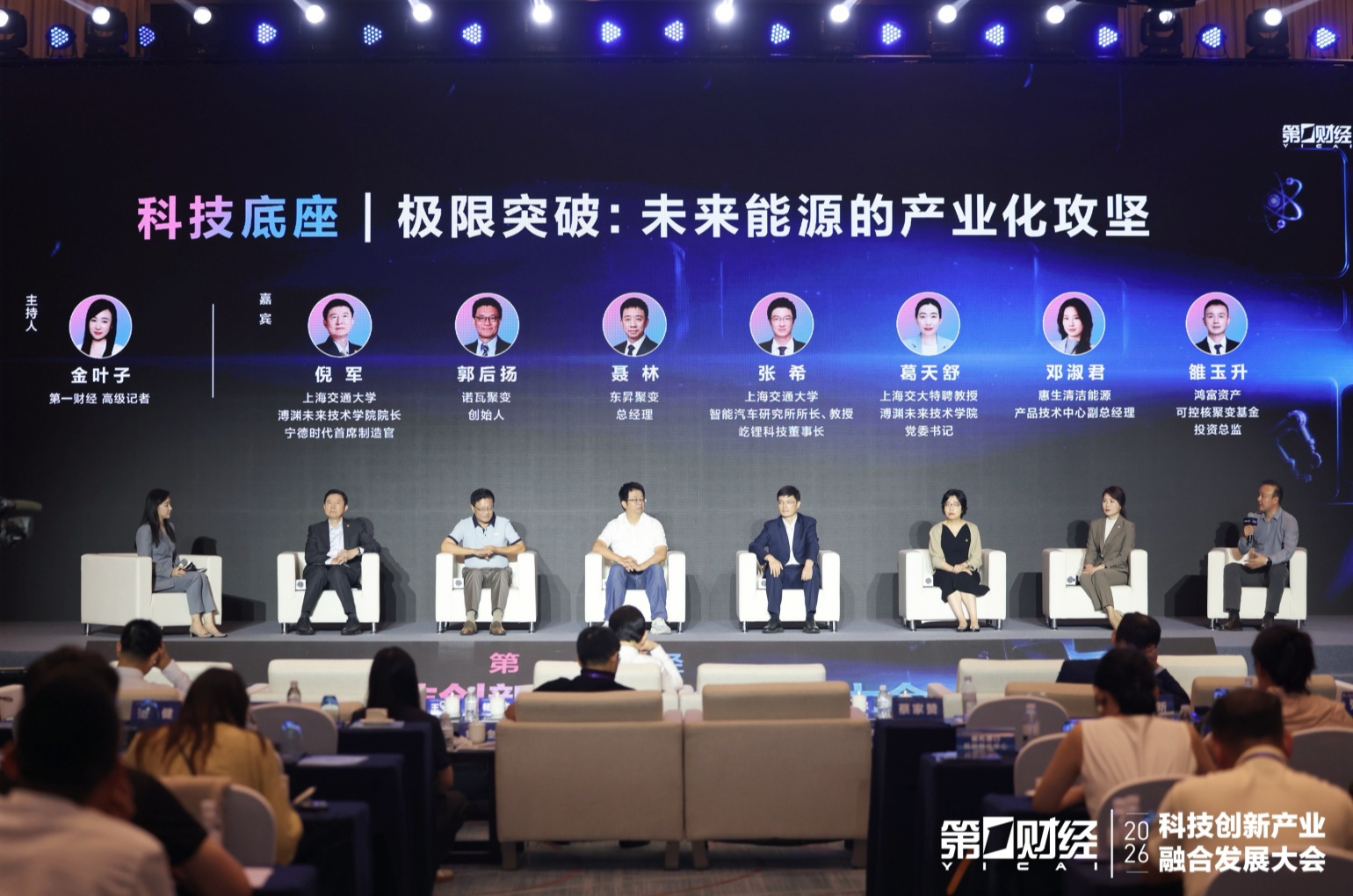
"The explosive growth of AI has driven electricity demand up exponentially, forcing us to compress the commercialization window for nuclear fusion to just five to 10 years from 30 to 50 years," NovaFusionX founder Guo Houyang told Yicai at a forum on July 28. "If we can't solve the power problem within five to 10 years, AI's computing power will inevitably hit an electricity ceiling."
Global data center electricity demand will likely reach about 1,130 terawatt-hours by 2030, roughly equivalent to the annual electricity consumption of Japan, Guo pointed out, citing Goldman Sachs. AI data centers require power that is stable, zero-carbon, deployable in distributed locations, and cost-competitive, conditions that conventional grid infrastructure and renewable energy sources cannot simultaneously meet, he stressed.
The accelerated timeline is due to the three overlapping factors, he noted. "First, the explosion in AI computing has created a rigid demand for stable, zero-carbon power around the clock.
"Second, tech from companies like US' Helion Energy have already validated the scientific feasibility and engineering viability of the field-reversed configuration route," Guo added. "Third, China's hard-tech startup ecosystem has matured, bringing together talent, industry, policy, and capital."
However, several experts at the same forum cautioned that the gap between laboratory devices and mass-producible, reliably reproducible commercial products involves substantial engineering and manufacturing challenges.
Set up in April last year, NovaFusionX aims to achieve its first plasma discharge by the end of this year, become the first Chinese private firm to surpass 100 million degrees Celsius by next year, achieve net energy gain from deuterium-tritium equivalent fusion (Q exceeding 1) by 2029, and build the country's first small, distributed fusion demonstration plant in the early 2030s, Guo pointed out, adding that the company is in talks with some clients to purchase power, but has not signed any agreements yet.
Different Technical Path
Unlike the tokamak, a device that confines plasma using a large ring-shaped magnetic field and remains the dominant approach among state-backed players, NovaFusionX has chosen a different path: field-reversed configuration (FRC) technology paired with a small modular reactor design, known as "FRC-SMR," Guo said.
Guo first proposed this approach in the US in 2010. The same design philosophy later became the foundation for Helion’s commercialization strategy. A small modular unit would cost around USD100 million to build, with electricity costs potentially falling below 7 RMB cents (1 US cent) per kilowatt-hour, while sidestepping the material-lifespan problems that large reactors face. Guo noted, however, that these figures are based on current projections and have yet to be validated through commercial operation.
Dongsheng Fusion also uses the tokamak route but has chosen a more difficult, more environmentally friendly deuterium-helium-3 fuel path to avoid duplicating investment already made by state-backed companies, said General Manager Nie Lin. Around 90 percent of the firm's underlying technology overlaps with that of the national program, he stressed.
Dongsheng could eventually feed innovations back into it, forming a complementary rather than competitive relationship, Nie pointed out.
New Capital
Tech breakthroughs and clearer commercial use cases have drawn substantial capital into the sector, with 56 fusion companies worldwide raising a cumulative USD14.2 billion, including USD4.5 billion in the past year, up 69 percent from a year earlier, according to the Fusion Industry Association. In addition, private capital surpassed government research funding as the dominant source for the first time.
Shanghai-based Hongfu Investment has set up a fund exceeding CNY200 million (USD28 million) for the controlled fusion sector, with tech being the core driver, noted Investment Director Luo Yusheng. Since ChatGPT's debut in late 2022, AI's rapid development has significantly affected areas across the fusion field, from plasma control to simulation, becoming one of the key variables behind the industry's rising heat, he added.
Component and material suppliers, including magnets, power electronics, and superconducting materials, tend to achieve scaled revenue and profitability earlier than reactor developers and have a clearer exit path, Luo said. Reactor developers, or so-called "chain leader" companies, represent a potentially trillion-yuan opportunity, but "whether they can ultimately succeed, and how long it will take, I don't think anyone can answer that," he stressed.
The fund's core criterion for evaluating targets is whether a team has a complete organizational structure and engineering experience, a bar high enough that genuinely investable teams remain scarce, Luo pointed out, noting that China's 15th Five-Year Plan that runs through 2030 has designated controlled fusion a "major national science and technology initiative," providing a policy basis for assessing exit paths, though the actual timeline still hinges on unmet technical milestones.
China-US Race
Helion Energy has signed a 50-megawatt power purchase agreement with Microsoft, targeting delivery by 2028, having previously completed a USD465 million Series G funding round at a USD15.5 billion valuation. Chinese peers are closely watching the company, even though it has yet to achieve commercial power generation.
The US holds an edge in "zero-to-one" prototype validation, with longer track records of iterating on devices and greater tolerance for capital risk, Guo said. China's advantages lie in its complete supply chain, the world's largest-scale AI, high-end manufacturing application scenarios, and policy support from the 15th Five-Year Plan, he added.
"The US does have a major advantage in zero-to-one engineering iteration, but China still has huge potential in the one-to-N phase of large-scale industrial production," he noted.
However, the engineering side remains difficult, according to manufacturing veterans.
Any energy breakthrough must first solve scientific problems, then technical and engineering ones, before it can become a manufacturable product, said Ni Jun, dean of Shanghai Jiao Tong University's Global Institute of Future Technology and chief manufacturing officer at battery giant Contemporary Amperex Technology.
Shanghai Firm Lithium New Energy Technology began research as a lab in 2017 and took nearly a decade to work through problems spanning materials to manufacturing processes for solid-state batteries, noted Chairwoman Zhang Xi. "Many companies claim they're about to hit the road, but most never actually get there."
Before fusion achieves commercial power generation, a transition relying on renewable power combined with energy storage and natural gas is more realistic, said Deng Shujun, deputy general manager of the product technology center at Wison New Energies, adding that many clean energy projects remain stuck at the conceptual design stage.
Editor: Martin Kadiev