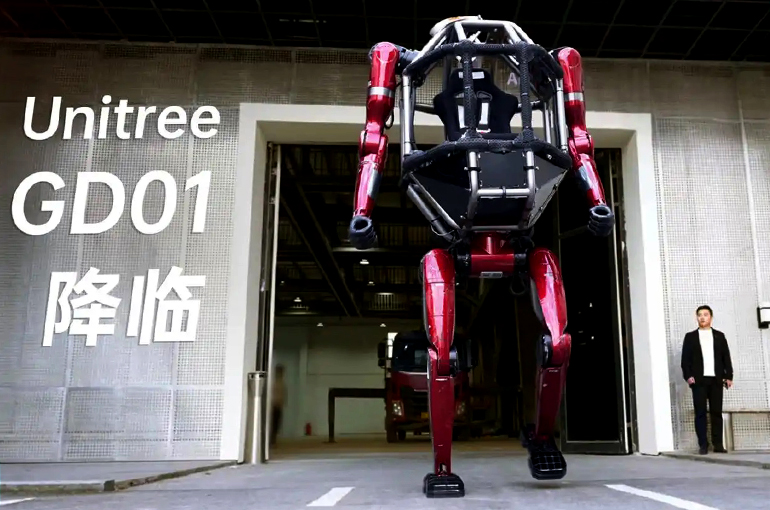
 China’s Unitree Debuts World's First Pilotable ‘Mech’ Humanoid for USD574,200
(Yicai) May 13 -- Chinese startup Unitree Robotics has turned a science fiction concept into reality with the arrival of its transformable ‘mech.’ Priced from CNY3.9 million (USD574,200), the machine is the world's first mass-produced pilotable humanoid robot.
Unitree released a video yesterday showing founder and Chief Executive Wang Xingxing operating the GD01 from a cockpit pod. Standing as tall as 2.7 meters and weighing about 500 kilograms when manned, this "civilian vehicle" can shift between two-legged and four-legged modes.
The reason for bringing out a mech robot is to give Unitree a highly visible, attention-grabbing way to show off its strengths in core technologies such as sensors, controllers, and engineering, Zhao Nan, an early investor in the Hangzhou-based company, told Yicai.
The machine’s hefty price tag makes it fairly unlikely that it would be used for everyday transportation, but it should be able to find uses in specific situations, said Zhou Di, a senior engineer at the Ministry of Science and Technology.
Zhou speculated that the GD01 could find a use in cultural tourism exhibitions and specialized hazardous operations. It may also find fans among niche groups, such as wealthy mech enthusiasts and collectors of cool tech products, he added.
Other potential uses listed by Zhou include performances in theme parks, at tourist attractions, and in exhibition halls, carrying out emergency rescue activities, surveying complex terrain, performing tasks in hazardous environments, and being used as a prop in film and television shoots.
Classifying the GD01 as a type of motor vehicle is difficult, and its road use would face legal obstacles, said Li Hongzhi, founder of Beijing Zeheng Law Firm, in relation to Unitree’s description of it as a “civilian vehicle.”
Constrained by regulations, safety, and technological maturity, this rideable mech is only suitable for operating in closed or special settings, and is unlikely to be allowed on public roads, Li said.
Zhou also pointed out that the GD01 differs greatly from traditional motor vehicles in driving stability, emergency braking capability, and other ways. If it malfunctions or if an unexpected road situation arises, it could easily cause an accident, he added.
In addition, insurance policies tailored to it do not yet exist, so the likelihood of the GD01 getting onto public roads at this stage is pretty low, Zhou stressed.
Editors: Tang Shihua, Martin Kadiev