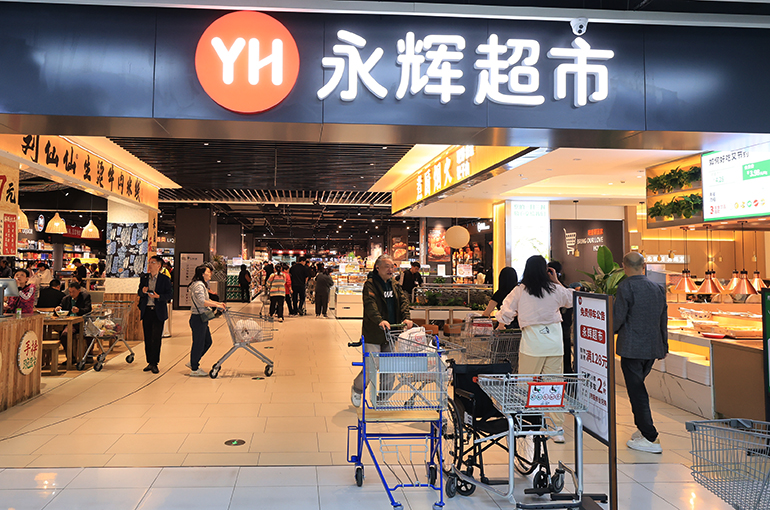
 China’s Yonghui Urges Sam’s Club to Stop Forcing Suppliers to “Pick One”
(Yicai) March 17 -- Chinese supermarket giant Yonghui Superstores issued an open letter yesterday calling on US big box retailer Sam’s Club to ensure its private label, Member’s Mark, plays fair and does not force suppliers to "pick one," a practice in which a dominant retailer uses its market power to make suppliers choose between itself and its competitors, and instead allows them to work with multiple retailers.
This seemingly sudden open letter is a result of increasingly fierce competition among retailers over supply chains, with tensions building up and finally spilling over, Yicai learned from multiple sources.
Given the current race among retailers to secure supply chain resources, Yonghui would not release a letter without reason, a source close to Yonghui told Yicai. The Fuzhou-based firm might have encountered real cases of suppliers being forced to "pick one," which caused setbacks and added to its operational pressure.
"Pick one" refers to a behavior where a dominant retailer leverages its leading market position to force suppliers to choose between itself and rival retailers. Chinese law prohibits companies from compelling suppliers to "pick one" without valid justification.
Yicai tried contacting US retail giant Walmart, which owns Bentonville-based Sam’s Club, regarding Yonghui’s letter today, but had not received a response as of press time.
“Consumers now care more about value for money and product uniqueness, so major supermarket brands are all vying for high-quality and distinctive suppliers to boost the share of their private labels. During this process, it is inevitable that several retailers will target the same supplier,” said an industry insider, who has many years of experience in retail procurement.
Private labels and exclusive products are the core competitive strength of membership stores. Sales of private labels at Sam’s Club account for more than 20 percent of its total sales. By comparison, such sales at Chinese membership stores or supermarket chains are usually less than 10 percent.
“As consumer demands and cost pressures rise, retailers are placing higher requirements on their suppliers and are especially eager to secure exclusive partnerships with top suppliers,” said senior retail industry analyst Shen Jun. “This leads to more exclusivity-related disputes among retailers.”
Without sufficient evidence, it is hard to determine whether the "pick one" accusations are valid, since the dispute is a conflict of interest between the two firms, another industry insider told Yicai. From the supplier’s perspective, they tend to prefer working more closely with retailers that have stronger sales capabilities and faster payment cycles. However, regardless of the situation, retailers should compete within the law and not use coercive tactics to force suppliers to make exclusive choices, the insider said.
This is not the first time that Sam’s Club has been accused by its rivals of forcing suppliers to "pick one," according to Yicai research. In October 2021, on the opening day of French hypermarket chain Carrefour’s first membership store in China, some suppliers collectively bought back their own products. A few days later, a similar incident occurred at the membership store of Freshippo, the grocery arm of e-commerce giant Alibaba Group Holding. Both Carrefour and Freshippo accused Sam’s Club of pressuring suppliers behind the scenes.
Editors: Tang Shihua, Kim Taylor