



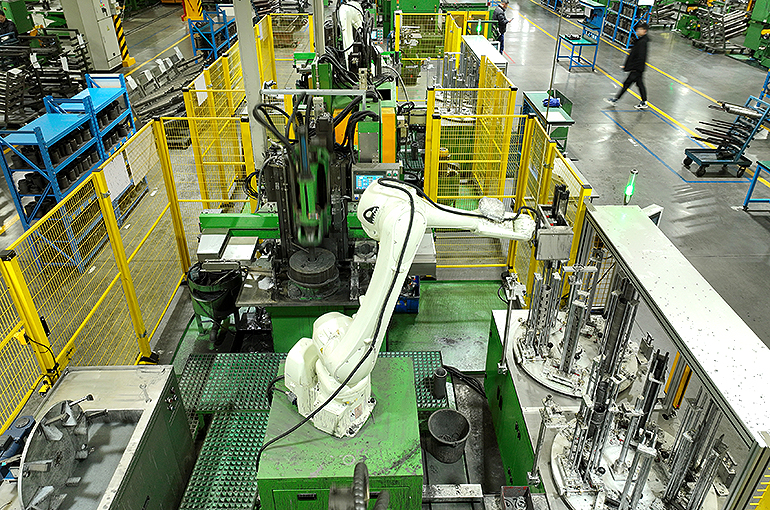
 With Margins Squeezed, Chinese Auto Parts Suppliers Pivot to Robotics
(Yicai) June 1 -- As profit margins shrink in China’s auto industry, auto parts makers are increasingly turning to robotics as a new growth engine, tapping their manufacturing, supply chain, and component expertise to enter what they see as a potentially massive future market.
Chaoda Equipment is devoting both capital and personnel to building its intelligent robotics business into a “second Chaoda,” Chen Cunyou, chairman of the Nantong-based maker of auto interior and exterior molds, said at a recent investor event. While molds still generated about 60 percent of the firm’s evenue last year, battery enclosures for new energy vehicles and smart agricultural robots have emerged as key growth areas, Chen noted.
Its agricultural robots are used in the cotton fields of Xinjiang Uygur Autonomous Region. Using artificial intelligence-powered visual recognition, centimeter-level navigation accuracy, and variable-rate spraying technology, the machines can cover 53.3 hectares to 66.6 hectares a day, which is five to eight times more than traditional manual operations.
Shuanglin Auto Parts and Xinquan Automotive Trim also recently set out plans to develop robots as a second growth driver for their businesses.
The car industry’s transformation will have two phases, evolving from electrification into a new stage centered on intelligence and robotics, said Wang Jianfeng, chairman of Joyson Electronic, a leading provider of smart vehicle technology solutions.
Auto parts suppliers enjoy two major advantages when venturing into the humanoid robot market, according to Wang Feili, industrial analyst at UBS Securities China. First, they already manage highly complex supply chains, since vehicles contain far more components than robots, and second, many of the core technologies behind autonomous driving, including sensing, control systems, and software-hardware integration, overlap with those required for humanoids.
The size of the opportunity is another draw. In its Robot Almanac published last December, Morgan Stanley predicted that global robot hardware sales will increase from about USD100 billion in 2025 to USD500 billion by 2030, USD9 trillion by 2040, and USD25 trillion by 2050.
Core components, where auto parts suppliers already have in-depth manufacturing expertise and established competitive advantages, account for about 60 percent to 70 percent of costs in the humanoid robotics industry chain, according to a research report by Shanghai Pudong Development Bank International Securities.
Editor: Futura Costaglione





