 Chinese Builders Shift to Smaller Luxury Residential Projects in Core Urban Areas
(Yicai) June 5 -- Chinese property developers now prefer building smaller luxury projects with about 100 apartment units, which allows them to buy small land parcels in prime downtown locations, rather than opting for oversized high-end complexes.
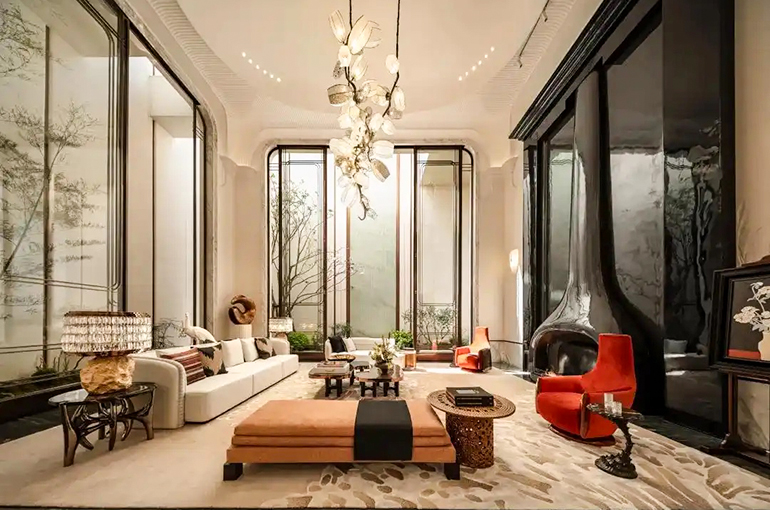
In China’s eastern Hangzhou, home to dense clusters of tech tycoons and private entrepreneurs, this trend is particularly noticeable. For example, the Take Wang Tianji luxury project in Hangzhou that hit the market this month had only 168 residential units between 296 and 876 square meters each, but boasted lavish amenities, including indoor and outdoor swimming pools, fitness centers, yoga studios, an indoor basketball court, and an indoor golf simulator.
A 7,115-sqm plot in Shanghai’s central Hongkou district was auctioned at a premium rate of 36 percent after 63 rounds of bidding from 12 developers on May 28. If the project’s average apartment size is around 200 sqm, it will have just over 80 units. Similar small-lot transactions with fierce competition and high premium rates were also recorded during auctions in Beijing, Nanjing, and Suzhou late last month.
“From this year, we no longer bid for large land plots,” a senior executive at a leading Chinese developer told Yicai. “Our targets will be no larger than 50,000 sqm, as the development logic of high-end housing has undergone fundamental changes.”
Small land parcels in core cities carry modest upfront land costs, requiring only CNY200 million to CNY300 million (USD29.5 million to USD44.3 million) in locked capital, which greatly lowers the financial entry barrier for property developers, Yan Yuejin, vice president of the E-House China Research and Development Institute, told Yicai.
“Moreover, plots in central locations are surrounded by mature public infrastructure, meaning that completed projects enjoy strong market liquidity upon completion,” Yan added. “Even modest losses on individual projects will not materially hurt developers’ overall financial performance.”
Large residential compounds with around 2,000 units typically require five to 10 years to complete, while small ones of about 100 units can be fully sold out quickly, accelerating builders’ capital turnover.
Heightened risk aversion is another factor steering firms away from large projects. “Holding extensive land reserves was an asset before 2022, but it has turned into a liability after that year,” the senior executive noted.
“The pool of high-net-worth buyers cannot expand endlessly,” the senior executive added. “Every city has a ceiling on how many ultra-luxury homes its market can absorb.” Compact luxury projects are tailor-made to match this constrained demand, helping sustain product scarcity and stable pricing levels.
Editors: Tang Shihua, Futura Costaglione