



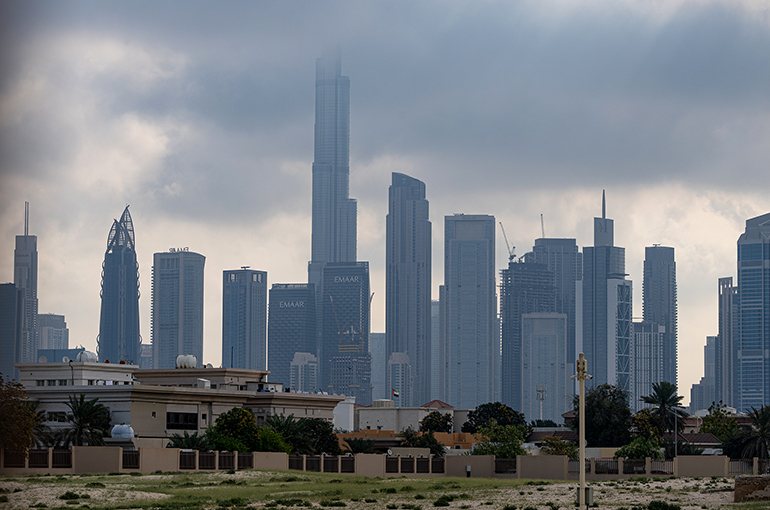
 Chinese Investors Hit Pause on Middle East Property Buying
(Yicai) March 6 -- Chinese home-buyers, who have become a major part of the real estate market in the Middle East over the past two years, attracted by long-term visas and high rental yields, have put everything on hold while the situation with the conflict in the region clears.
"Wait-and-see" and "bottom-fishing" are the current market sentiment in Dubai, Wang Yani, who works as a broker in the city, told Yicai. Some clients have begun to hesitate about making a move, while others are inquiring whether there are any "bargain properties" available, Wang noted.
Before the US-Israeli military strikes on Iran on Feb. 28, the real estate markets in Dubai and Abu Dhabi were experiencing an unprecedented period of strong growth and were some of the fastest-growing among emerging economies worldwide.
"There will be a sense of panic in the short term," Wang said. "In the past few days, we have noticed that some clients are adopting a wait-and-see attitude.
"Some investors may feel that they cannot bear the current situation and might want to sell off their investments," she noted. "However, the situation has only developed over a few days, and most people prefer to observe for a while longer."
Chinese people who go to live in Abu Dhabi for the long term tend to quickly buy a property because rental prices increase by 20 percent to 30 percent per year, Shen Anran, who bought a 120-square-meter apartment in the city for CNY6 million (USD869,015) last August, said to Yicai.
"There is a larger residential community next to our apartment, which has about a thousand households, with about half of the residents having East Asian features, not only Chinese but also South Korean and Singaporean," she said.
Shen has been stranded in Beijing after she came to China for the Chinese New Year holiday last month, with her flight back to Abu Dhabi canceled due to the Middle East crisis. She is waiting at a hotel for the resumption of flights to the United Arab Emirates. Her husband works in the local telecommunications industry.
"We never anticipated that the UAE would be drawn into the conflict," Shen said, adding that her life would certainly be affected in the short term, but she believes peace in Abu Dhabi will be restored.
Wang moved to Dubai with her parents in 2001, making her among the first Chinese immigrants to the UAE, entering the local real estate market in 2017. "Foreign home-buyers primarily came from India and Arab countries at the time, with very few Chinese clients," she said.
She was later invited by a friend to join a local real estate company that aimed to expand into the Chinese market, leading the relevant department.
"Chinese ranked in the top three among all foreign buyers in the Dubai real estate market and second in Abu Dhabi," Wang noted, adding that the market conditions were quite favorable from 2018 to 2019. Her clients mainly came from southern Chinese cities like Guangzhou and Shenzhen, primarily worked in foreign trade and finance, with the majority being women aged between 30 and 40, and preferred investing in smaller properties priced around AED1 million (USD272,260).
Starting in 2024, after the Covid-19 pandemic impact eased, there has been an increase in Chinese clients again, many of whom are business owners or executives, as well as younger individuals engaged in new media and the digital currency sectors, mostly aged around 30. Their investments are typically in the millions of dirhams, with many investing in core global cities such as Dubai.
Wang pointed out that the number of Chinese visiting clients she received doubled last year from 2024.
Properties in Dubai and Abu Dhabi have attracted considerable attention from Chinese mainland and Hong Kong investors over the past two years, Teresa Chan, director of business development at List Sotheby's International Realty Hong Kong, told Yicai. They are particularly interested in the absence of capital gains and income taxes in the region, the offer of long-term visas with property purchases, and the option to buy homes using cryptocurrency, she noted.
Editor: Martin Kadiev





