



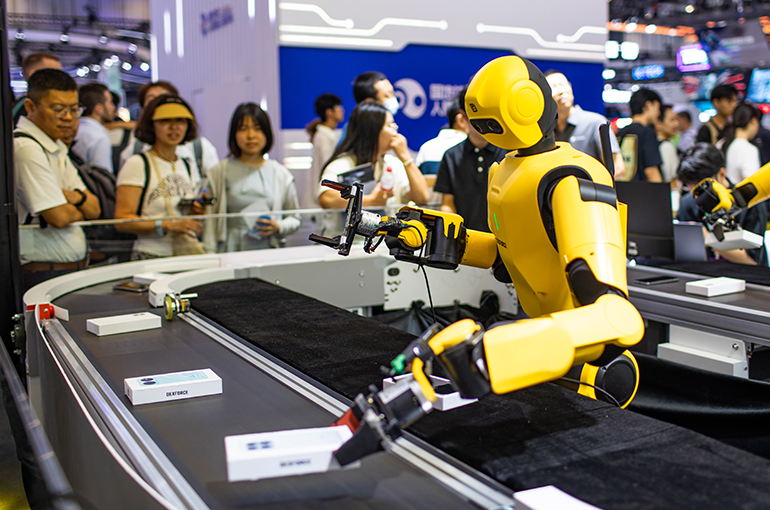
 Chinese Central SOEs Shift Focus to Industrial Robots From Acrobats at World Robot Conference in Beijing
(Yicai) Aug. 25 -- Chinese central state-owned enterprises at this year's World Robot Conference in Beijing focused on showing their products' industrial applications in complex environments, including deep-sea operations, manufacturing, and cooking, unlike previous years when they mostly made them do backflips and dance moves.
Forty-eight central SEOs displayed 263 robots at the five-day WRC, which ended Aug. 23. In addition, more than 100 organizations, including central SOEs, universities, research institutes, private companies, and industry associations, jointly formed the central SOE robot innovation consortium led by China North Industries Group, unveiling the top 10 innovative achievements in SOE robotics and 10 high-value application scenarios.
In offshore applications, China State Shipbuilding Corporation's Zhihai Turing platform enables smart yachts to navigate autonomously while avoiding obstacles, while its underwater surveying and dredging robots can simultaneously map the seabed and remove sediment.
In addition, State Power Investment Corporation's offshore wind power intelligent operation and maintenance robot targets underwater inspection and maintenance needs for turbine towers and foundation structures. Equipped with amphibious capabilities, it can perform inspections, cleaning, testing, and repairs, reducing the need for divers.
In manufacturing, CRRC's logistics and welding robots work together to shorten production line cycles by about 40 percent, while achieving a first-pass weld qualification rate of 99.5 percent. Moreover, China Minmetals' robot grinding workstation for counterweight iron has enabled fully automated operations throughout the entire process, improving precision by 50 percent.
In household applications, China National Coal Group's multi-cuisine cooking robot replicates professional chefs' techniques, including stir-frying, ingredient dispensing, and heat control. It is also equipped with oil fume purification and automatic cleaning functions.
In security applications, SDIC Intelligence Information Technology's outdoor patrol robot with a four-wheel chassis design can detect intrusions, high temperatures, open flames, missing manhole covers, and other security threats.
As the "national team," central SOEs possess extensive application scenarios and vast industrial data resources, making them a key force driving breakthroughs in the robotics industry, Wu Gangliang, a researcher at the China Enterprise Reform and Development Society, told Yicai. Such companies in the sector have moved from isolated technological breakthroughs to a new phase of systematic advancement, Wu noted.
However, significant weaknesses remain, with core algorithms and key technologies for hardware-software integration still lagging, while central SOEs' strengths are primarily concentrated in application scenarios and system integration, Wu stressed.
In the next stage, central SOEs should clarify their role as leading players in supply chains, define industry boundaries, and leverage their advantages in application scenarios and testing platforms to support the broader industry, rather than attempting to control the entire value chain, Wu noted. In addition, application scenarios and data sharing should be incorporated into their performance evaluations, with standardized and secure mechanisms set for data circulation, Wu said.
State-owned and private enterprises should be encouraged to conduct equity partnerships, strategic ties, and resource integration through market-oriented approaches, Wu said, adding that large-, medium-, and small-sized enterprises can achieve coordinated development by building a sound framework that benefits cooperation and risk sharing.
Editor: Martin Kadiev





