



 Lower Cost ‘Carpooling’ Helps China’s Space Firms Break Into Global Satellite Launch Market
(Yicai) Dec. 12 -- CAS Space Technology’s launch this week of a rocket carrying nine satellites, including three foreign payloads, marks the latest step in the push by Chinese commercial space firms to expand their footprint in global markets.
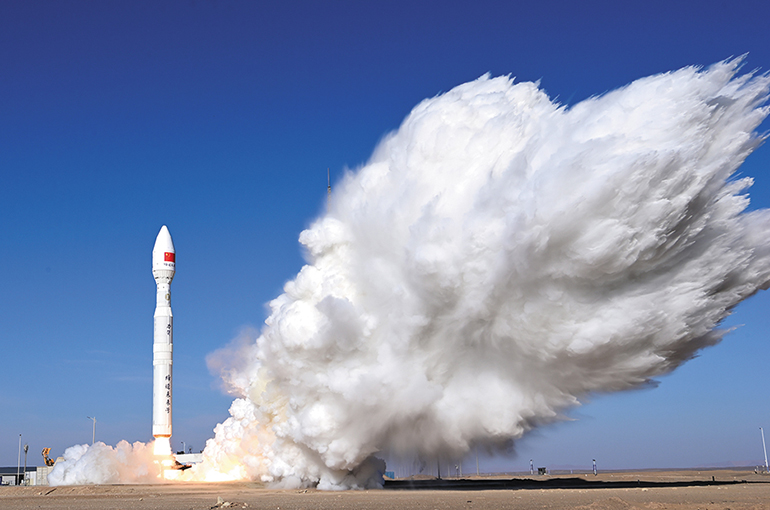
CAS Space put nine satellites, including one each from Egypt, Nepal, and the United Arab Emirates, into orbit on Dec. 10. They were carried aloft by a Lijian-1 Y11 carrier rocket launched from the Jiuquan Satellite Launch Center in the Gobi Desert of northwestern China.
The launch employed a “carpooling” model, in which several satellites share the payload capacity of a single rocket, an engineer with a private space firm said. This arrangement cuts launch costs per satellite, boost rocket payload use efficiency, and shortens response times for overseas orders, the person noted.
China’s commercial space launchers have been snagging more foreign business since the start of this year.
Galactic Energy has signed launch service agreements with German and Malaysian clients, while Galaxy Space has penned a deal on low-orbit satellite communication tech with a major Thai operator, and SpaceSail has held talks with businesses in Thailand, Brazil, Malaysia, and elsewhere about using Qianfan, China's first giant low-orbit commercial satellite constellation.
Launch costs for some Chinese commercial rockets have now fallen to between CNY50,000 and CNY60,000 (USD7,080 and USD8,500) per kilogram, the engineer said, adding that "as more liquid rockets enter the market, costs are expected to drop by roughly another 30 percent.
“Compared with SpaceX’s Falcon 9 at USD3,000 to USD5,000 per kg, this still confers a competitive advantage in the international market,” he pointed out.
But cost advantage is only one factor. Many emerging market countries have differences in launch procedures, interface specifications, and mission management, so Chinese players must adapt to common international standards in advance, the engineer said.
“Only by delivering reliability, predictable delivery schedules, and full-process services can they truly win the trust of more overseas clients,” he said.
SpaceX remains the main rival for overseas business, an industry insider noted.
“Although the development speed of China's commercial space industry lags behind SpaceX, going global to obtain more orders is a dual consideration for Chinese companies in terms of business and national strategy,” said Zhang Chi, founding partner of Xinding Capital.
Some European aerospace players oppose SpaceX's monopoly, Zhang pointed out, noting that customers from Asia, Latin America, the Middle East, and Africa seek a broad range of suppliers, giving China an opportunity.
Editor: Martin Kadiev





