



 Chinese Enterprises Still Unearth Investment Potential in Venezuela Despite Its Upheavals
(Yicai Global) July 5 -- Though Venezuela confronts intractable problems, potential economic opportunities for investment by Chinese enterprises still beckon.
These opportunities, especially in the oil industry, offset problems such as recession, runaway inflation and political turbulence.
This was the advice of Niu Haibin, vice director of the Center for American Studies of the Shanghai Institutes for International Studies
"In the oil sector, China can help locals improve oil yields. After all, Venezuela is the country with the world's largest known oil reserves, so there is significant room for production growth. The time is inopportune, however, with such problems as low oil prices, the competition from shale oil in the US, and countries in the Middle East and Africa like Iran that have resumed their oil supply. And now OPEC members are boosting oil prices by restricting supply, and Venezuela is also implementing this measure as a member. Demand for increased capacity is thus not so urgent now," Niu said, "but there are also some cases like Chinese enterprises' new exploration projects and the bids and cooperation on current capacity in this country. After all, China's demand for energy still persists, but neither party has an urgent demand for upgraded oil production now."
Also, as the oil Venezuela produces is heavy oil that needs refining, its major oil customer is the US, a nation with an industrial sector specialized in refining oil, but one now mooting imposing sanctions on Venezuela, so its oil exports to the US are likely to decline, which in turn will impose greater demands on its own oil-refining capacity. Locals lack this ability, however, and so for Chinese enterprises to engage in local midstream and downstream activities will reap rewards. "There is still room for investment in the production, refining and distribution of oil," said Niu.
Additionally, to diversify the economic structure in Venezuela is something both China and Venezuela desire. Of course, the current social insecurity and financial capacity of this country betoken significant difficulties in cooperation in industries other than oil.
"Most investors now are still sidelined," Niu observed in this vein.
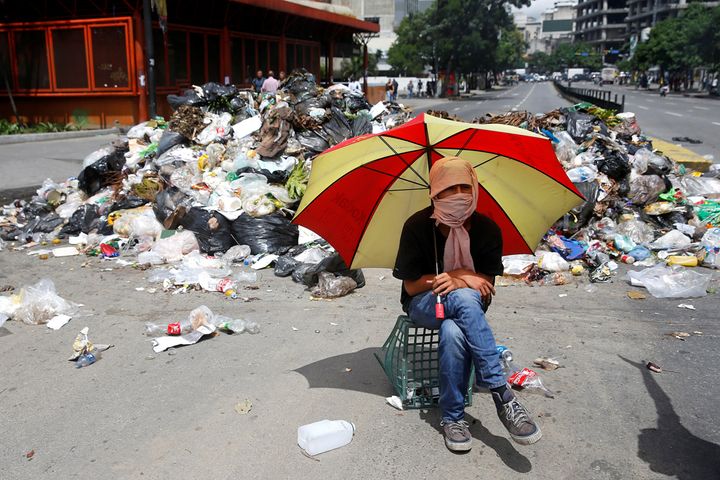
This country's hyperinflation is inflicting an unprecedented calamity on its citizenry. Soaring prices, materials shortages, and foreign exchange restrictions deprive many of normal access to daily necessities, and many must buy these goods across the nation's borders. Over the four-year tenue of incumbent President Nicolas Maduro, the depreciation of bolivar (VEF), the national currency, has been as high as 99.5 percent. On the current black markets, it costs as much as VEF5,100 to buy USD1.
Compounding the severe recession, Venezuelan politics is also roiled by severe turbulence, where the volume of dissenting voices is rising, even as conflict grows between the opposition and the government. The former demands that the government hold an election ahead of schedule and take measures to rein in the economic decline, while the latter is firmly against organizing an advance election. A hijacked police helicopter flew over and dropped grenades on the country's supreme court, which Maduro later called a willful act of sabotage, or even a terrorist attack.





