



 Chinese Firms Eye Southeast Asia as Next Frontier for Growth, FutureChina Forum Speakers Say
(Yicai) Sept. 29 -- Chinese companies are increasingly turning to Southeast Asia for new markets and supply-chain opportunities as the country shifts toward higher-value industries and seeks to boost domestic consumption, speakers said at the recent FutureChina Global Forum in Singapore.
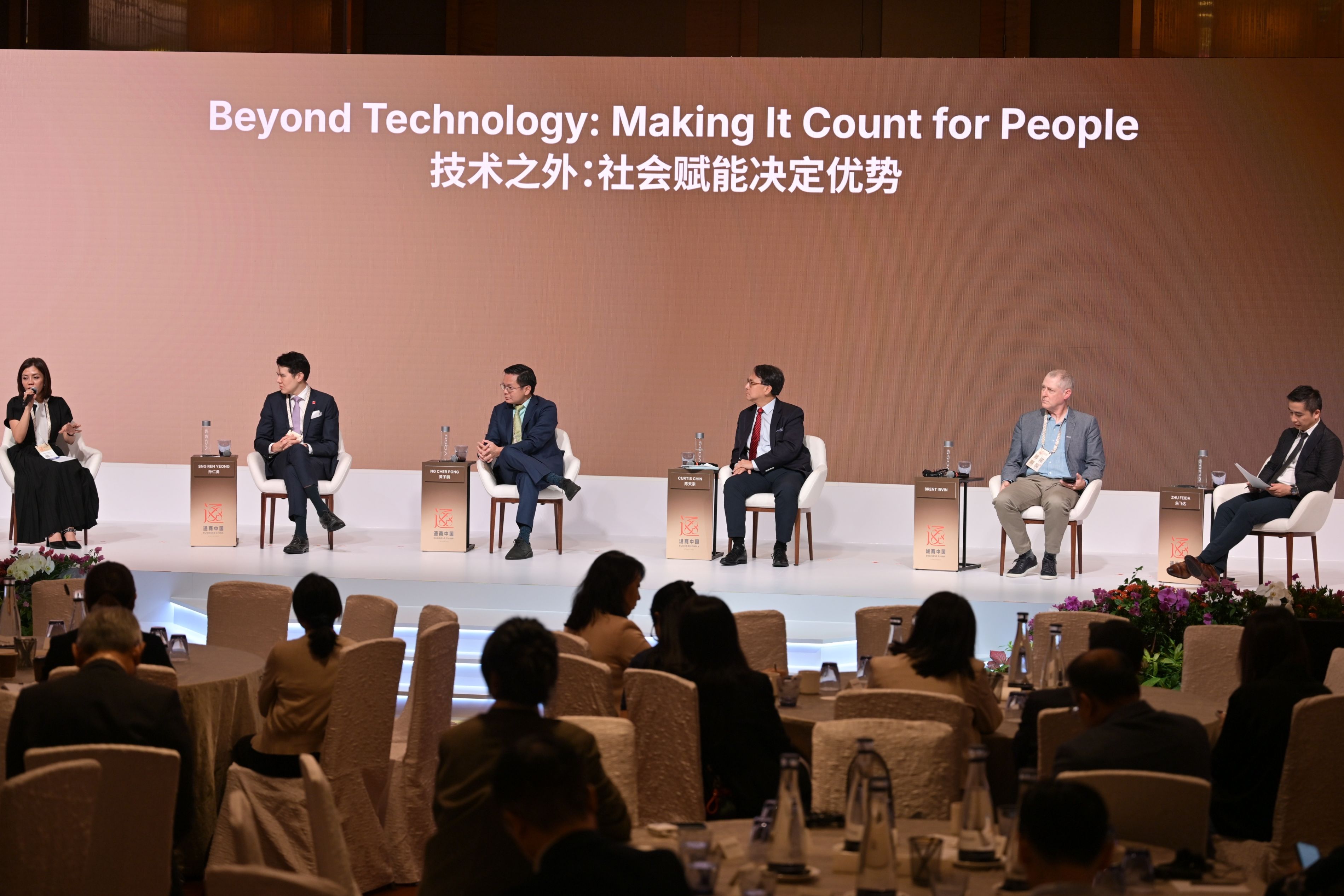
Discussions at the 17th edition of the forum, which was organized by Business China, focused on China’s next phase of growth as it enters its 15th Five-Year Plan for 2026 to 2030, highlighting the country’s economic transition, the rise of artificial intelligence and the Association of Southeast Asian Nation’s role amid intensifying regional and global competition.
Emphasis was put on higher-value sectors including electric vehicles, batteries, artificial intelligence and advanced manufacturing. The need for stronger consumer demand to support broader economic growth was also addressed.
As high-tech manufacturing expands faster than domestic consumption, Chinese companies are looking overseas for new markets and building supply, production and consumer networks across Southeast Asia, according to discussions at the forum, which brought together more than 1,400 participants from over 1,000 organisations over a two-day period from Sept. 24 to Sept. 25.
At the same time, efforts to manage the property market and strengthen social and job security, as well as durable income growth, were highlighted as factors that could support consumer confidence in China.
ASEAN’s role in the regional economy was another focus of the forum. Speakers discussed the need to maintain the region’s openness as competition intensifies, while strengthening connections across financial systems, data infrastructure and energy networks.
Singapore will work with other ASEAN members as it takes on the bloc’s chairmanship in 2027, said Singapore Deputy Prime Minister and Minister for Trade and Industry Gan Kim Yong, who opened the main forum as Guest of Honour.
“We want an ASEAN that remains open to the world with the capabilities, connections, and agencies to be able to shape our own future,” Gan said.
The forum also examined the implications of artificial intelligence for businesses and economies.
Singapore’s advantage would depend on turning AI into practical outcomes rather than competing with larger economies on computing power, chips or frontier models, Singapore Senior Minister of State for Digital Development and Information and Health Tan Kiat How said at a dedicated AI Track session.
Speakers at the AI sessions discussed China’s manufacturing and deployment capabilities as an advantage for embodied AI, while stressing the importance of real-world data, workforce retraining and organizational changes to ensure that AI delivers practical business value.
Participants also explored potential cooperation between Singapore and China, particularly by combining China’s engineering and manufacturing capabilities with Singapore’s business and governance environment.
Singapore needs to remain relevant in a more fragmented global economy by recognizing diverse perspectives within society, Singapore Coordinating Minister for Public Services and Minister for Defence Chan Chun Sing said at the main forum. For ASEAN, he highlighted the need for closer connections across finance, data and energy as areas that could support regional competitiveness.
The FutureChina Global Forum was launched in 2010 by Business China as a platform for dialogue on China’s development and its engagement with Singapore, ASEAN and the wider world.
Editor: Kim Taylor





