



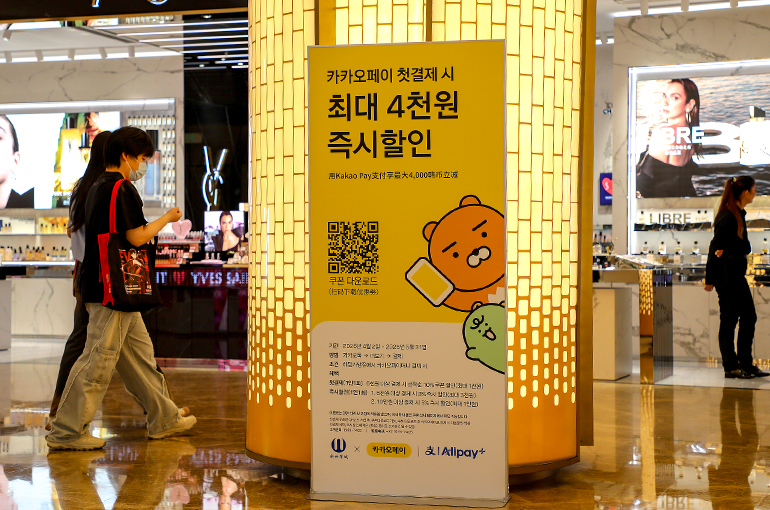
 Chinese Payment Providers Deepen Push Into South Korea’s Small Merchant Market
(Yicai) Dec. 17 -- Chinese cross-border payment firms have begun expanding deeper into South Korea’s retail market by improving value-added services for small and micro merchants, after largely securing coverage of major duty-free shops and brand-name retailers, Yicai found during recent visits.
The shift marks a new phase of competition as providers seek growth beyond core merchants. In Seoul’s Myeongdong shopping district, where fashion brands cluster, nearly 200 small vendors on both sides of the busy street still rely mainly on cash, but Alipay+ is becoming the only non-cash payment method they commonly accept, Yicai observed.
Spending by overseas tourists via e-wallets supported by Alipay+ in Myeongdong surged over sevenfold in the period from January to November from a year earlier, according to data from Ant International.
In locations where local South Koreans typically pay in cash, Alipay+ has devoted significant effort to building the market and earning merchants’ trust one by one, Jiang Weixiao, general manager of Ant International’s Alipay+ business for North Asia and North America, told Yicai. Ant International will continue visiting small and medium-sized merchants in commercial districts and traditional markets to persuade those not yet using its services to adopt them, Jiang said.
Alipay+ now covers more than two million local merchants, the vast majority of which are micro, small, and medium-sized businesses, accounting for over half of South Korea’s total merchant base. Through Alipay+, these merchants can accept 21 e-wallets and banking apps, including Alipay, while providing more convenient payment options for tens of millions of cross-border tourists visiting South Korea each year.
“I didn’t know how to communicate with overseas guests because of the language barrier,” said the owner of a popular local snack stall at the Myeongdong Night Market. “Since using Alipay and Alipay+ in 2023, it has become very convenient for overseas customers to pay, and the sales volume of my stall has risen by three times.”
Competition in South Korea’s cross-border payments market is also intensifying. Tencent Holdings’ WeChat Pay and UnionPay International are expanding their presence as well. In July, UnionPay International signed a cooperation agreement with Gyeongsangnam-do and other local authorities to jointly promote convenient mobile payment services at major tourist attractions in the province.
Competing Beyond Payments With Value-Added Services
Neither technology nor policy poses a major obstacle for Alipay+ in South Korea, Jiang said, adding that at this stage of competition, as a latecomer, Alipay+ needs to break entrenched business models in the mature market and deliver value innovation for both merchants and consumers.
Joint marketing with key overseas merchants via Alipay is emerging as a new overseas expansion model for Alipay+. The company has partnered with South Korea’s local transportation card Namane to launch a customized “Alipay+ Worry-Free Transportation Card,” and has helped Korean merchants attract Chinese consumers by offering coupons from Olive Young, Shilla Duty Free Shop, and Lotte Mart to Alipay users.
In high-value consumption sectors in South Korea that are seeing rapid growth among Chinese consumers, such as medical aesthetics, cosmetics, and dental clinics, Alipay has worked with local merchants to offer conveniences and incentives, including service reservations and fee discount coupons.
Alipay has so far rolled out these services to nearly 1,500 such institutions in South Korea, according to Ant International. From January to November, the number of health care and beauty transactions completed through Alipay in South Korea rose 90 percent from a year earlier, while payment amounts more than doubled.
“The recent joint marketing campaigns offer not only discounts but also small gifts, food vouchers, and interactive promotions between duty-free shops and attractions such as museums,” said the marketing director of Shinsegae Duty Free. Shinsegae began accepting Alipay in 2016 and introduced more Alipay+ e-wallets starting in 2021.
The diverse marketing needs and gaps among South Korean merchants could become a key competitive battleground for Chinese cross-border payment giants, as competition in the sector is no longer limited to payment services alone, the marketing director added.
Editors: Tang Shihua, Emmi Laine





