



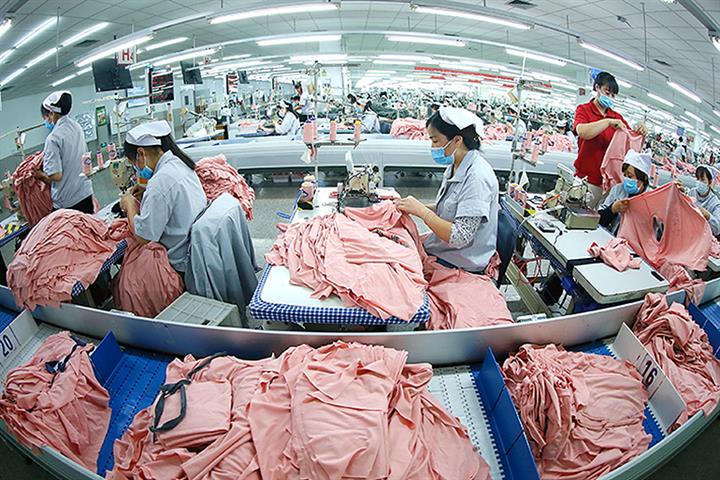
 China’s Textile Firms Lose Out to Rivals Who Attend Offline Events
(Yicai Global) July 7 -- Chinese textile manufacturers are losing orders to competitors that are able to attend overseas trade shows in person, according to an industry group.
Eighty-five percent of Chinese garment producers have seen a significant loss of orders, the findings of a recent survey by the China Chamber of Commerce for Import and Export of Textiles (CCCT) showed. Over 90 percent said orders on hand have dropped, while almost half said orders have fallen from a year earlier.
Since the second quarter of this year, in-person exhibitions in North America and Europe have restarted and the Association of Southeast Asian Nations, India, and Turkey are actively participating, a person in charge at the CCCT said. That is badly affecting orders with Chinese firms, which are struggling to get new overseas clients and show their wares offline amid China’s Covid-19 restrictions and the surging cost of logistics.
In the first half, some USD6 billion worth of textile orders were shifted out of China mainly to India, Bangladesh, Vietnam, Indonesia, and Cambodia, according to the CCCT's estimate. In the second half that may climb to about USD10 billion.
The effect can be felt at the grassroots level. This year, orders are at least 40 percent less than last year, a person in charge of a small textiles company in Wujiang told Yicai Global. Other small and medium-sized firms in the Jiangsu province city are having similar issues, the person added.
Anhui province-based Garments Import and Export has entered an ‘idle' state almost two or three months earlier than in previous years, Manager Meng Zhuo said.
Order outflows are only one of the reasons for the dismal market. Poor demand is a bigger problem, according to Hu Kehua, deputy director of social responsibility at the China National Textile and Apparel Council. In the first half, domestic textile and apparel consumption fell nearly 20 percent, and foreign markets are also shrinking, Hu said.
The overall loom operating rate in the Chinese provinces of Jiangsu and Zhejiang is currently less than 50 percent, the lowest in the past five years, according to industry data.
Policy support can alleviate the pain. Many regional governments have introduced bailout policies and encouraged local companies to start exploring cross-border e-commerce to enlarge their scopes. Zhejiang, Guangdong, Shandong, Henan, and other provinces have provided subsidies to help businesses take part in offline exhibitions overseas through representatives.
Online exhibitions need to be optimized to enable companies to pick up more foreign trade orders, Commerce Vice Minister Wang Shouwen said in a recent press briefing. Micro firms and SMEs are urged to negotiate with overseas customers and transport their products abroad for offline exhibitions. Moreover, the Canton Fair should cooperate with cross-border e-commerce platforms to smooth trade.
Editors: Shi Yi, Emmi Laine, Xiao Yi





