



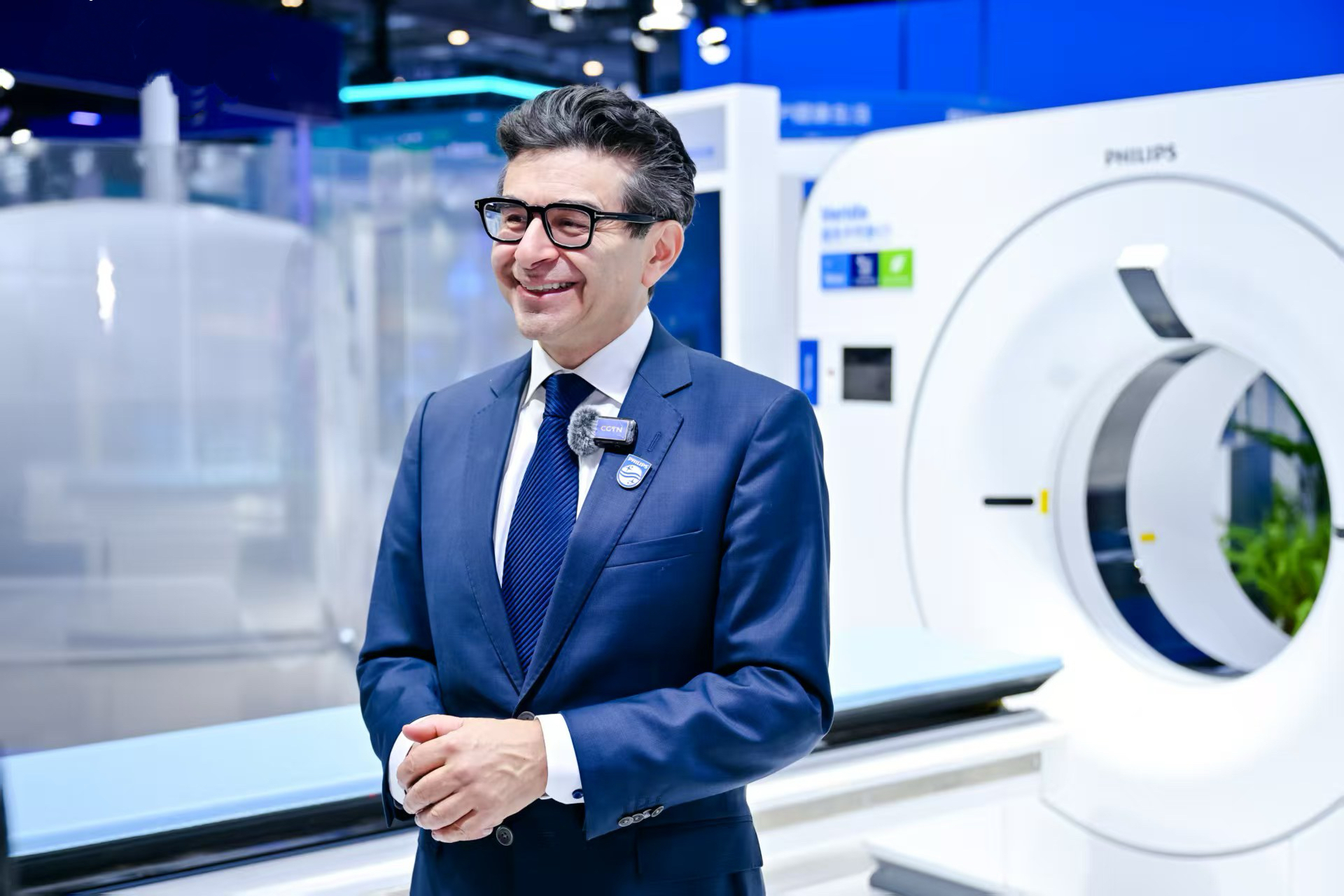
(Yicai) Nov. 10 -- Doctors and nurses worldwide are increasingly seeking artificial intelligence solutions, with demand particularly strong in China, Shez Partovi, chief artificial intelligence officer at Dutch health technology giant Royal Philips, told Yicai during the ninth China International Import Expo. This appetite presents an opportunity for industry players, healthcare providers and policymakers to accelerate AI adoption.
A report released by Amsterdam-based Philips during this year’s CIIE found that 87 percent of Chinese healthcare professionals said AI has improved their workflow efficiency while 69 percent said they are optimistic that AI can improve patient outcomes, an increase of 5 percentage points from a year earlier.
When AI tools provided by their healthcare institutions fail to meet their needs, 79 percent of clinicians in China said they turn to personal AI tools, compared with 64 percent globally, according to the China edition of Philips' Future Health Index 2026 report, which polled more than 2,000 clinicians and over 20,000 patients in 10 countries.
In China, clinicians' demand for AI is outpacing the ability of healthcare institutions to provide the necessary tools and training, said Partovi, who is also executive vice president at the Amsterdam-based firm and a member of its Executive Committee. This presents an opportunity for industry players, healthcare systems and policymakers to accelerate the adoption of AI.
Two-Way Flow
China offers a uniquely favorable environment for healthcare AI development thanks to several factors, Partovi said. These factors are well-developed digital infrastructure, a highly engaged clinical community willing to embrace innovation, supportive government policies and a large number of young companies specializing in AI.
Philips’ approach in China is built on three layers, Partovi said. The middle layer consists of Philips’ core technological innovations that the firm brings to every market. The top layer focuses on local clinical workflows, recognizing that doctors and nurses work differently across different regions and that products must be adapted accordingly. The bottom layer reflects China’s own ecosystem, including its clinically engaged physician community and young AI-focused companies. Combining these three layers enables Philips to deliver innovations specifically tailored to the Chinese market.
"Our approach to working with China is not simply taking an application that works well oversea and then introducing it directly into China. Instead, we bring our core innovations here and work with the healthcare system to customize and adapt them to the way doctors and nurses work locally," he said.
"For us, it's really a two-way street," Partovi said. Philips brings its global innovations to China, while also developing solutions “in China, with China, for China," with the intention of subsequently introducing them to the rest of the world.
Philips has five innovation centers, five manufacturing bases and about 7,000 employees in China, including around 1,000 research and development staff. Products manufactured in China are exported to more than 150 markets worldwide.
Following the opening of its Beijing innovation center this year, China has become Philips' second-largest R&D hub worldwide covering all product lines. SBI Viewer, a spectral image-reading tool developed by Philips’ China team, was showcased at this year’s CIIE and is being gradually rolled out globally.
Painkillers, Not Vitamins
AI should be measured by its outcomes, Partovi said. “As the saying goes, the best innovations are painkillers, not vitamins.”
Philips’ approach is to first establish baseline performance data before introducing an AI application, then assess whether the technology delivers measurable improvements in patient care, diagnostic throughput and access to healthcare services.
Chinese companies' speed of execution is a key advantage, said Partovi. “I think what you see here in China is the pace is faster than anywhere else. Everything gets magnified when you add speed.”
Philips takes an open-platform approach that allows partners to build applications on its platforms. "We don't believe that we can solve every problem at every stage of the process ourselves." he said.
Philips has taken part in all nine editions of the CIIE. At this year's expo, it is showcasing 10 products making their China debut including the Verida spectral CT scanner, which has been approved by China’s National Medical Products Administration and which the company says can reduce radiation exposure by 80 percent.
"We'll be back for the 10th year," Partovi said.
Editor: Kim Taylor





