


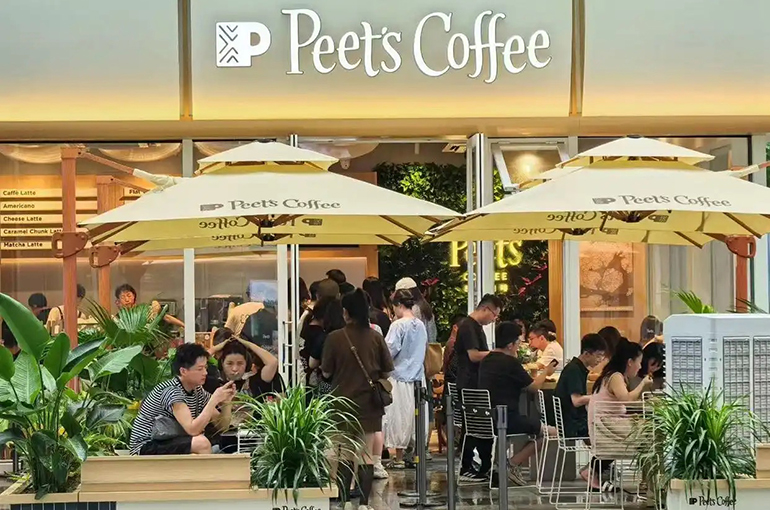
 Closure of Peet's Coffee's First Store in South China Is Routine Business Adjustment
(Yicai) Aug. 11 -- Peet's Coffee has closed its first store in southern China. According to a spokesperson for the US premium coffee chain, the move was just a routine business strategy adjustment.
"This type of optimization is based on systematic evaluation of store profitability and return on assets and aims at improving the overall operational efficiency and ensuring more rational resource allocation than downsizing or withdrawing," the Peet's Coffee spokesperson told Yicai on Aug. 8.
Peet's Coffee closed its first outlet in Shenzhen at the MixC World shopping plaza on July 16 after nearly four years of operation due to lease expiration. The firm has closed several other stores this year, including one in Hangzhou in February, one in Guangzhou in March, and others in Shanghai.
"Over the past three to four years, we have grown from 47 stores to more than 260 this year, with double-digit revenue growth annually," the spokesperson noted.
When asked about the intensifying competition and frequent price wars in the Chinese coffee market, the spokesperson said that Peet's Coffee will not sacrifice quality for efficiency and will not participate in price competition. The company will only selectively and moderately engage in the delivery business, as it refuses to lower profits for short-term sales increase, they added.
China's food and beverage industry entered a "survival of the fittest" phase last year, with the Matthew effect becoming increasingly prominent, said Zhu Danpeng, an industry analyst. "In this environment, how companies can more precisely meet core consumer demand while balancing their own development speed and quality is crucial," he added.
"I believe Peet's Coffee's strategy is correct," Zhu noted. “When the industry, market, and consumer mindset and behavior change, it will inevitably drive innovation, upgrading, and iteration.”
Founded in California by Dutchman Alfred Peet in 1996, Peet's Coffee entered the Chinese market in 2017. It has stores in 35 core cities across 20 Chinese provincial-level regions, mostly in first- and new-first-tier cities. In the second half of this year, it plans to expand to Zhengzhou, Hohhot, Nanchang, Xiamen, and other Chinese cities.
Editor: Futura Costaglione