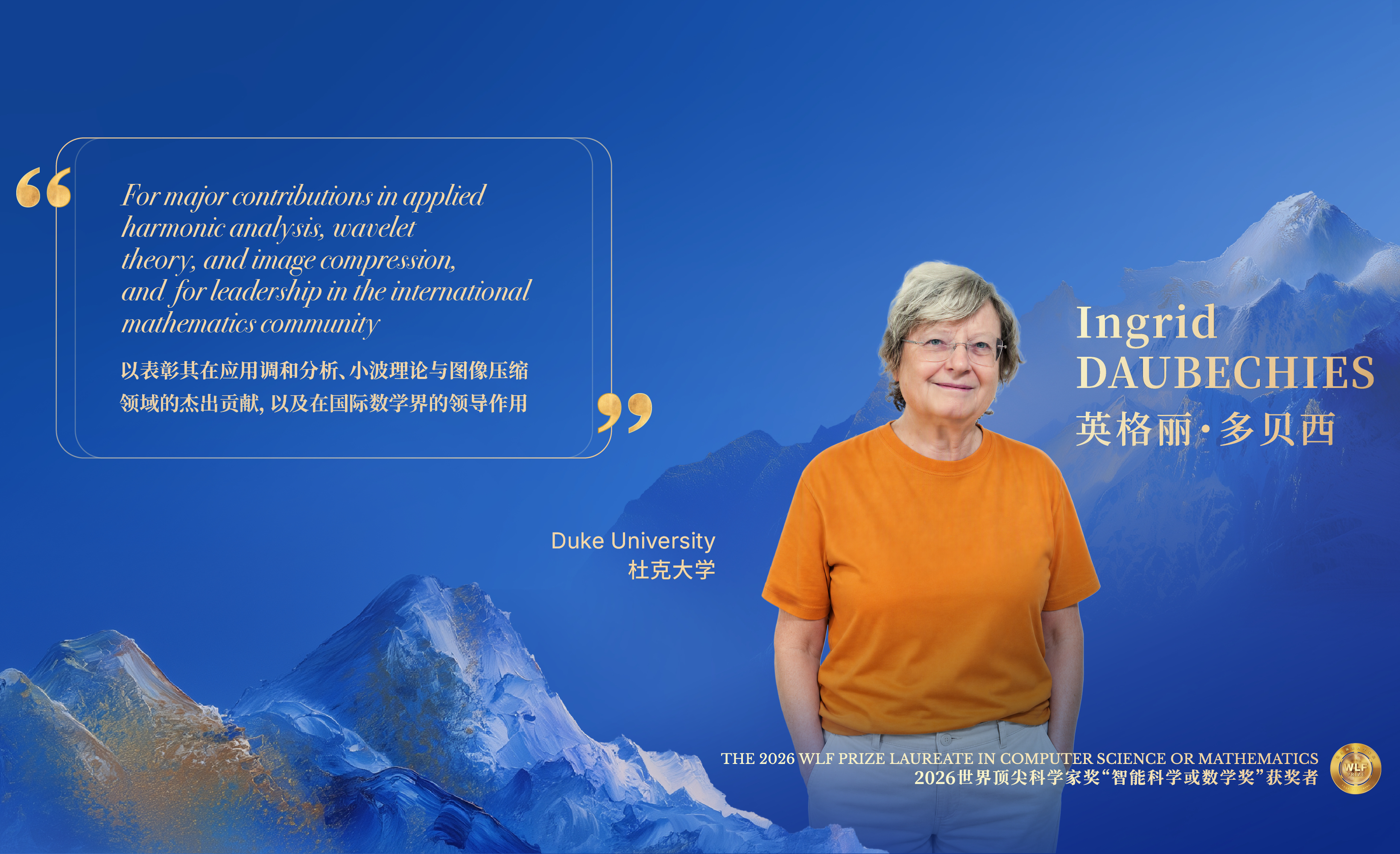
 Compressing the World with Wavelets, From a Ripple to an Image
(Yicai) Sept. 30 -- An Interview with 2026 WLF Prize Laureate in Computer Science or Mathematics Prof. Ingrid DAUBECHIES.
I.Feelings about winning the 2026 WLF Prize:It is a wonderful initiative to establish prizes in fields with fewer highly recognized awards.
How do you feel about receiving the 2026 WLF Prize in Computer Science or Mathematics?
Prof. Ingrid DAUBECHIES: It was a complete surprise! I didn't even know I had been nominated and was absolutely blown over, still reeling, actually! It is a wonderful initiative to establish prizes in fields with fewer highly recognized awards, and I am very happy to help build worldwide recognition for it.
II. The Breakthrough:I do not claim to have caused the wavelet revolution at all.
Your creation of "Daubechies wavelets" fundamentally revolutionized image compression and signal processing. If you were to explain your breakthrough to a non-mathematician using a simple everyday analogy, what real-world problem did your mathematics solve?
Prof. Ingrid DAUBECHIES: Well, it solved issues called for in the JPEG 2000 standard, allowing images to compress with "graceful degradation" as channel bandwidth decreased. Interestingly, memory became very cheap soon after, so cell phones stuck with older JPEG. Now that memory is becoming expensive again, that might change—I have no idea, I'm really not into these market forces! But in cinema film compression (theater movies are compressed frame-by-frame with JPEG 2000) and several medical applications, it has had a huge impact.
To explain how it works: in the older JPEG standard, typically the image is divided into little squares and on each square it's decomposed into elementary building blocks, each of which fill the whole block; some oscillate more, others less, but they have all the same size. In wavelets, there is no fixed scale: wide blocks are used for coarse variations, and very confined blocks are used for localized edge details, supported by efficient algorithms.
I must add that wavelets were a synthesis of ideas from many fields and people. I happen to be lucky to be the right person at the right place and time with the right background to make, to see the importance of filters that were a finite length and that implemented all those mathematical ideas and to construct them. I do not claim to have caused the wavelet revolution at all, and I feel a little awkward when given more credit than what I actually did.
III. Overcoming the Bottleneck:Why not feed the network original images alongside their wavelet transforms right from the start?
Today, generative AI models like Sora and DALL-E are making headlines, but they require huge amounts of data, computing power, and energy. How can classic mathematical tools like wavelet analysis help overcome these bottlenecks?
Prof. Ingrid DAUBECHIES: Modern AI networks contain a high degree of redundancy. Redundancy is a good thing because that allows the model to choose in what direction to parameterize. Since redundancy is useful, why not feed the network original images alongside their wavelet transforms right from the start? Evidence shows neural networks already compute wavelet-like transforms in their initial layers anyway. If we supply this directly, the network won't waste energy calculating basic transforms in its initial layers and can focus its computational energy on analysis and training.
This could help networks optimize with lower work intensity, power usage, and water consumption—and water will be a major issue because power generation requires massive cooling! Furthermore, mathematicians are working to understand the inner workings of neural nets; once we truly understand things, we can apply them much more broadly.
IV. Real-World Impact: Mathematics is everywhere, and a very human thing.
Every time people send photos on smartphones, doctors read MRI scans, or museums restore ancient masterpieces, your mathematical formulas are working in the background. What does it feel like to know that your equations serve billions of people daily while also protecting human cultural heritage?
Prof. Ingrid DAUBECHIES: Well, I believe mathematics is everywhere, and everybody uses mathematical thinking all the time as a very human thing. We discover mathematical principles as toddlers because we make shortcuts in our reasoning—applying logic from one direction to another is really doing mathematics.
When I detect that compressed images are using wavelets, I have an inward chuckle. I don't think of it as "my thing"; I think, "Oh, wavelets—this thing of which I was a part—is represented here". I am proud of all the stuff that humans do, and I am exhilarated by human ingenuity and creativity. That's what makes me tick!
V. Industrialization and Education: Poetry taught as rules of rhyme loses its soul.
Many people find mathematics too abstract to see its direct connection to engineering and industry. What do you think is the key step in turning pure mathematical research into real-world technology?
Prof. Ingrid DAUBECHIES: Whenever people say they weren't good at math in school, I always apologize to them: "I'm sorry you didn't have a good teacher". When teachers who don't love math teach only formulas and test-taking tricks, it becomes incredibly boring.
It is like teaching poetry solely by rhyming patterns and rules—it completely misses the core purpose of resonating with the soul! If you only concentrate on the tricks, people write things obeying rules, but it is not real math.
Mathematics is NOT a spectator sport! Just like sports, very few reach the Olympic level, but most people can enjoy the pleasure of exercising their brains. That pleasure in thinking is part of what makes us human.
VI. Pass the Torch:The essence of math lies in doing.
What advice would you give to young people to help them stay encouraged and choose foundational math or computer science topics that will remain valuable a decade from now?
Prof. Ingrid DAUBECHIES: Every bit of mathematics I learned eventually came in handy. When students ask about taking abstract courses like algebraic topology, I tell them: if your schedule allows and you're interested, go for it! New ideas often spring from the convergence of different mathematical fields, like the Langlands program.
If you want to get better at math, you must DO math—it is not a spectator sport! People say AI can solve math problems now, but solving problems is merely a measure of our understanding. The essence of math lies in doing, deepening understanding, and forging new connections. Simply getting yes/no answers from AI teaches us nothing substantial.
VII. Scientific Relay: This is so cool, let's work together and do something cool!
As part of our "Science Relay," if you were to leave an open scientific guess or unsolved mystery in math or science for another award winner to answer, what would you ask them?
Prof. Ingrid DAUBECHIES: There are classic problems like the Riemann hypothesis. People work on them not just for the result itself, but because they require fundamental new connections across mathematics.
When I did research, it was never driven by wanting to make a "big impact". During wavelets, our mindset was simply: "This is so cool, let's work together and do something cool!" I encourage young people to seek collaboration, create cool things together, and treat mathematics seriously as a tool for honing logical thinking.